

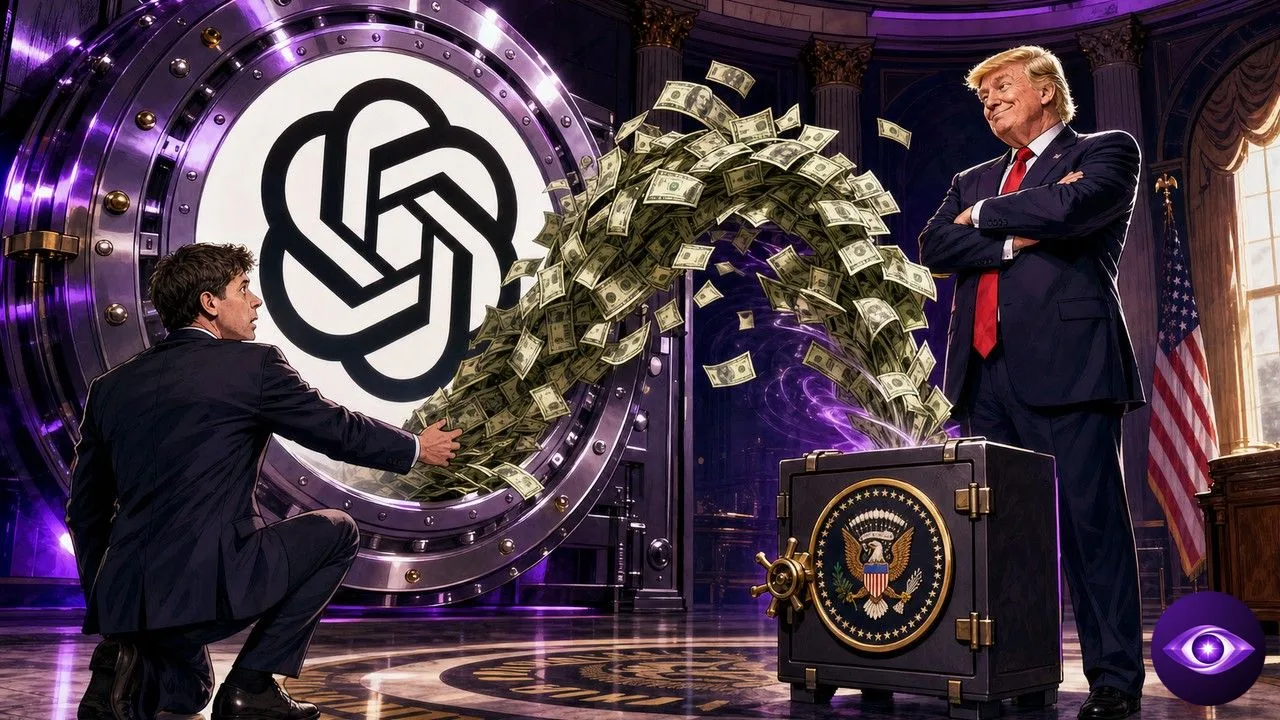
Sam Altman offered the Trump administration a 5 percent equity stake in OpenAI, worth roughly $42.6 billion, through a public vehicle modeled on the Alaska Permanent Fund. The proposal opens the door to matching 5 percent stakes from Anthropic, Google and Meta into the same federal fund.
Key Takeaways
- Sam Altman put on the table a 5 percent stake in OpenAI for the Trump administration, worth about $42.6 billion at the post-money valuation of $852 billion set in March.
- The setup would flow into a federal public wealth fund modeled on the Alaska Permanent Fund, with the option to extend to Anthropic, Google and Meta on the same 5 percent basis.
- The deal would likely require an act of Congress, and it echoes the Trump administration’s earlier equity moves inside Intel for 10 percent, IBM and quantum computing companies.
Have an AI Sum Up This Article
ChatGPTA $42.6 billion equity stake on the table
Sam Altman walked the Trump administration through a setup in which Washington picks up a 5 percent equity stake in OpenAI. On the $852 billion post-money valuation the company hit in March, that stake would be worth around $42.6 billion at signing.
Altman’s public framing is direct. Giving the general public a direct financial interest in OpenAI is the best way to share the upside of AI. The CEO positions the proposal as a response to political pressure and to the central question of who captures the wealth from a sector that could reshape entire chunks of the economy. Altman is blunt elsewhere too, accusing researchers of holding AI back.
The idea does not stop at OpenAI. Altman and his executives argue that America’s leading AI labs, Anthropic, Google and Meta, should each cede a 5 percent stake to a shared vehicle. The aggregate would form a federal public wealth fund, structured at the national level, with dividends flowing to the US government.
The reference model is the Alaska Permanent Fund. That sovereign fund invests Alaska’s oil revenue into public markets and pays an annual dividend check to residents. Altman proposes applying the same mechanic to the rents expected from American AI over the coming decades.

What the deal needs to clear on the legal side
A stake of that size goes beyond what a bilateral executive agreement can seal. An act of Congress would likely be needed to formalize the federal vehicle, its governance rules and its reporting duties to US taxpayers. The legislative calendar is the first real bottleneck.
The Trump administration would not start from a blank page. It already took a 10 percent stake in Intel last August after investing $8.9 billion in the American chipmaker’s stock. It also took an equity position in IBM and in several quantum computing companies. The state-as-shareholder logic is no longer a hypothesis in US tech, it is an active tool.
Extending the model to the other labs opens a coordination question. Anthropic, Google and Meta do not share OpenAI’s capital structure. A uniform 5 percent template will hit boards, legacy shareholders and, for Google and Meta, listed companies already regulated at Wall Street level. Building the legal wrappers is a matter of quarters, not weeks.
The proposal also fits into a broader Washington-OpenAI thread. Mythos access reopened to 100 US partners and the White House-run vetting of every GPT-5.6 customer already put an executive branch layer on top of OpenAI’s rollouts. Moving to explicit federal ownership is the next logical step in that architecture.
Also on Horizon:
- DeepSeek Builds Its Own AI Chip to Cut Nvidia Reliance
- iOS 27 Finally Lets You Reshape Siri’s Voice
- Nvidia Pushes Its New AI Rack to 2028, Over a Year Late
What it changes for OpenAI, its rivals, and the ecosystem
Short term, the announcement plays as a political defuse. OpenAI is under pressure on several fronts, from state-level deals like California’s Claude arrangement, from public anxiety around AI-linked layoffs, and from the still-open question of training data ownership. Handing 5 percent to the government reshapes the conversation, without necessarily reshaping the products. Legal pressure is climbing too, state attorneys probing OpenAI.
For OpenAI’s private investors, the dilution is real but absorbable. At 5 percent, the Washington stake trims the share of existing holders, but the signal sent to regulators could smooth the next funding rounds and any eventual public exit. The math is the cost of entry for a calmer path to IPO. The finances stay strained, OpenAI burning $34 billion ahead of its IPO.
For rivals, the effect depends on their choice. A lab that agrees to give up 5 percent to the federal vehicle inherits the same political protection as OpenAI. A lab that refuses signals independence, but exposes itself to less favorable treatment on licenses, federal contracts and antitrust decisions. The diplomatic hand plays inside every boardroom.
Medium term, the real question is governance. A public AI fund at creation would sit at over $200 billion of aggregated value, with observer or voting seats on multiple boards. Product decisions at OpenAI, Anthropic, Google DeepMind and Meta AI would then carry an explicit political footprint. That is a structural shift, closer to the state-champion relationship the US already runs in energy or aerospace than to the venture-backed startup posture that defined the sector so far.
Follow the story on Horizon.


