


From December, ChatGPT and Codex will draw on a single usage allowance for Plus, Pro and Business subscribers, counted in tokens. OpenAI is also merging the Chat and Work tabs of its desktop app, starting with a small group of selected users.
Key Takeaways
- OpenAI’s help center says ChatGPT and Codex will share one allowance on Plus, Pro and Business plans starting in December.
- Instant chat will not count against it, and the remaining balance will show up under Settings, then Usage.
- The Chat and Work tabs of the desktop app are merging, first for selected users, with no date for a wider rollout.
Have an AI Sum Up This Article
ChatGPTHow the new ChatGPT and Codex allowance works
OpenAI lays out the switch in its help article on ChatGPT and Codex usage limits, updated on Sunday. Starting in December, the allowance attached to Plus, Pro and Business plans will cover both tools, as the agent capabilities of Work move into the main ChatGPT experience.
The unit changes as well. Usage will be counted in tokens, and how fast it drains depends on the model and the task. More advanced models and complex requests will eat into the allowance faster than simple exchanges.
One carve-out matters: Instant chat will not draw from the allowance. A quick question in ChatGPT leaves untouched the budget a developer keeps for Codex sessions.
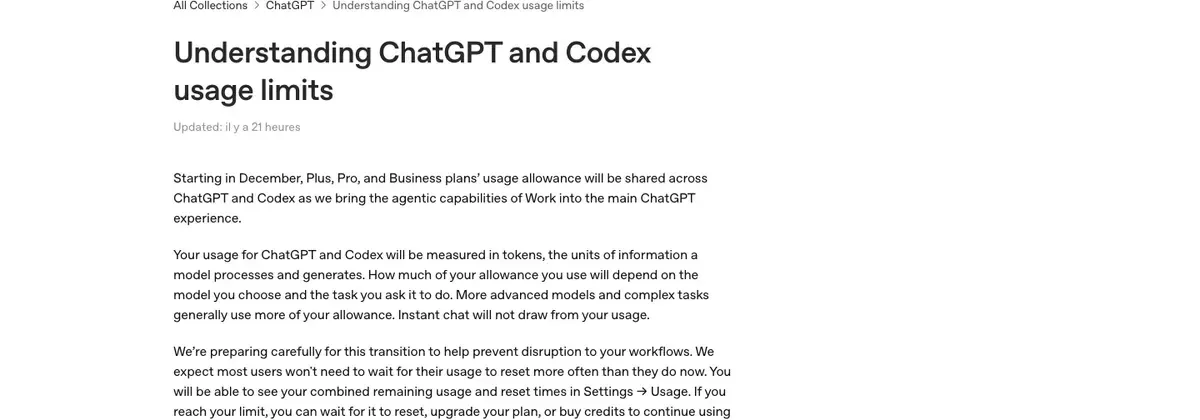
OpenAI is trying to reassure subscribers. The company expects most users won’t have to wait for a reset more often than they do today, and the combined ChatGPT and Codex balance, along with reset times, will sit under Settings, then Usage.
Hit the cap, and there are three ways forward: wait for the reset, move to a higher plan or buy credits. Credits become the built-in escape hatch for anyone who needs to keep working without a pause.
The Decoder reads the change as the end of all-you-can-prompt pricing, with OpenAI steering heavy users toward credits once they hit the limit. The outlet also points out that OpenAI had just doubled usage limits on its priciest plans.
Capacity is a familiar issue at OpenAI, which stopped taking new ChatGPT Pro subscribers in September, seven days after Astra shipped, with demand outrunning its infrastructure.

Chat and Work become one tab on desktop
The second change is about the interface. In an email to users, OpenAI announced that the Chat and Work tabs of its desktop app will merge, a message that TechCrunch walked through on Monday.
The new layout goes to selected users first, so OpenAI can gather feedback before a broader release. No date has been set for that wider rollout, and the email does not say which plans are included.
Codex keeps its own space. The coding tool stays a separate experience inside the ChatGPT desktop app, so the link between ChatGPT and Codex comes down to one shared allowance.
The move caps a busy run of agent launches, from Dots, the ChatGPT agents that work on their own in the cloud, to a persistent mode spotted in Codex’s code that keeps the agent running and lets it write its own follow-up tasks.
Those long-running jobs are exactly the kind of work that will weigh most on a shared allowance, since complex tasks use more. Anthropic took a similar path in September, folding Claude’s chat and Cowork into a single screen, as TechCrunch notes.
More articles on Horizon
- Toyota Plans 400,000 Robots for Its Factories From 2028
- GPT-6.1 Terra: OpenAI Ships a Model at Half the Price
- GPT-6.1 Terra: OpenAI Ships a Model at Half the Price
What a single ChatGPT and Codex cap means for teams
For developers, the effect is immediate. A long agent session in ChatGPT will shrink the room left for coding in Codex, and the reverse holds too. Teams that rely on both tools will now watch a single counter.
Companies on ChatGPT Business already have one lever, the $125 per month Premium seat added in August, which offers five times more usage. A shared ChatGPT and Codex cap could make that kind of trade-off a more frequent discussion inside engineering teams.
On the competitive front, counting in tokens brings the subscription closer to the logic of the API, where OpenAI is already pushing on price with GPT-6.1 Terra at half the cost of GPT-5.6 Terra. A readable allowance turns into a selling point against Claude, which already puts chat and Cowork in one interface.
Some details are still missing. The help article does not give the exact day in December, and the tab merger has no public timeline yet. Subscribers of ChatGPT and Codex have a few weeks to check how much they actually use before the switch.
Follow the story on Horizon.