

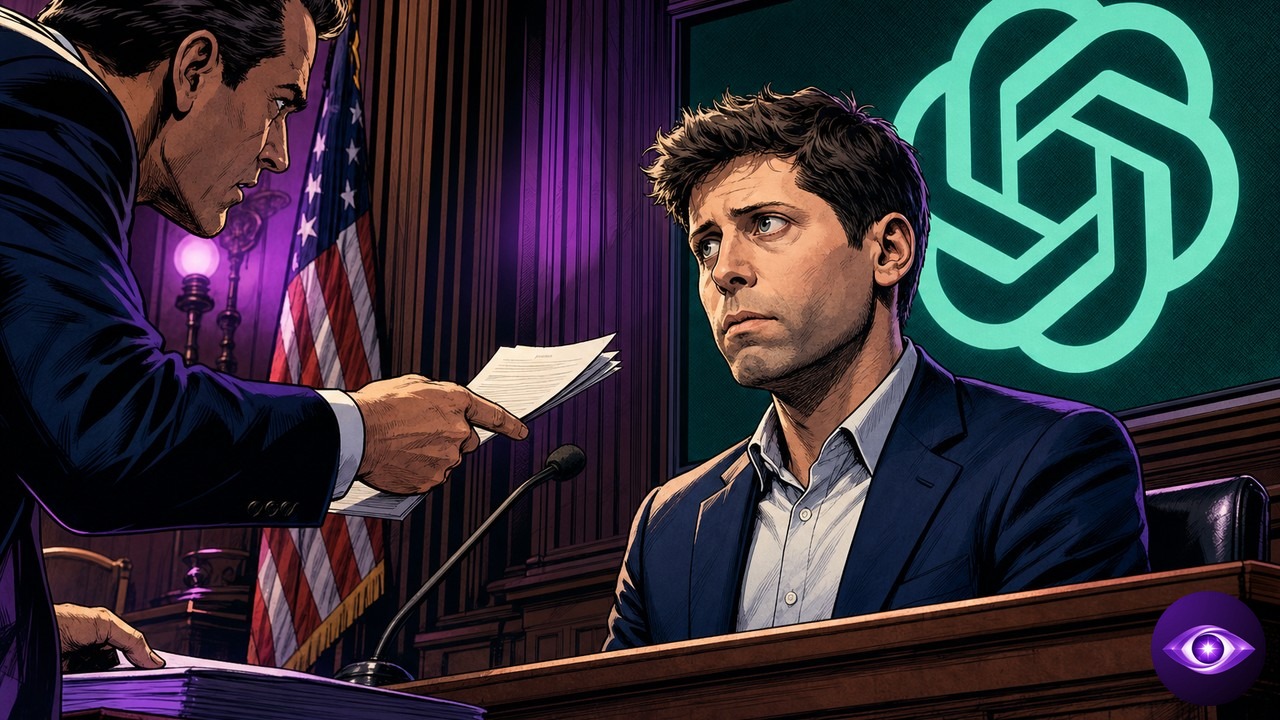
Sam Altman is testifying in the federal trial pitting Elon Musk against OpenAI’s for-profit structure. His credibility is at the center of the case: former board members, contradictory statements and accusations of a culture of dishonesty have resurfaced in a federal courtroom.
Key Takeaways
- Sam Altman faces cross-examination on his honesty in Musk’s lawsuit against OpenAI’s commercial structure
- Former board members testified about his lack of candor during their tenure
- The central question: does the nonprofit board truly control the for-profit entity?
Have an AI Sum Up This Article
ChatGPTA trial that cuts to the heart of OpenAI’s governance
The federal lawsuit brought by Elon Musk against OpenAI rests on a central argument: that the organization’s transformation into a for-profit entity betrays its original nonprofit mission. To support that case, Musk’s legal team has focused heavily on the credibility of Sam Altman himself. For context, see our earlier piece on Horizon: Elon Musk vs OpenAI: Trust at the Heart of the Verdict. The case ultimately resolved, a verdict clearing OpenAI’s path to an IPO.
Attorney Steve Molo, representing Musk, conducted a cross-examination built around inconsistencies between Altman’s past statements and established facts. The strategy is deliberate: if the CEO has been less than fully transparent in the past, his current claims about OpenAI’s governance deserve close scrutiny.
The federal court is examining whether the nonprofit board of directors exercises genuine oversight over OpenAI’s commercial operations. This is a structural question, and its answer could have direct consequences for the legitimacy of the hybrid model OpenAI has developed over recent years.
OpenAI has been expanding aggressively on multiple fronts in parallel, launching enterprise security platforms and pursuing large-scale commercial partnerships. These moves illustrate the growing distance between OpenAI’s current commercial ambitions and the research-driven, public-interest image the organization cultivated in its early years.

The contradictions that keep resurfacing
In 2023, Sam Altman told Congress he had “no equity in OpenAI.” The statement was technically narrow. Altman held indirect economic exposure through his investments in Y Combinator, which in turn has interests in OpenAI. A distinction he did not raise on his own initiative during the hearing. The reality was more nuanced, Altman in fact holding a stake in OpenAI.
This gap between what was said and what was left unsaid sits at the center of Molo’s cross-examination. The boundary between a technically accurate statement and a misleading one is precisely what the court is being asked to assess. And for the parties involved, the line between omission and deception is often a matter of context and intent.
The 2023 board incident, when Altman was briefly ousted for “not being candid,” has resurfaced naturally in the proceedings. The official reason given for his temporary removal has become one of the most direct arguments against his credibility in this trial, carrying particular weight because it came from the board’s own assessment at the time.
Microsoft CEO Satya Nadella, a key OpenAI partner, described the handling of that firing as “amateur city” at the time. A candid public assessment that illustrated the dysfunction inside OpenAI at a pivotal moment and that has remained part of the conversation ever since.
Also on Horizon:
- Sam Altman on the Stand: The Question of Trust
- Ramp AI Index: Anthropic Edges Out OpenAI in Enterprise
- Claude Code and AI Agents Are Blowing Up Dev Budgets
The testimonies that carry weight
Helen Toner and Tasha McCauley, two former OpenAI board members, both testified about Sam Altman’s lack of candor during their time on the board. Their accounts do not come from outside critics or business rivals. They come from people who sat in governance positions inside the organization itself.
McCauley went further, describing a “toxic culture of lying” at OpenAI. That phrasing is unusual in a legal context, and it signals that what is being contested in this trial is not simply a disagreement over strategy or structure. It is a challenge to the character of the organization itself under Altman’s leadership.
Altman’s defense rests on two pillars. Current board chair Bret Taylor stated that Altman has been “forthright” in his dealings with the board. And Altman himself, when asked directly about his trustworthiness, told the court: “I believe I am an honest and trustworthy businessperson.”
The court must now weigh two sharply opposed narratives. On one side, a CEO presenting himself as transparent and aligned with OpenAI’s founding mission. On the other, former governance insiders describing an organization where candor was the exception rather than the standard.
In the short term, the outcome of this trial could force OpenAI to restructure the oversight role its nonprofit board plays over its commercial activities. Over a longer horizon, it is Sam Altman’s standing as a trusted figure in the AI industry that is at stake, at a moment when OpenAI is negotiating strategic partnerships and raising capital at an unprecedented scale. Altman faces scrutiny elsewhere too, researchers accusing him of holding back on safety.
Follow the story on Horizon.



Pingback: Ramp AI Index: Anthropic Edges Out OpenAI in Enterprise - Horizon IA
Pingback: OpenAI Trial: The Expert Who Fears an AGI Arms Race - Horizon IA