

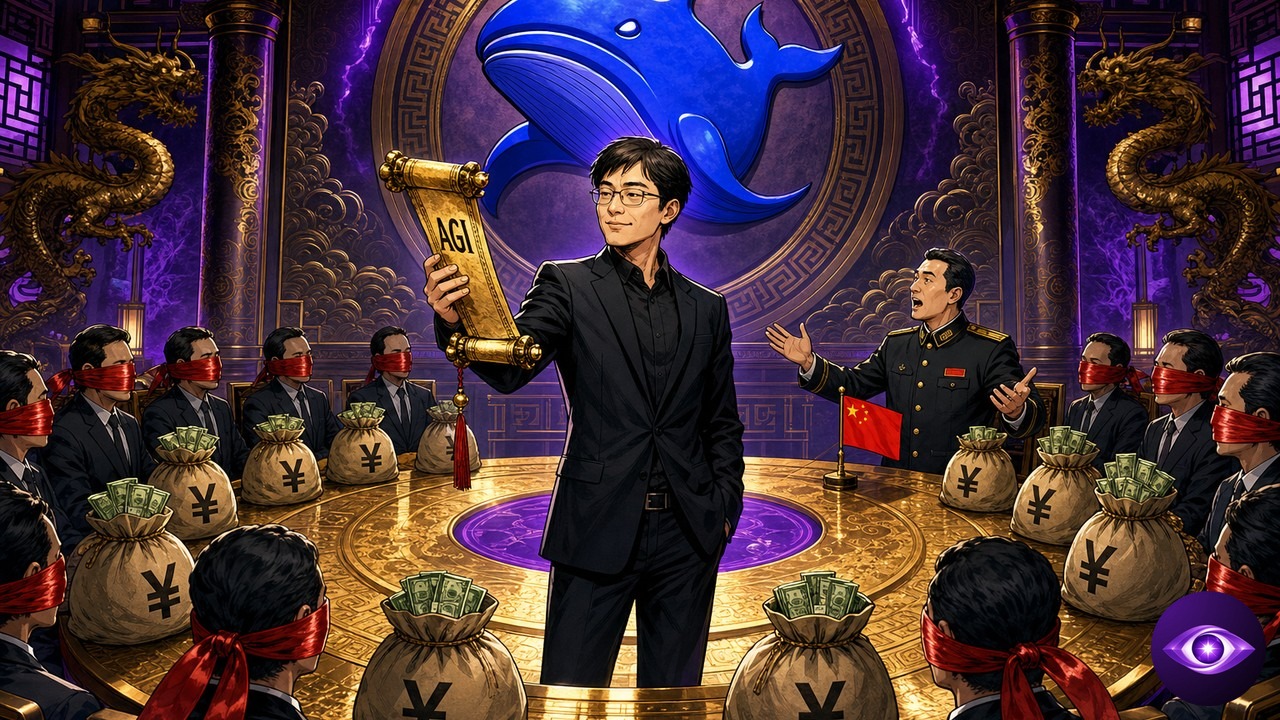
DeepSeek Raises $7.4B at a 50B valuation. The DeepSeek funding round closes with over $7.4 billion in fresh capital at a $50 billion valuation. Tencent and CATL sign in, Liang Wenfeng commits 20 billion yuan of his own money. And the new investors get zero voting rights.
Key Takeaways
- The DeepSeek funding round hits 50 billion yuan ($7.4 billion) at a $50 billion valuation.
- Tencent and CATL join the cap table with no voting rights and a five-year lock-up.
- DeepSeek keeps the open-source playbook, V4 already runs on Huawei chips.
A round locked down by the founder
DeepSeek just closed its first deal with outside investors. The DeepSeek funding round exceeds 50 billion yuan, or $7.4 billion. The final valuation lands at $50 billion, up from the $10 billion still being discussed back in April 2026.
The structure is unusual for a deal of this size. Outside capital comes in through a limited partnership managed by CEO Liang Wenfeng. Investors receive no voting rights. They also accept a five-year lock-up on their stakes.
One single exception sits inside this rule. China’s state-backed AI investment fund enters directly, keeps its voting rights, and gets its own status. The political signal is plain. Beijing keeps a real seat at the table while private financiers accept a silent role.
Liang Wenfeng also put his own money in. The founder personally contributed about 20 billion yuan. The move locks his control and sends the message that outside capital comes in as reinforcement, never as command.

Tencent, CATL, and the political lock
On the big-name side, two signatures dominate the round. Tencent joins, which is no surprise on the Chinese AI map, and battery maker CATL joins too, which is more surprising. Seeing a battery industrial in an AI lab cap table says a lot about the planned convergence between energy, compute, and models.
For Tencent, the deal secures privileged access to DeepSeek’s open models. For CATL, it opens a direct window on the future energy needs of an AI infrastructure scaling on Huawei chips. The two signatures complement instead of compete.
The arrival of the state fund sets the frame. Beijing is not letting the sector organize itself outside its direct field. The episode of Manus unwound by Meta under Chinese pressure already worked as a reminder. This time, control gets enforced at entry, not at exit.
The real test sits in the long run. A governance where shareholders have no voice works while performance keeps up. When strategy gets debatable, the absence of voting rights becomes a source of tension, not a piece of legal elegance.
Also on Horizon:
- Anthropic Korea partners: NAVER, Samsung and LG sign on
- DeepSeek funding round: $7.4B at $50B valuation
- OpenAI burn rate hits $34B before going public
The $50 billion open-source bet
DeepSeek already laid out its technical pitch. V4, released in April 2026, remains the largest open-weights model published to date. It runs on Huawei chips, which validates the China bet on hardware, and keeps the weights open, which sets it apart from every American competitor.
Pricing carries the financial narrative. V4 Pro is billed roughly 11 times cheaper on input and 35 times cheaper on output than GPT-5.5. With gaps that wide, DeepSeek can take share on high-volume usage where token-price pressure has become a deal breaker.
This pricing argument sits inside the broader API price war already shaking OpenAI and Anthropic. Except here, DeepSeek does not need to align its margin with that of a Western competitor. Its cost structure is different, its political frame too.
Liang Wenfeng confirms the direction. Foundational research and AGI come before short-term profits. Models will keep getting published as open-source. That is the clearest statement we have had from DeepSeek so far. $50 billion valuation or not, the trajectory does not change.
The contrast with OpenAI and Anthropic, both close to a trillion-dollar valuation, is striking. $50 billion is still a fraction of that level, but DeepSeek reaches it with an incomparable cost structure and direct state backing. Performance per dollar becomes a strategic weapon.
In the short term, expect Western cloud providers to push back on their inference pricing. In the medium term, the stakes shift elsewhere. The DeepSeek funding round bankrolls the next generations of open models, and the global open-weights ecosystem just picked up $7.4 billion in additional ammunition.
Follow the story on Horizon.