

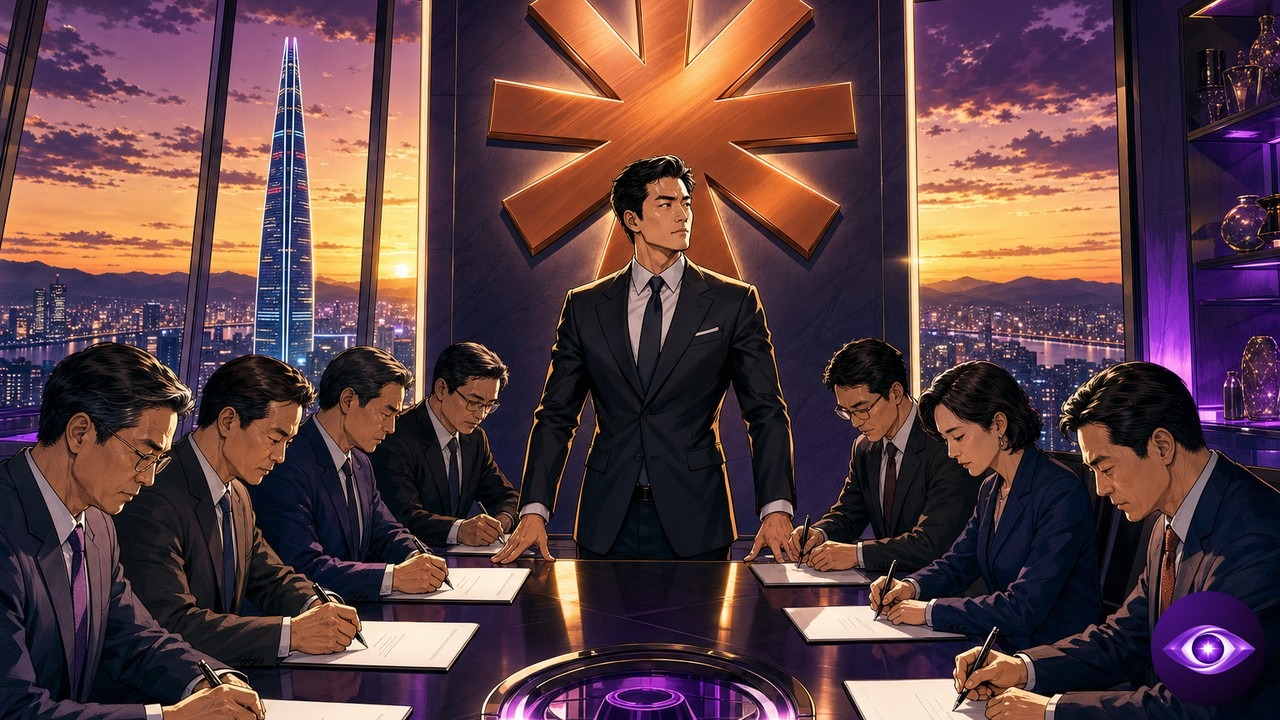
Anthropic Signs Samsung : three giants sign simultaneously. Anthropic locks down Korea on the same day it opens its official Seoul office, signing seven of the country’s biggest names. NAVER, Samsung SDS, LG CNS, Hanwha Solutions, Nexon, Channel Corp and the NGO Good Neighbors all join. A memorandum of understanding with the Korean science ministry seals the operation.
Key Takeaways
- Seven partnerships announced alongside the official opening of Anthropic’s Seoul office
- NAVER, Samsung SDS, LG CNS, Hanwha, Nexon, Channel and Good Neighbors all join the alliance
- MoU signed with the Ministry of Science and ICT plus Claude access for 60 NAIRL researchers
Have an AI Sum Up This Article
ChatGPTSeven Korean partnerships in a single day
Anthropic did not stop at cutting a ribbon in Seoul. On the same day, Anthropic locks down Korea with seven partnerships that cover most of the country’s industrial landscape. NAVER, the leading Korean cloud and AI player, opens the list. Samsung SDS and LG CNS, the IT arms of the two largest Korean conglomerates, follow immediately. The Samsung tie goes deeper, Anthropic co-developing a custom AI chip.
The profile of the other signatories completes the picture of a methodical sweep. Hanwha Solutions operates in energy, chemicals and materials. Nexon represents the online gaming sector, an industry where Korea is a global heavyweight. Channel Corp arrives with a customer-service platform used by more than 230,000 companies in Korea, Japan and the United States. The NGO Good Neighbors Korea, focused on children’s rights, closes the list and signals the social dimension of the deal.
The scope of expected use cases is far from cosmetic. At NAVER, thousands of engineers already use Claude Code in their daily workflows. Moving to a formal partnership turns an existing dependency into a structured commercial relationship. The same logic applies to Samsung SDS and LG CNS, which drive the internal generative-AI roadmaps of their respective parent companies.
The concentration of signatures sends a clear market signal. Anthropic is not betting on a handful of marquee accounts. It is rolling out a transversal deployment that spans cloud, heavy industry, gaming, customer service and the nonprofit sector. No Western competitor has presented Korean coverage this broad in a single announcement. Korea also anchors AI hardware, SK Hynix and Samsung dominating AI memory.

KiYoung Choi locks in the institutional grid
The operation carries the fingerprints of KiYoung Choi, the Representative Director appointed in May to run Anthropic in Korea. His arrival had been framed as a signal to enterprise buyers. We noted at the time that his profile was chosen for its deep knowledge of Korean enterprise decision-makers, after thirty years at Microsoft, Autodesk, Adobe, Google Cloud and finally Snowflake Korea.
Three weeks later, Choi has met his timeline. Anthropic locks down Korea beyond the standard commercial perimeter, adding an institutional layer that no rival has matched in the region. A memorandum of understanding was signed with the Ministry of Science and ICT, the public authority that steers the country’s digital strategy. That kind of document, still rare for an American AI lab in the region, gives the deal regulatory weight. The full picture is available in Anthropic’s announcement on its Seoul office and Korean AI ecosystem partnerships.
The academic leg completes the apparatus. Anthropic opens Claude access to 60 researchers affiliated with the National AI Research Lab, or NAIRL. The four universities involved (KAIST, Korea University, Yonsei and POSTECH) form the elite of Korean scientific research. For Anthropic, this is a direct channel of influence on the training of the country’s next generation of AI engineers.
Choi sums up the public posture of the company in a single line that runs through every launch communication. According to him, innovation and safety are two sides of the same coin. The phrase is more than a slogan. It works as a sales argument facing Korean enterprise buyers who demand strict guarantees around data sovereignty and regulatory compliance.
Also on Horizon:
- Anthropic Signs Samsung partners: NAVER, Samsung and LG sign on
- DeepSeek funding round: $7.4B at $50B valuation
- OpenAI burn rate hits $34B before going public
Korea as Anthropic’s Asian bridgehead
In the short term, these seven signatures will accelerate the contractual shift of relationships that already exist. The thousands of NAVER engineers running Claude Code today move from self-service usage to a structured enterprise contract. That kind of migration changes the economics of a deployment, with multi-year commitments, SLAs and local account management.
In the medium term, Anthropic’s Korean play has to be read against the internal turbulence of its competitors. The recent Anthropic survey on American AI anxiety positioned the company as the most credible voice on safety and societal impact. Korea, already inside the global top 12 for Claude.ai usage, becomes a market where this positioning can be monetized at scale.
The contrast with other labs is striking. No Western competitor has announced an equivalent combination of industrial partnerships, ministerial agreement and university program in the region. Existing accounts like SK Telecom and Law&Company, already under contract with Anthropic before this announcement, complete an ecosystem that now runs without sector blind spots.
What remains to be watched is the execution timeline. The announced partnerships are framework agreements, not yet hard commercial contracts with named volumes. The next few months will tell whether the institutional coverage built by Choi turns into measurable revenue. For Anthropic, the Korean stake reaches beyond top-line dollars. It is the demonstration that an American AI lab can root itself in a strategic Asian market without relying on an exclusive local partner.
Follow the story on Horizon.


Pingback: Anthropic Samsung Weigh a Custom AI Chip - Horizon IA
Pingback: Newsom Anthropic Deal: Claude at Half Price - Horizon IA