

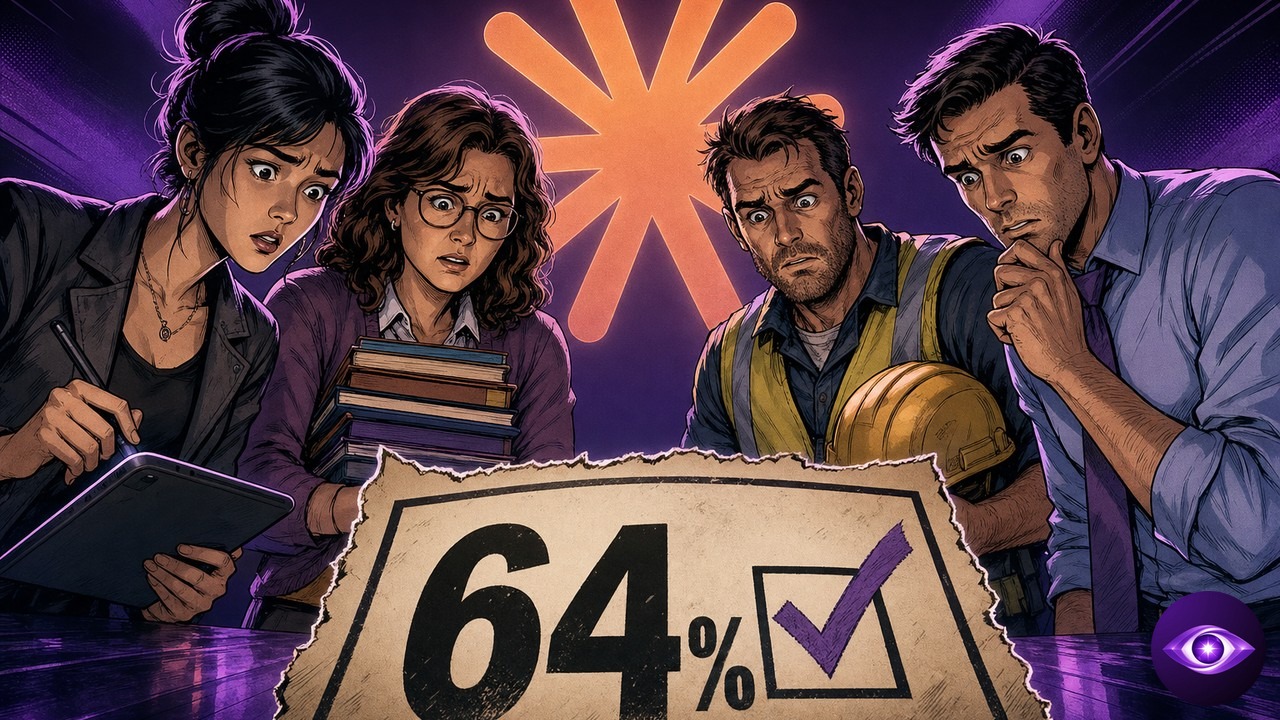
Anthropic had YouGov poll 51,993 Americans aged 16 and up between November and December 2025. The results dropped on June 12. 64% fear AI is coming for their job. 56% fear losing the ability to think without it. The numbers tell a different story depending on who answers.
Key Takeaways
- Nearly two thirds of Americans expect AI to directly hit their position.
- Non-users of AI are far more worried than people who use it daily.
- Trust in AI vendors stays low: only 15% trust them on deployment calls.
Have an AI Sum Up This Article
ChatGPTThe Anthropic survey numbers, without spin
The Anthropic survey covers 51,993 respondents recruited through YouGov. The sample includes Americans aged 16 and older, which factors in a meaningful share of future entrants to the labor market.
Fear of losing one’s job to AI lands at 64%. Fear of losing the ability to think independently sits at 56%. The concern that AI will amplify misinformation stabilizes at 52%. The layoffs back that fear, Meta cutting 8,000 jobs to fund AI.
Hopes exist but stay in the back seat. 48% of respondents see AI as a possible lever to cure disease. 36% picture useful applications in disability assistance. The fear-hope balance tilts firmly toward threat.
Trust in the AI labs themselves is the hardest number in the Anthropic survey. Only 15% of Americans trust AI companies on their deployment decisions. Almost no one believes those calls are made in the public interest. The full picture is available in Anthropic’s Public Record survey on American attitudes toward AI.

The fractures the survey exposes
The sharpest divide in the Anthropic survey is about usage. Daily AI users report a 54% fear of job loss. Among non-users, the figure climbs to 70%. AI reduces the anxiety of people who learn to handle it, without dissolving it.
The breakdown by occupation is more surprising. Fear of cognitive dependency climbs to 61% in arts and design, 61% in education. It drops back to 39% in construction. The national average lands at 56%.
The professions most exposed to generative AI are also the ones where fear of losing judgment autonomy runs highest. The tight loop between the tool and the creative act probably explains the feeling. Construction, a physical and procedural trade, experiences it very differently.
A detail worth keeping in mind. Among those worried about cognitive dependency, only one in five says they would actually struggle to function without AI. Conversely, about one third of those who say they feel fine would genuinely be disrupted. Perceived risk does not track the reality of usage.
Companies adopt the technology faster than society can digest it. ClickUp’s recent decision to lay off 22% of its workforce and deploy 3,000 AI agents shows entire chunks of office work being shifted to agents. The labor market starts reacting before the middle class has had time to prepare. For context, see our earlier piece on Horizon: ClickUp Fires 22% of Its Staff and Deploys 3,000 AI Agents.
Also on Horizon:
- Fable 5 throttling: Anthropic admits the wrong call
- API price war: OpenAI takes aim at Anthropic
- German court holds Google AI Overviews liable for lies
What about your job in all this?
You read these numbers and you wonder what they mean for your specific role. That is the logical question. The Anthropic survey proves one simple thing. The majority of US workers already anticipate a rupture. Most of them have no idea where to start to prepare for it.
AI-driven layoffs have already started. Autonomous agents are taking on entire office workflows, from junior legal work to sales assistants, from customer support to copy production. The trajectory is no longer a hypothesis, it is a documented curve. Another survey drives it home, Claude already handling half the tasks in some jobs.
For most workers, the problem is not awareness anymore. The problem is moving from awareness to action. Understanding which jobs go first, how fast, and most importantly what concrete step to take this week.
If you want a clear view of the sequence already unfolding and of who it hits first, a free report was put together to lay out the situation honestly. It sells you nothing. It shows exactly what’s coming, and for whom.
Get free access to the report here.
Follow the story on Horizon.



Pingback: Anthropic Modeled 17.9% Knowledge Worker Unemployment - Horizon IA
Pingback: Anthropic Survey: AI Does Half Your Work - Horizon IA