

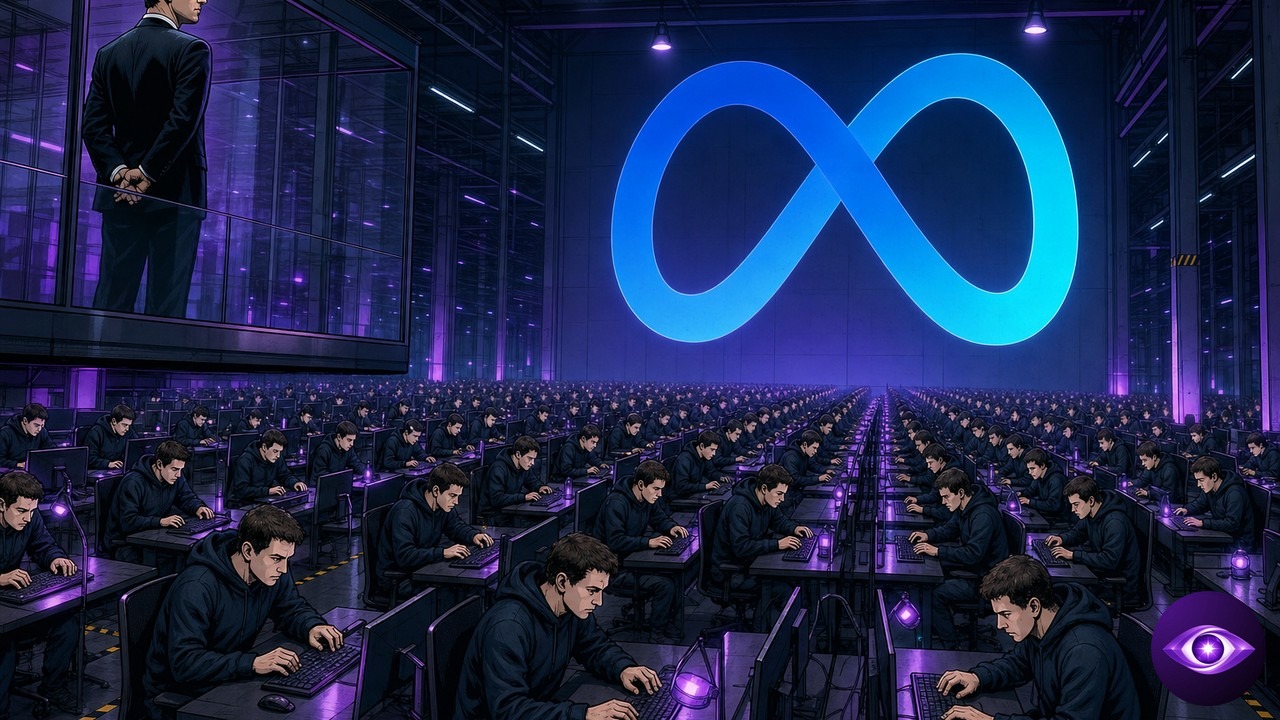
Meta engineers call AI division — that’s how engineers describe Applied AI. Meta’s Applied AI team is three months old and already holds the worst internal reputation in the company. Engineers drafted into the unit call it a “gulag” and describe the work as “soul-crushing”. Central leadership acknowledges the situation in private, without reversing course.
Key Takeaways
- The Applied AI team was set up in three months under Maher Saba, reporting straight to Andrew Bosworth.
- Engineers were assigned by surprise email with no real opt-out, with up to 50 reports per manager at launch.
- 1,600 Meta employees signed a petition against being monitored to train AI on their own activity.
Have an AI Sum Up This Article
ChatGPTApplied AI seen from the inside
The Applied AI team launched three months ago. Today the unit counts roughly 6,500 engineers and product managers, making it one of the largest internal structures inside Meta.
At the helm sits Maher Saba. A twelve-year Meta veteran and former Reality Labs VP, he reports to Andrew Bosworth, the company’s CTO. Strategic oversight climbs up to Alexandr Wang, Meta’s Chief AI Officer and former Scale AI founder, who runs Meta Superintelligence Labs.
The internal staffing model triggered the first wave of anger. Engineers were reassigned to the unit through a surprise email, with no prior conversation and no real way to decline. The actual job consists mostly of generating puzzles and coding problems used to train the models.
At launch, up to 50 employees reported to a single manager. Internal feedback describes repetitive work with no product visibility, inside a saturated chain of command. Several anonymous voices call the unit “literally the gulag”. Others echo the line that “most people find the work soul-crushing”.
The discontent reaches beyond Applied AI itself. 1,600 Meta employees, across departments, signed a petition against keystroke and click monitoring used to generate AI training data. The line between personal productivity and model fuel is dissolving inside the company. Meta is also reclaiming control of internal costs, a gateway capping token budgets.

Leadership cracking, live
Chief Product Officer Chris Cox acknowledged an internally “brutal” work environment. The official wording came from product leadership, not from an HR memo.
Mark Zuckerberg stepped in twice. Once in leaked internal audio where he defends the forced reassignment model. A second time in an internal memo acknowledging team-level “distress” without announcing any process change.
The most telling incident came from a livestreamed internal presentation. An unidentified participant hijacked the stream and dropped an expletive-laden outburst aimed at an unnamed senior AI executive. The scene stayed on air for several seconds before being cut.
Meta’s AI talent bet has a visible cost that is no longer just about salary bands. The group has stacked nine-figure offers to attract frontier researchers, while simultaneously reassigning existing engineers to work they did not pick. The two populations are not cohabiting well. Meta tightens the screws on tooling too, banning Claude Code and Codex for staff.
On the infrastructure side, the spending keeps flowing. The 168 MW Meta Reliance data center build-out in India and the other compute deployments are not in question. The bottleneck Zuckerberg flags internally is talent, not hardware.
Also on Horizon:
- Fable 5 throttling: Anthropic admits the wrong call
- API price war: OpenAI takes aim at Anthropic
- German court holds Google AI Overviews liable for lies
What this exposes about Meta’s talent bet
Applied AI was born to close Meta’s gap on frontier models. Leadership made the call that a massive, fast mobilization of internal engineers, paired with very expensive outside hires, would compress the catch-up window to twelve months.
On paper the bet can land. In practice, base-level morale becomes a product-risk factor. When 1,600 people sign a petition and an internal livestream goes off the rails in public, the hidden cost of the “forced mobilization” model starts showing up on the balance sheet.
Short term, the immediate risk is silent attrition. Engineers reassigned against their will have two options: stay, or look elsewhere. Rival labs know how to read that signal and open the door right back.
Medium term, the question is more strategic. If Applied AI fails to deliver a measurable model breakthrough by year-end, no one will publicly defend the human-cost ledger. The operational justification disappears the moment a published benchmark from OpenAI, Anthropic, or Google buries the internal models.
The contrast with Meta’s external AI product strategy is sharp. The Meta Hatch launch at $200/month targets a premium audience that expects calm and competence. Inside, the picture that emerges is an industrial-scale mobilization under strain, that its own engineers describe with the word “gulag”.
Follow the story on Horizon.