

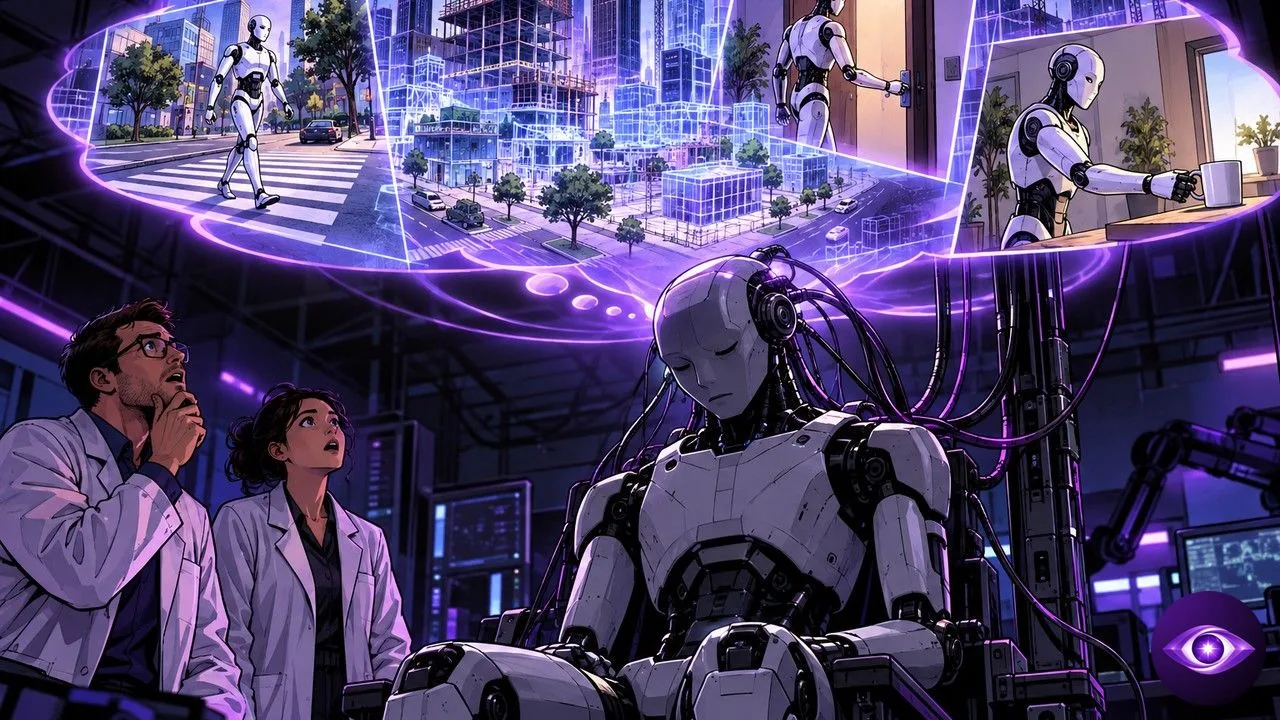
California startup Odyssey released Odyssey-3 on October 8, a world model that generates an explorable environment in real time from a short text description. A free preview is open to anyone, while the real target is training robots, self-driving cars and drones.
Key Takeaways
- Odyssey-3 ships in three versions, standard, Pro and Flash, the last one tuned for real-time interaction.
- The free preview lets you generate a place, move through it and trigger events inside it.
- The record Odyssey claims on Physics-IQ comes from a single test run, while the protocol asks for four.
Have an AI Sum Up This Article
ChatGPTOdyssey-3, a world model that renders the scene as you move
Odyssey walks through the release in a launch post calling it the company’s most powerful foundation world model yet. It describes the system as a learned dynamical model that predicts how objects move and interact through space, and how a situation evolves over time.
Under the hood, Odyssey-3 is an autoregressive diffusion transformer. Every new frame follows from the previous one and from what the user just did, so the scene keeps extending for as long as someone interacts with it.
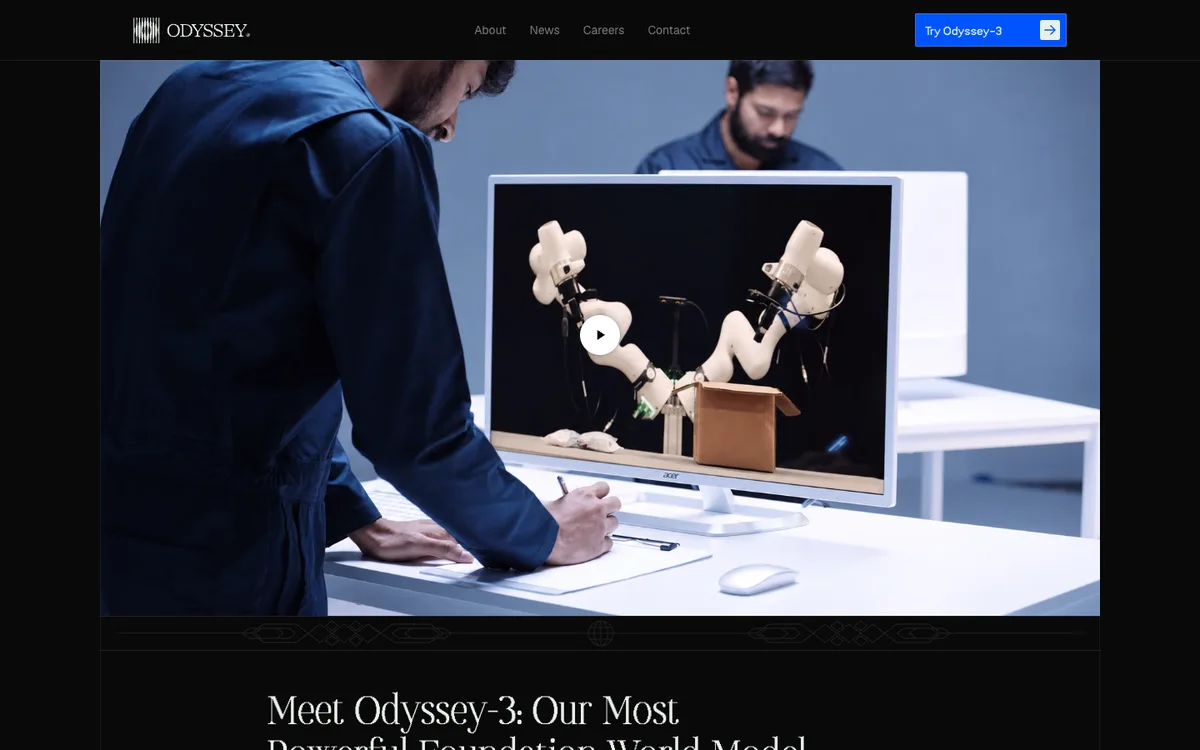
Three versions landed on the same day. The standard model runs at 832 by 480 pixels, the Pro version steps up to 1280 by 720, and a distilled Flash version handles real-time interaction.
The company behind it is young and well funded. Oliver Cameron and Jeff Hawke founded Odyssey in 2023, and the startup raised 310 million dollars in June 2026, with Amazon and AMD Ventures among its backers.
The world model field is getting crowded fast. This summer, Fysiverse, the Chinese model that hardcodes physics laws into its architecture, argued for a more constrained approach, while Odyssey-3 predicts how a scene unfolds frame after frame.

What the free Odyssey-3 preview lets you do
The preview lives at experience.odyssey.systems. You describe a place, pick a first-person or third-person view, then move around the generated world. The camera can move on its own, and you can drop new events into the scene while it is being generated.
That consumer mode works mostly as a showcase. API access stays reserved for teams building robots and vehicles, who have to request it from Odyssey directly.
For anyone working with video, the gap with standard generators is obvious. A tool like Wan 3.0, which turns a PDF into thirty seconds of video, hands you a finished clip, while Odyssey-3 produces a scene that keeps responding to your actions.
Odyssey claims a score of 66.1 for its Pro version on the video-to-video track of Physics-IQ Verified, which it calls the highest reported. The Decoder pointed out that the record comes from a single test run with hand-picked videos, while the benchmark’s rules require four runs before anyone claims the top spot.
On a separate benchmark, WorldMark, the Pro version takes first place in three categories, scoring 77.2 on first-person stylized scenes, 79.0 on third-person realistic scenes and 76.3 on third-person stylized scenes.
More articles on Horizon
- Meta Launches Muse Wonder, an AI Model That Remembers You
- ChatGPT Watermark Comes to Every Answer in the EU
- Claude for Startups Offers a Free Year of Claude Team
Robots, self-driving cars and drones are the real customers
The demos Odyssey published make the business case clear. The model controls a robot arm that pours cereal and closes a container, a humanoid that opens containers and a car that works its way through roundabouts, and it generates multi-sensor data for autonomous driving. It can also build environments where software agents learn to complete tasks given in plain language.
For a robotics team, the first argument is cost. Every simulated trial stands in for a real one that would be slower, more expensive and harder on the hardware. Odyssey itself notes that putting the model to work on a physical machine means evaluating the behaviors that matter for that machine and its tasks.
Competition also comes from the big labs. Google DeepMind is pushing ahead with Gemini Robotics ER 2, the model that gets a rover and a humanoid to work on the same task. Odyssey positions itself one step earlier, building the worlds where robots like these can practice.
The disputed score matters for the whole field. If world models are going to be compared fairly, developers will have to publish results under the full Physics-IQ protocol, or every new record will stay open to challenge.
Follow the story on Horizon.