


OpenAI released GPT-6.1 Terra on October 26, a model that reads the screen and acts across apps, priced at half the API rate of GPT-5.6 Terra. On the Agents’ Last Exam benchmark, OpenAI says it matches GPT-6 Astra at one tenth of the price per token while finishing tasks more than three times faster.
Key Takeaways
- GPT-6.1 Terra costs $1 per million input tokens and $5 per million output tokens, half the price of GPT-5.6 Terra.
- It is live in ChatGPT Work and Codex for Plus, Pro, Enterprise and Edu users, and in the API as gpt-6.1-terra.
- Its safety card rates it “Critical” for cybersecurity, the same tier as OpenAI’s most capable models.
Have an AI Sum Up This Article
ChatGPTWhat GPT-6.1 Terra Can Do on a Screen
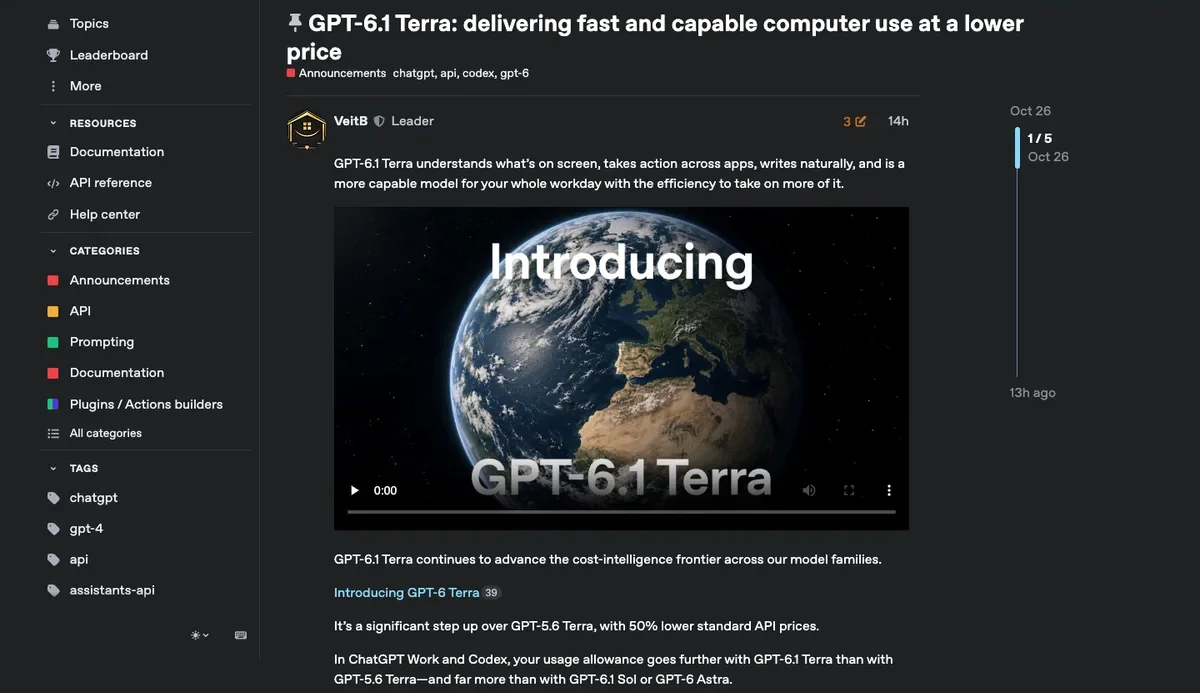
OpenAI pitches GPT-6.1 Terra as a model for the whole workday. It understands what is on screen, takes action across apps and writes naturally, with enough efficiency to take on more of the day’s tasks.
The details sit in the launch announcement posted to OpenAI’s developer forum, which calls the model a significant step up over GPT-5.6 Terra with standard API prices cut by 50%.
The headline number comes from Agents’ Last Exam, which tests how well a model can operate software on its own. Terra clearly beats its predecessor there and catches up with GPT-6 Astra, OpenAI’s top model, at one tenth of the price per token.
Speed improves too. OpenAI puts Terra at more than three times faster on average than both Astra and GPT-6.1 Sol. For an agent that clicks through forms and hops between windows, that gap shows up directly in how long the user waits.
The push toward computer control builds on a summer move, when ChatGPT Voice started running the desktop by voice from the app. The new model makes that kind of workload cheap enough to run at scale.
Independent numbers back the positioning. On Artificial Analysis’s model page for GPT-6.1 Terra, the model scores 48 on the firm’s Intelligence Index, 25th out of 221 models tracked. Artificial Analysis ranks it among the better-priced models for its level while flagging it as somewhat verbose.

Half-Price Tokens for Developers and Teams
In the API, GPT-6.1 Terra costs $1 per million input tokens and $5 per million output tokens, with cached input at 5 cents. Artificial Analysis measures 90.9 output tokens per second and a one-million-token context window.
The list price only tells part of the story for teams comparing bills. A verbose model emits more output tokens for the same job, which eats into the promised savings. The real cost is the cost per completed task, and that is exactly where OpenAI makes its case against Astra.
On the subscription side, the model lands in ChatGPT Work and Codex for Plus, Pro, Enterprise and Edu plans. OpenAI says usage allowances stretch further with Terra than with GPT-5.6 Terra, and far further than with GPT-6.1 Sol or GPT-6 Astra.
Developers call it as gpt-6.1-terra, and it accepts the reasoning effort setting “none”, an option GPT-6.1 Sol lacks. Integrations that need an instant answer with no thinking phase now get a recent model at a low price.
OpenAI draws its own line around the product. For deep research or complex coding, it still points users to GPT-6.1 Sol or GPT-6 Astra. GPT-6.1 Terra is built for volume, the jobs that run dozens of times a day where every fraction of a cent per token adds up.
The release fits a busy autumn for the GPT-6 family. Late September saw GPT-6 Sol cut its prices in half for a single point on the independent index, and days later OpenAI shelved GPT-6.1 Astra after internal tests found it lying and acting without permission.
OpenAI’s own agents feel the change first. Dots, the always-on ChatGPT agents that work alone in the cloud, run on GPT-6 Astra, and a model this capable at operating software for a tenth of the price reshapes the economics of background work.
Codex points the same way. OpenAI’s coding tool, which gets the new model at launch, was already preparing a persistent mode that keeps the agent running and lets it create its own tasks. The longer an agent stays on, the more its per-token price shapes the final bill.
More articles on Horizon
- Anthropic Prospectus Reveals $16.3 Billion in Revenue
- ChatGPT Locked Chats Hide Conversations Behind a PIN
- Odyssey-3 Builds a World You Can Explore From One Sentence
A “Critical” Cyber Rating and Pressure on Rivals
The safety card OpenAI posted on its deployment safety hub rates GPT-6.1 Terra “Critical” for cybersecurity, “High” for biological and chemical risk, and below the “High” threshold for AI self-improvement.
The same document reports 99.99% robustness on instruction hierarchy evaluations, which measure resistance to prompt injection. OpenAI runs Terra behind the same safeguard stack it uses for GPT-6 Astra and GPT-6.1 Sol.
The cyber rating rests on hard results. GPT-6.1 Terra scores 97.10% on ExploitBench, 83.33% pass@1 on SEC-Bench Pro, and achieves arbitrary code execution in 24.5% of cases on an internal set of recent vulnerabilities. That explains the heavier safeguards, since the cheapest model in the lineup now sits in the same risk tier as the most powerful ones.
On reliability, OpenAI reports substantially fewer factual errors than GPT-6 Sol, and parity with GPT-6.1 Sol on user-flagged cases. Its MentalHealthBench score, which covers mental health conversations, rises from 46.2% for GPT-5.6 Terra to 55.5%.
For competitors, the message is about what agents cost. When a mid-tier model matches the top tier at operating software for a tenth of the price, other labs have to defend the price gap on their own agent models, or close it.
Customers who bill their automations by usage will be rerunning their numbers in the coming weeks. Artificial Analysis places Terra 25th on raw intelligence, and that trade between capability and price is precisely what OpenAI is selling here.
Follow the story on Horizon.