

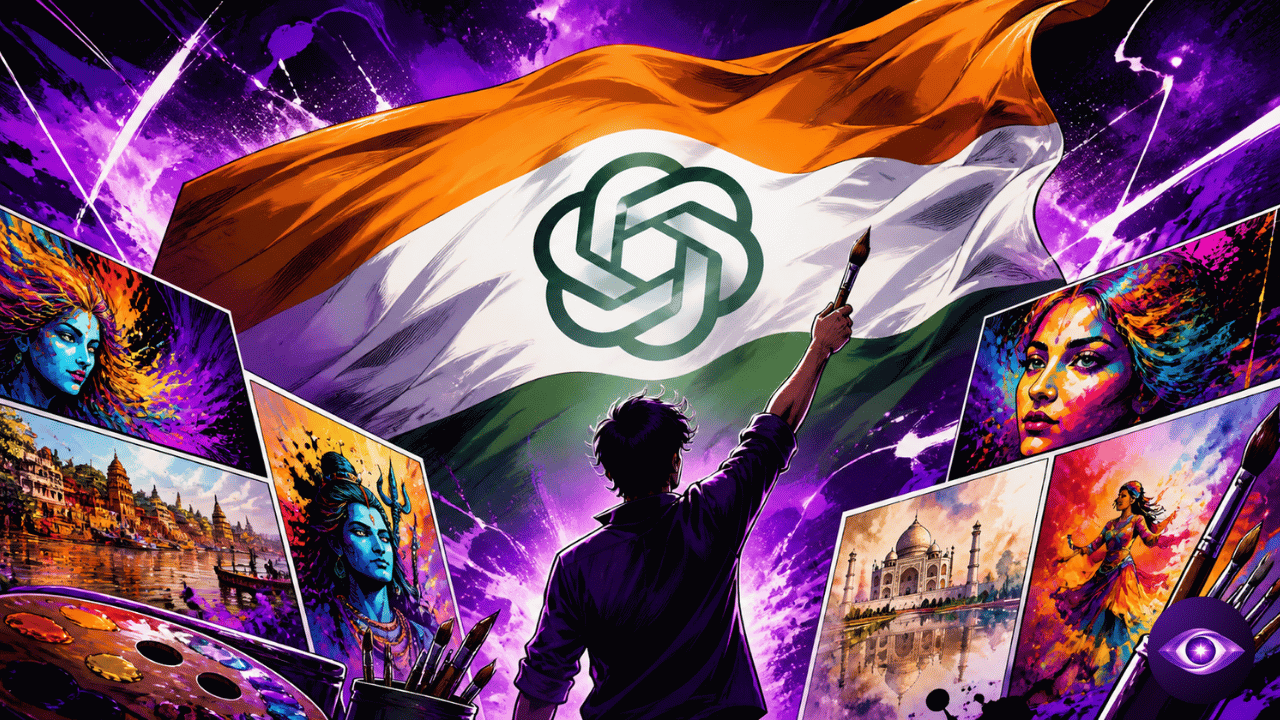
OpenAI launched ChatGPT Images 2.0 the week of April 21, 2026, with improvements to complex prompt handling and multilingual text rendering. In India, the launch generated 5 million downloads in a single week against 2 million in the United States. Globally, daily active users grew by just 1%. Adoption is happening, but it is concentrated where no one was looking.
Key Takeaways
- 5 million downloads in India versus 2 million in the US during the launch week of April 21
- Global daily active users grew only 1% week-over-week
- Pakistan, Vietnam, and Indonesia posted up to 79% week-over-week growth in app downloads
India as ChatGPT Images 2.0’s Largest Market
The gap between India and the United States is not a statistical outlier. Over the seven days following the April 21 launch, India accumulated 5 million downloads of the app while the United States reached 2 million. More than double, in a market the tech industry consistently treats as secondary.
Indian users adopted the tool for specific use cases. Studio-style portraits from everyday photos, social media-ready visuals, personalized avatars, fantasy newspaper covers, tarot-style imagery, and fashion moodboards. Practices rooted in personal expression, accessible without any particular technical skill.
Version 2.0 significantly improves multilingual text rendering. That is precisely what a market like India needs. Hundreds of millions of users communicate in Hindi, Tamil, Bengali, and Marathi. A tool that accurately generates images with localized text becomes immediately relevant where it previously was not.
Daily active users in India rose 3.4% week-over-week. The number looks modest in isolation. It stands in sharp contrast to the near-stagnation recorded in Western markets over the same period. A few weeks later, OpenAI would shift ChatGPT’s default to GPT-5.5 Instant, signaling that product cadence is moving in parallel with this geographic expansion.

Pakistan, Vietnam, Indonesia: Emerging Markets Accelerate
India is not alone in this dynamic. Pakistan, Vietnam, and Indonesia posted increases of up to 79% in weekly app downloads. For an application launched less than two weeks prior, that kind of movement in emerging markets is a signal OpenAI cannot afford to ignore.
Globally, app downloads rose 11% week-over-week. That is a reasonable result for a new launch. But daily active user sessions and web traffic grew only 1% to 1.6%. The gap between downloads and active usage indicates that users are downloading, testing once, and not returning at a meaningful rate.
This pattern is typical of saturated markets. Emerging markets show different retention because the tool addresses a genuine need that local alternatives could not meet as effectively.
Google had already observed a similar dynamic with its Nano Banana image model, which posted strong early adoption in India before spreading elsewhere. India is establishing itself as the primary testing ground for AI image generation, not by trend effect, but because the conditions are in place: a massive user base, appetite for accessible creative tools, and language barriers lowered by the improved multilingual rendering.
Also on Horizon:
- China cuts 12,000 university degrees made obsolete by AI
- 79% of parents already use AI to raise their kids
- GPT-5.5 Instant beats doctors on health answers
What the Numbers Reveal About the Geography of AI Adoption
The real story may not be India’s score. It is what that score reveals by contrast.
In the United States and Europe, ChatGPT Images 2.0 is generating no wave. A 1% rise in global daily active user sessions signals that existing users are experimenting without committing. In markets where the image generation offer is already dense, a new version of an existing tool is not enough to trigger a shift in behavior.
For OpenAI, the signal is clear. If ChatGPT Images 2.0 is to reach mass adoption, growth will come from emerging markets, specifically those where multilingual rendering concretely changes what the tool can do for a user. The India, Pakistan, Vietnam, and Indonesia axis represents hundreds of millions of potential users.
In the short term, global metrics will remain misleading. Worldwide figures will be pulled down by Western stagnation while real growth concentrates in regions that receive less media attention. Regional metrics will be needed to read actual product performance accurately.
In the medium term, the question is whether OpenAI will adjust its product roadmap accordingly. The features that drove success in India can be systematized: stronger multilingual rendering, personal expression use cases from real photos, accessibility without a learning curve. Competition is already positioned on this ground. The AI image market in emerging economies is being decided now, and the results of this launch make that clear.
Follow the story on Horizon.



Pingback: ChatGPT Images 2.0 : l'Inde explose, le monde attend - Horizon
Pingback: IA vs urgentistes : o1 d'OpenAI fait mieux au diagnostic - Horizon