

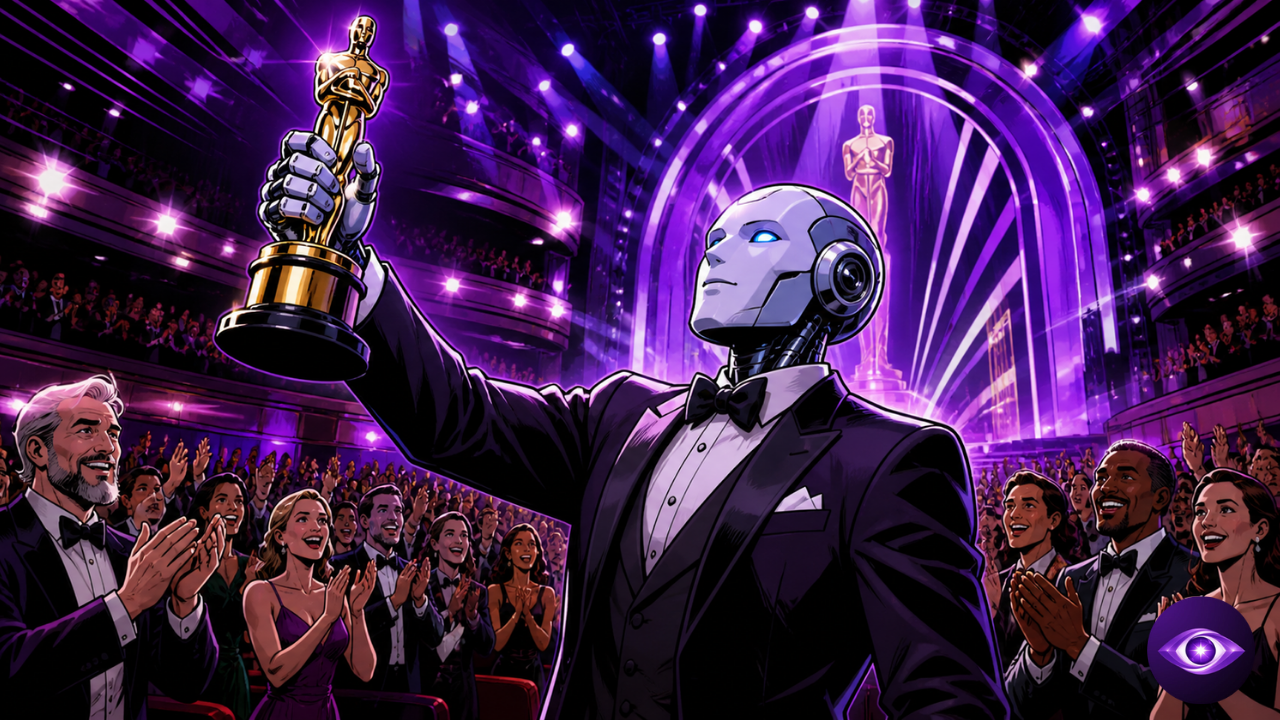
The Academy of Motion Picture Arts and Sciences has drawn a formal line between Hollywood and generative AI. New rules explicitly exclude AI-generated actors and scripts from any Oscar nominations. It is the first time the film industry has adopted an official position on the matter. The decision does not ban AI from production. It places it outside the line of reward.
Key Takeaways
- The Academy excludes AI-generated actors and scripts from any Oscar nominations
- This is the film industry’s first formal stance on generative AI in creative production
- The rule creates a clear distinction between AI use in production and eligibility for awards
Have an AI Sum Up This Article
ChatGPTA Formal Rule Where Only Informal Positions Existed Before
Until now, the debate over AI in cinema had remained in the domain of union declarations, strikes, and contract negotiations.
The Academy of Motion Picture Arts and Sciences has moved that debate onto institutional ground. By establishing clear eligibility rules, it introduces a form of implicit certification: works recognized at the Oscars are, by definition, works where actors and scripts are human.
The scope of the decision extends well beyond the Oscars themselves. The Oscars are the reference award of the global film industry.
What the Academy defines as eligible or ineligible directly influences the criteria that other award organizations will adopt in the short term. BAFTA, the Golden Globes, and the César Awards will all need to take a position.
The rule covers two distinct domains: AI-generated actors and AI-generated scripts. This dual scope is significant. It signals that the Academy perceives risk not only in visual representation, where digital actors could replace human performers, but also in writing, where LLMs could produce scripts without substantial human authorship.
The phrase “AI-generated” immediately raises a definitional question the Academy will need to clarify. The vast majority of productions today use AI tools at one stage or another: visual effects, assisted dubbing, writing support. The boundary between “assistance” and “generation” is not trivial to draw and will likely be the terrain of the first challenges to the rule.
The decision comes at a moment when the rise of generative AI in creative production is documented and growing. The Academy is not anticipating a future problem. It is responding to practices already present on sets and in editing rooms.

What This Decision Changes for Productions in Development
In the short term, the most concrete effect will be on productions currently in development or post-production that were considering using AI-generated actors in significant roles, or LLMs for all or part of the writing.
These productions will have to choose between the potential efficiency of these tools and their eligibility for awards.
For studios that target the Oscars as a prestige indicator and distribution lever, the rule creates a real constraint. The prospect of an Oscar nomination influences production decisions long before filming begins. It shapes casting choices, budget allocation, and artistic treatment. Excluding productions with a heavy AI component from that prospect changes the economic calculation.
For human actors, the decision is a formal protection in a sector where the question of digital replication of their image and voice has been central to union negotiations for several years. The Oscars cannot prevent a production from creating a digital actor. But they can decide not to reward it.
For screenwriters, the rule raises a question of traceability. How does a production demonstrate that a script was not AI-generated? The burden of proof and verification mechanisms will need to be defined. This is a technical and legal challenge that the Academy has likely not yet fully resolved.
Independent productions, which often have fewer resources and might find in AI tools access to production capabilities they could not otherwise afford, are also directly affected. The rule applies to all categories of productions eligible for the Oscars, not just major studio releases.
Also worth checking on Horizon:
- Elon Musk Predicts AI Will Eliminate Us All
- Tesla’s Optimus Robots Are Coming
- Apple Is Going All In on Humanoid Robots
Medium-Term Implications for AI in the Creative Industries
In the medium term, the Academy’s decision will fuel a broader debate about the value attributed to human creation versus AI-assisted or AI-generated work. The Oscars answer a simple but structuring question: does the artistic quality of a work depend on the human process that produced it, or only on its result? The rule established says that yes, the process matters.
This position will create a progressive segmentation of the film market. On one side, productions positioned on certifiable human creativity, eligible for major awards. On the other, productions making heavy use of AI, potentially cheaper and faster to produce, but valued on other criteria such as volume, accessibility, or specific market segments.
The regulatory question will also resurface in this context.
Several governments have already begun examining frameworks for AI in cultural industries. The Academy’s decision provides a clear precedent: a globally recognized private organization defining its own criteria for human authenticity. This type of private sector regulation can precede, influence, or supplement legislative regulation.
The rule will also accelerate investment in AI-generated content detection tools for audiovisual media. If Oscar eligibility depends on the absence of AI generation, verification tools are needed. That is a market being created, one that will benefit directly from the formalization of these criteria.
Follow the story on Horizon.