
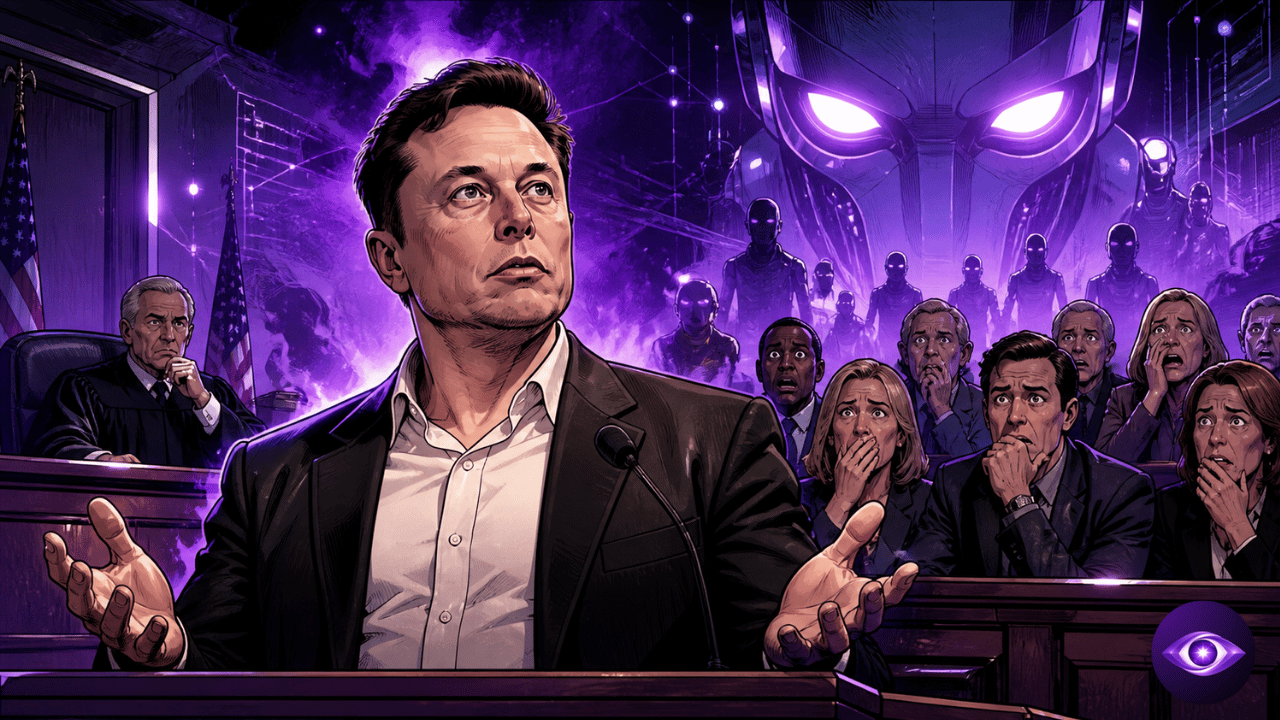
Since April 28, 2026, Elon Musk and Sam Altman have been facing off in a federal courthouse in Oakland. The trial pits OpenAI’s co-founder against the organization he accuses of betraying its original mission. From the stand, Musk declared that AI “could also kill us all” and repeatedly returned to his obsession with a Terminator scenario. The judge eventually banned him from bringing it up.
Have an AI Sum Up This Article
ChatGPTTo summarize
• Musk is seeking $130 billion and the removal of Altman and Brockman, whom he accuses of betraying OpenAI’s nonprofit mission.
• On the stand, he declared that AI “could also kill us all” before being cut off by the judge.
• OpenAI claims the lawsuit is motivated by jealousy and a desire to undermine a direct competitor.
“AI could also kill us all”
The line came out on the first day of testimony.
Asked about his deeper motivations, Elon Musk told the jury that he had “extreme concerns about AI”, a technology that can make everyone prosperous but “could also kill us all”. He repeatedly said he wanted to avoid what he calls a “Terminator scenario”, a direct reference to James Cameron’s 1984 film, in which an AI takes control and attempts to eliminate humanity.
“In the movie, it’s not a good situation,” he clarified from the stand.
This is not the first time Musk has expressed these fears. For years, he has been one of the most prominent voices on the existential risk posed by artificial intelligence. His conversation with Demis Hassabis, the founder of DeepMind, illustrates how his thinking evolved. The two men had debated what mattered most: colonizing Mars to ensure the survival of the species, or developing AGI to solve all of humanity’s problems. Hassabis pointed out that killer robots could very well follow humans to Mars. Musk concluded that Hassabis was right: powerful AI might be more consequential than space exploration. For context, see our earlier piece on Horizon: Tesla’s Optimus Robots Are Coming.
“If we build the robots, I can make sure they are safe, and we don’t have a Terminator future situation,” he told the court.
Judge Yvonne Gonzalez Rogers quickly put an end to these developments. She banned Musk from continuing to raise existential AI risk and the possibility of human extinction on the stand: “It’s not the point of the case,” she ruled.
His brother had once asked him to stop talking about AI at parties because “it’s a buzzkill.” Musk recounted the anecdote from the stand, prompting laughter across the courtroom.
Outside the courthouse, he continued posting on X throughout the trial. “Scam Altman and Greg Stockman stole a charity. Full stop.” The judge publicly reprimanded him and threatened a gag order before the jury entered the room.
What Musk actually holds against OpenAI
The substance of the case is more precise than the headline-grabbing statements suggest.
Musk co-founded OpenAI in 2015 alongside Altman and Brockman, investing at least $44 million in its early years. His argument is straightforward: he would never have contributed if the mission had not been to develop AI for the benefit of humanity, within a nonprofit structure.
“I came up with the idea, the name, recruited the key people, taught them everything I know, provided all of the initial funding. Besides that, nothing. It was a lot,” he said under oath, with characteristic irony.
He left the board in 2018 after an internal power struggle. A year after his departure, OpenAI created a for-profit subsidiary to raise capital, including $10 billion from Microsoft. This is the moment Musk identifies as the central betrayal: the organization was no longer acting for the good of humanity, but for the benefit of its shareholders.
He then went on to found xAI, his own competing AI lab.
Musk is now seeking $130 billion in damages, a return of OpenAI to a purely nonprofit structure, and the removal of Altman and Brockman from leadership. He claims he waited until he was certain of their conduct before taking action. “No good, it turns out,” he quipped from the stand, drawing more laughter from the room. The outcome could reshape OpenAI’s path, including its IPO targeted for September 2026.
Jury selection was itself complicated. So many candidates expressed personal antipathy or political opposition to Musk that the judge publicly acknowledged that “people don’t like him”. The jury ultimately selected was largely composed of people who declared a neutral opinion of Musk and of AI.
OpenAI fights back
The defense did not miss the opportunity to turn Musk’s arguments against him.
An OpenAI lawyer pulled up an old tweet from Musk: “The future is going to be amazing with AI and robots enabling sustainable abundance for all.” Confronted with the quote under oath, Musk hesitated: “There are many possible futures. Some futures are good, and some are not good.”
OpenAI claims Musk himself pushed for a for-profit structure, and that he left the board solely because he could not assume total control. The lawsuit, they say, is “motivated by jealousy, regret for walking away from OpenAI and a desire to derail a competing AI company”.
Defense lawyers also noted that Musk only filed the lawsuit after founding xAI. The implication is clear: if Musk had truly been driven by principles, he would have acted far sooner.
Under oath, Musk also took the opportunity to promote Grok, his chatbot developed at xAI, claiming it was “catching up” to ChatGPT. He had also reportedly told analysts on a call about his plans to build “an enormous AI-enabled robot army”. A quote the defense immediately used to challenge the consistency of his concerns about existential risk.
Altman and Brockman have yet to testify. Their depositions could shift the balance of the trial, particularly Brockman’s, which should shed light on how OpenAI’s co-founders decided to restructure the organization and forge deals with Microsoft.
The trial is expected to run for several more weeks. And what is at stake goes far beyond the fate of one company: it is the future of AI governance that hangs in the balance, at a moment when the world’s most powerful models are being developed without a clear legal framework.
Follow this story on Horizon.