

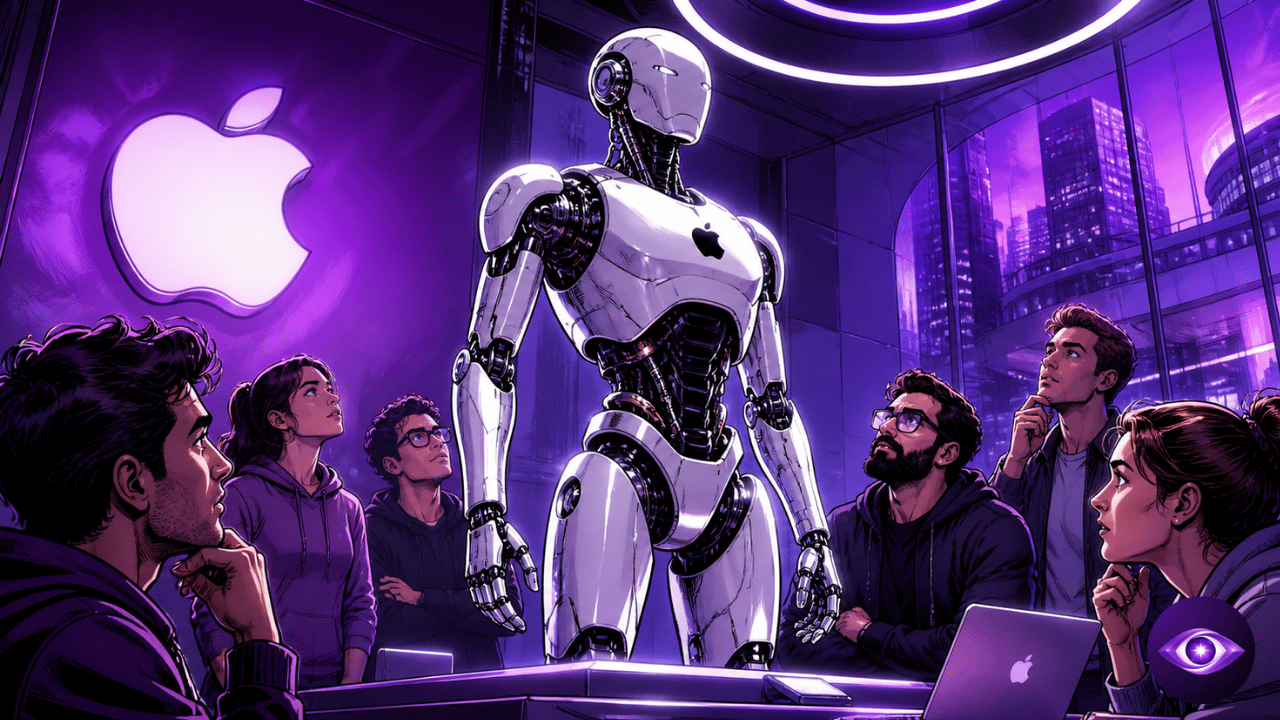
Apple never does things halfway. After the iPhone, iPad, and Apple Watch, Cupertino’s next big bet might walk on two legs. Or roll. Or swivel. Apple’s robotics projects are still secret, but early information paints a clear strategy: integrate robotics into the Apple ecosystem, start with the home, and aim very high.
Have an AI Sum Up This Article
ChatGPTTo summarize
• Apple is developing several robotics projects, including the J595 “Pixar Lamp”, a robotic arm with a screen targeted for 2027 at around $1,000.
• Morgan Stanley estimates Apple’s robotics could generate $130 billion in annual revenue by 2040.
• A humanoid robot is in very early stages, but Bloomberg considers a release before 2030 unlikely.
The “Pixar Lamp”: Apple’s first robot
The first concrete project is internally called J595.
Engineers have nicknamed it the “Pixar Lamp”, a reference to the animated lamp in the studio’s logo. A robotic arm topped with an iPad-like screen, capable of rotating 360 degrees and tracking the user through facial recognition. The device would respond to conversations, automatically orient its screen toward the person during FaceTime calls, monitor security cameras, and serve as a home control center.
The target price is around $1,000, in line with high-end iPads.
Matt Costello, who previously worked on the HomePod, is leading hardware development. The device would run on an internal software platform called “Charismatic”, designed for voice commands, personalized content, and home automation.
The launch is targeted for 2027, according to Bloomberg sources. A simpler home hub, essentially a connected AI screen, is planned for 2026 and is further along in development.
Several robots in parallel
The J595 is not the only project in progress.
Apple is also exploring a mobile robot on wheels that would follow users from room to room, incorporating AI algorithms to navigate cluttered spaces without bumping into furniture or people. An ambition reminiscent of Rosey, the robot from The Jetsons, though sources close to the project temper expectations: a robot capable of cleaning and doing household chores remains far too complex an engineering challenge for this decade.
More ambitious still: a humanoid robot project, currently in a very early proof-of-concept stage, initially oriented toward industrial rather than domestic use.
The team leading these robotics projects is headed by Wolfram Tappeiner, a robotics expert, with around one hundred engineers. The two supervising executives are John Giannandrea, Apple’s AI chief, and Kevin Lynch, head of product development. Apple reportedly even has a secret facility designed to look like the inside of a home, where these products are tested under real-world conditions.
A $130 billion bet
The figures put forward by Morgan Stanley give a sense of what is at stake.
According to the investment bank, Apple’s robotics projects could generate up to $130 billion in annual revenue by 2040, in what it describes as a “median scenario”. This scenario is based on an estimated 9% market share, well below what Apple typically achieves in categories it enters.
The reference to the iPhone in 2007 is on everyone’s mind. Apple did not invent the mobile phone, but redefined it to the point of dominating the market. The question is whether it can replicate that pattern in home robotics, a sector where players like Figure, Boston Dynamics, Agility Robotics, and Tesla Optimus have years of head start. For context, see our earlier piece on Horizon: Tesla’s Optimus Robots Are Coming.
The strategic context is clear. Apple abandoned its autonomous car project after years and billions invested. The Vision Pro, despite an M5 update in October 2025, failed to revive sales. Robotics appears to be one of the new priorities meant to justify the next years of growth.
Tim Cook told employees at an internal all-hands meeting that Apple needed to “win in AI”, describing the product pipeline as “amazing” without mentioning robotics explicitly. Analyst Ming-Chi Kuo confirms that robotics projects remain at an early stage. Nothing is official. No product is confirmed. That ambition also runs through the assistant, with a rebuilt Siri taking on ChatGPT.
But in Apple’s history, silence has never meant absence.
Follow this story on Horizon.