
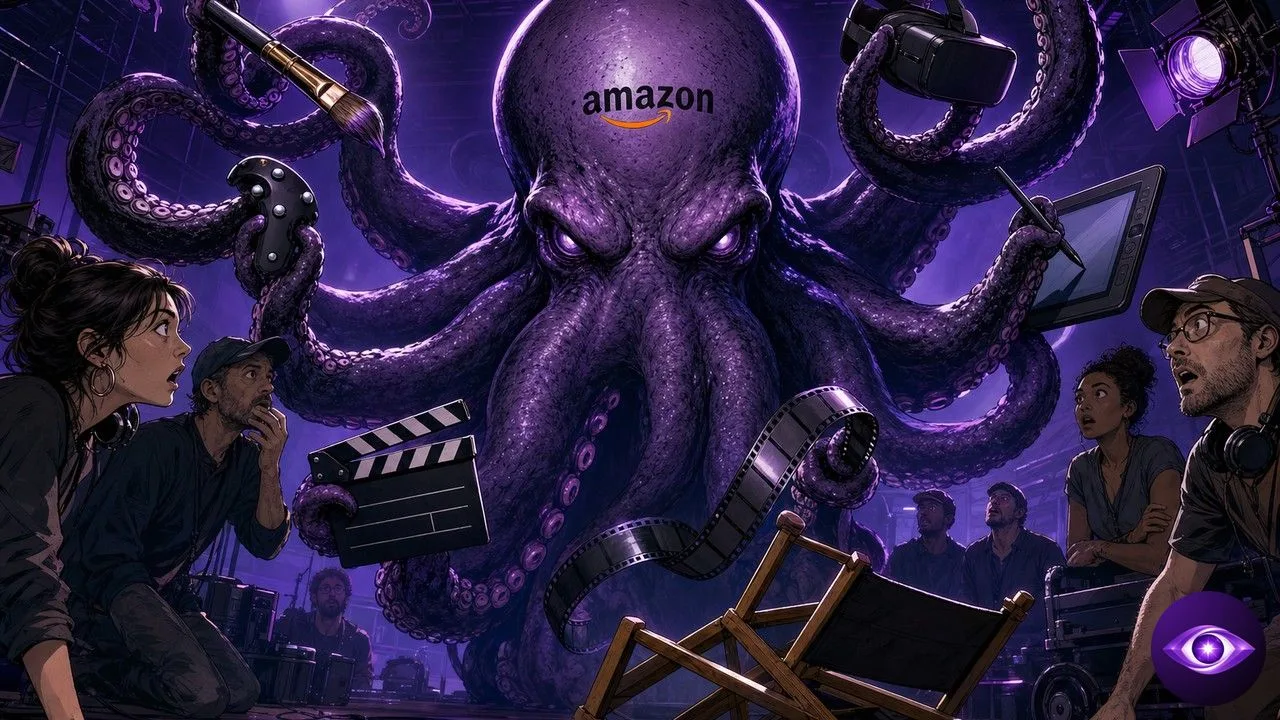
Amazon MGM Studios and AWS launched Project Nara on May 27, 2026 at the “AI on the Lot” event in Culver Studios. The platform is presented as a collaborative workspace for AI-assisted cinematic production, connected to Maya, Blender, Nuke, Unreal Engine and the Adobe suite. One month after launch, the industrial strategy behind Amazon MGM starts to come into focus.
Key Takeaways
- Nara is an AI production platform for cinema, wired into Maya, Blender, Nuke, Unreal Engine and Adobe
- The launch was coupled with the GenAI Creators’ Fund and three greenlit animated series for Prime Video
- Jorge Gutierrez, director of Punky Duck, stepped away from the project two days after the announcement under industry pressure
Have an AI Sum Up This Article
ChatGPTAn AI Platform Wired Into the Tools Studios Already Use
Amazon MGM Studios describes Nara as a purpose-built platform for cinematic storytelling, running on AWS infrastructure. The technical pitch highlights a collaborative workspace that plugs AI production agents directly into the standard tools of the industry.
The list of software connected to Nara says a lot. It includes Maya for 3D animation, Blender for open-source modeling, Nuke for compositing, Unreal Engine for virtual production, and the full Adobe suite for the finishing workflow. In other words, Amazon MGM is not asking studios to change stack. The launch communication, detailed in the official press release Amazon MGM Studios issued on May 27, 2026, positions Nara as an AI orchestration layer sitting on top of the existing tools.
The described mechanism relies on automated routing of production tasks. Nara selects the optimal AI model at each stage, combines external third-party video models with proprietary solutions trained on MGM Studios’ catalog, and propagates the results back into the finishing software. The stated philosophy is model-agnostic, backed by a provenance tracking system meant to protect the intellectual property used as input and output.
The GenAI Creators’ Fund is the second arm of the strategy. Amazon MGM Studios and AWS bundle funding with Nara access for selected creators. Three animated series were greenlit right at launch for Prime Video: Cupcake and Friends by BuzzFeed Studios, Love, Diana Music Hunters by Albie Hecht, and Punky Duck by Jorge R. Gutierrez. No release date has been announced so far.

Jorge Gutierrez Pulling Out Reshaped the Launch Narrative
Two days after the announcement, Jorge Gutierrez pulled his Punky Duck project from the GenAI Creators’ Fund under pressure from the creative industry. That single exit, from one of the three headline creators, damaged Amazon MGM’s launch narrative. The signal is clear. Part of the creative community still refuses to publicly attach its name to an AI platform backed by a studio that only weeks earlier shelved the Artificial film on Sam Altman.
Amazon MGM has not publicly replaced Punky Duck since. The two remaining projects, Cupcake and Friends and Love, Diana Music Hunters, now carry the fund’s demonstration alone. The original communication rested on the idea that Nara could attract recognized independent creators. Gutierrez pulling out removes that card from the table, at least temporarily.
In the short term, the challenge for Amazon MGM is to run Nara on projects that bring industrial credibility. The next greenlit orders will be scrutinized. A traditional studio agreeing to use Nara on an existing production would send a much stronger signal than adding one more independent creator to the roster.
The Prime Video production calendar becomes a barometer. The ByteDance push behind Seedance 2.0 that is already shaking Hollywood on the video generation side installs direct competitive pressure. Amazon MGM can no longer afford to leave Nara at the demo stage. The platform must produce hours of aired content in 2026 to justify its own investment.
Also on Horizon:
- AI Jobs Data: Ramp Sees +12%, Goldman Sees -16k
- Claude Science: Anthropic’s New Lab AI Workbench
- Claude Fable 5 Officially Returns Worldwide July 1
Amazon MGM Redefines AI Production While Rival Studios Hesitate
The strategic bet behind Nara is to capture creative workflows ahead of traditional competitors. Netflix, Disney, Warner Bros. Discovery and Paramount have no public equivalent platform. Amazon MGM takes the risk of leading the way, absorbing the criticism that Netflix and Disney watch from a distance.
The choice to wire Nara into Maya, Blender, Nuke, Unreal Engine and Adobe is particularly revealing. These five environments cover the bulk of the Hollywood production pipeline, from storyboard to final render. By installing itself as an orchestration layer on top of that stack, Amazon MGM aims to become the connective tissue of AI workflows across audiovisual production, not just another model provider.
Over the medium term, the move exposes two fractures. The first opposes studios that will adopt integrated platforms like Nara against those that prefer negotiating with several separate AI providers. The second opposes independent creators who will accept the AI trade-off to secure funding against those who will keep refusing public exposure, the Jorge Gutierrez way.
Provenance tracking will weigh in over the next months. Amazon MGM promises a system that protects intellectual property, but no independent audit has been published so far. The topic ties directly into the recent tensions between studios and AI labs over model access and training rights. Hollywood guilds will demand formal guarantees before authorizing Nara use on member productions.
One month after launch, Nara remains a platform whose industrial demonstration is still ahead. The technical stack is described, the funding is aligned, but adoption by top-tier creators is fragile. The next six months will determine whether Nara becomes a Prime Video production standard or stays a lab experiment isolated from the rest of the industry.
Follow the story on Horizon.


