

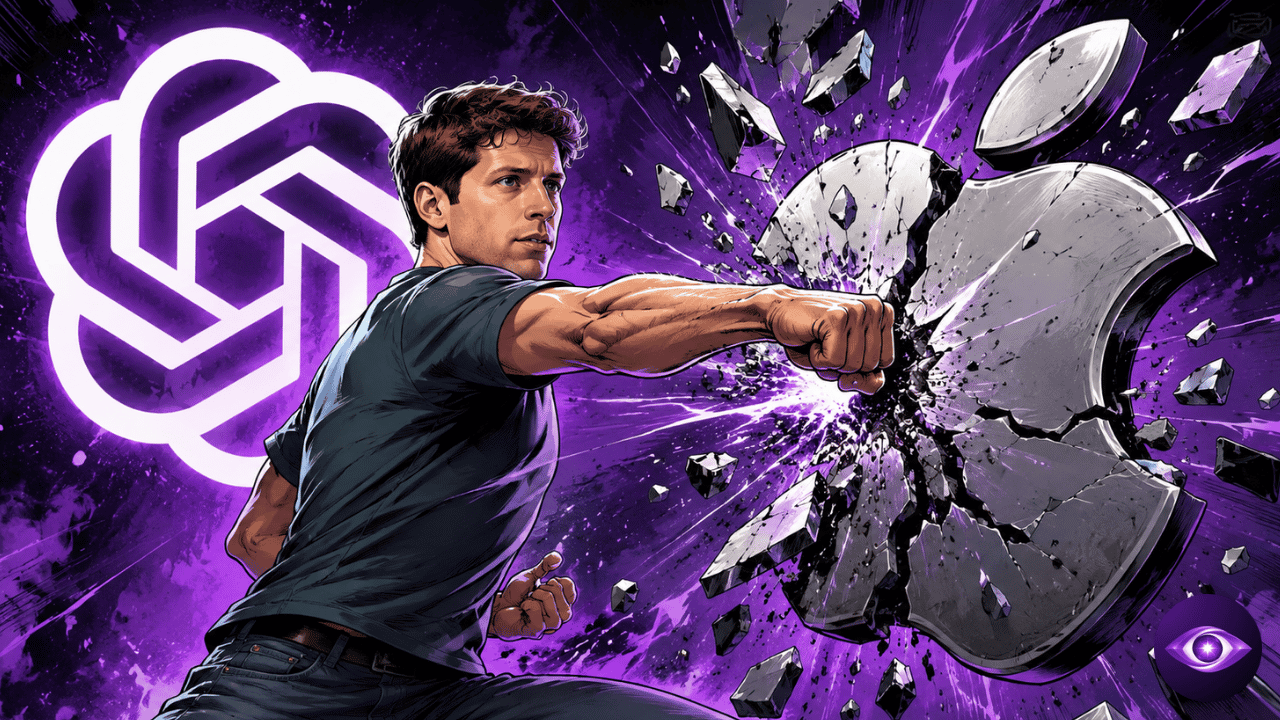
OpenAI is reportedly exploring legal action against Apple over a failed ChatGPT integration. The partnership, announced at WWDC 2024 with considerable fanfare, buried the features so deep inside iOS that they never drove real revenue. Now OpenAI has hired outside counsel and may be preparing a breach-of-contract notice.
Key Takeaways
- OpenAI accuses Apple of deliberately “burying” ChatGPT inside Siri, making the features nearly impossible to find
- Revenue from the partnership fell drastically short of OpenAI’s projections
- Outside lawyers have been engaged; a formal breach-of-contract notice is under consideration
Have an AI Sum Up This Article
ChatGPTAn Integration That Never Really Existed
June 2024, Apple Park. Tim Cook took the stage and announced that ChatGPT would be natively integrated into Siri and Visual Intelligence. The partnership was billed as the alliance between the world’s best consumer hardware and the most widely used language model on the planet. Apple is readying its answer, a rebuilt Siri taking on ChatGPT.
Ten months later, according to a Bloomberg report published on May 14, 2026, OpenAI is exploring legal action against Apple. The core allegation: the features stemming from the partnership were deliberately “buried” inside iOS. They exist in theory, but they are difficult enough to locate that they have generated almost no commercial value.
Revenue from the integration fell far short of OpenAI’s projections. An OpenAI executive quoted by Bloomberg put it plainly: “They basically said, ‘OpenAI needs to take a leap of faith and trust us.’ It didn’t work out well.”
The framing matters. OpenAI is not accusing Apple of technical failure. It is accusing Apple of making deliberate integration decisions that rendered the product invisible inside operating systems meant to distribute it to hundreds of millions of users.
The distinction is significant. A bug gets fixed. A visibility policy gets renegotiated, or litigated.

Lawyers Hired, Apple Pushes Back Quietly
According to Bloomberg, OpenAI has brought in outside counsel to review its options. A first step would be sending a formal breach-of-contract notice before any full lawsuit. That kind of move typically signals an intent to force renegotiation rather than immediately trigger courtroom proceedings.
Any more aggressive action will likely be held off until OpenAI’s ongoing trial against Elon Musk concludes. As we covered during Sam Altman’s testimony in that case, OpenAI is currently managing multiple legal fronts simultaneously, which limits how quickly it can move on any single dispute. OpenAI is already fighting other fronts, Florida suing it alongside Sam Altman.
Apple is not without its own grievances. Bloomberg reports two key friction points from Cupertino’s side: concerns over OpenAI’s privacy standards, which Apple considers below its internal requirements, and irritation over OpenAI’s hardware ambitions with Jony Ive, Apple’s former chief design officer.
Ive spent over two decades shaping Apple’s aesthetic identity. Seeing him collaborate with a potential competitor on a consumer device is felt in Cupertino as a form of betrayal that goes beyond any contractual clause.
These elements point to a conflict that runs deeper than a missed revenue target. Both sides have accumulated grievances, and neither appears interested in a quick settlement.
Also on Horizon:
- Alexa for Shopping: Amazon Brings AI Into Its Search Bar
- Sam Altman on the Stand: The Question of Trust
- Ramp AI Index: Anthropic Edges Out OpenAI in Enterprise
Apple and Its Partners: A Pattern That Keeps Repeating
This dispute fits a well-documented pattern. Apple has a long history of partnerships that turned adversarial: Google Maps integrated then sidelined in favor of a homegrown alternative, Adobe Flash blocked on grounds that were never fully made explicit, Spotify kept in a structurally unequal position by App Store rules that the EU has since challenged. Apple already carries AI baggage, having settled $250M over false AI advertising.
In each case, the dispute came down to the same question: who controls the user experience on an Apple device? The answer has always been the same. Apple does. Partners adapt or leave.
For OpenAI, that meant the integration could only exist on Apple’s terms, in the spaces Apple chose to allocate. When those spaces turned out to be marginal, OpenAI had no apparent contractual lever to demand more visibility. The potential lawsuit is essentially an attempt to create that lever retroactively.
In the short term, the stakes are both financial and strategic for both parties. If a formal notice is sent, Apple and OpenAI will have to renegotiate the terms of the partnership or face each other in court. Both scenarios consume time and resources at a moment when each company has other pressing priorities.
Over the medium term, this conflict exposes a structural problem for OpenAI. The company needs massive distribution to stay dominant. Apple represents access to over a billion active devices worldwide. But that dependency comes at a cost: accepting that the partner decides how visible the product is. The launch of Daybreak, OpenAI’s AI cybersecurity platform, and the accelerated rollout of Codex across developer environments suggest OpenAI is actively working to reduce its reliance on third-party distributors.
The Apple partnership remains, on paper, a significant asset. OpenAI appears to have decided it is no longer acceptable to leave it underutilized without drawing contractual consequences.
Follow the story on Horizon.



Pingback: ChatGPT Lawsuit: Florida Sues OpenAI and Sam Altman - Horizon IA
Pingback: Apple Pays $250M to Settle Apple Intelligence Lawsuit - Horizon IA