

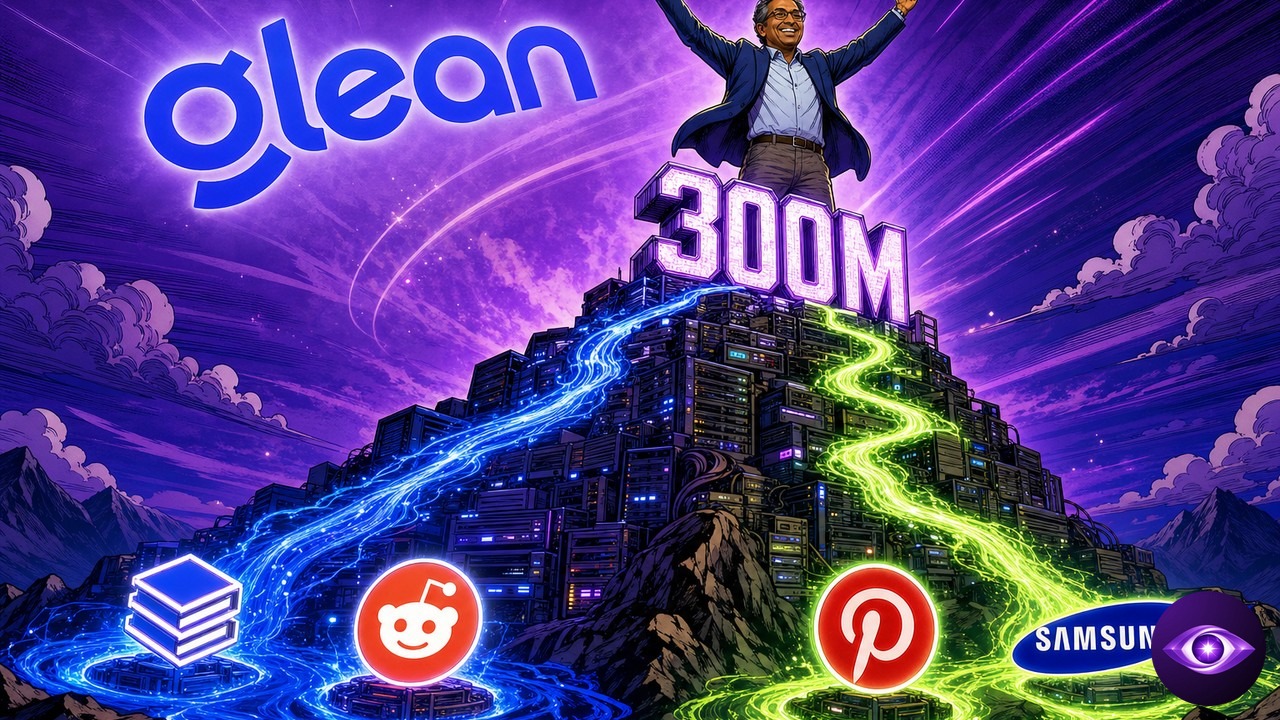
Glean went from $100M to $300M ARR in 15 months. The enterprise AI search platform is now selling the opposite of what most AI vendors pitch: fewer tokens, lower costs, same quality. In a market where AI budgets are starting to sting, that position is finding real traction.
Key Takeaways
- Glean reaches $300M ARR from $100M in 15 months, valued at $7.2 billion
- The platform cuts AI compute costs through “context graphs” that reduce token consumption
- Glean competes directly against Google, Microsoft, OpenAI, Anthropic, Salesforce, and Atlassian
Have an AI Sum Up This Article
ChatGPTFrom $100M to $300M in 15 Months: How Glean Built Its Momentum
Tripling in fifteen months is rare even in the AI hypergrowth era. Glean pulled it off, going from $100 million to $300 million ARR while holding a $7.2 billion valuation after a $150 million Series F. For a seven-year-old company built before the AI wave hit, the timing is working in its favor.
One caveat deserves attention. The $300M figure combines traditional ARR with consumption-based pricing. It’s not pure recurring revenue in the strict accounting sense: it’s an aggregation that includes a variable component tied to usage. That distinction matters when benchmarking Glean against more mature SaaS players.
The customer list tells a cleaner story. Databricks, Reddit, Pinterest, and Samsung are among Glean’s active clients. These are data-intensive companies with complex internal workflows and teams that cannot afford an approximate internal search system. Their presence on the roster signals that Glean is solving a real operational problem at scale.
This growth was built on a seven-year head start. Glean launched before Google, Microsoft, or Salesforce made serious moves into enterprise AI search. That runway allowed the company to accumulate product maturity that late entrants struggle to offset with distribution advantages alone.
In the short term, competitive pressure will sharpen significantly. Enterprise AI budgets are allocated on 12 to 18-month cycles. Glean needs to close deals before competitors lock the doors. The conversion rate of its pipeline over the next two quarters will be the defining metric.

The Context Graph: An Architecture Built Against Waste
Glean’s core proposition rests on architecture CEO Arvind Jain describes directly. Connecting your AI to Glean, he argues, gives it “all the information you need to do your work, and that results in AI consuming far fewer tokens.” This isn’t a performance argument: it’s an economic one, and right now it’s a more useful pitch than raw capability.
The mechanism relies on what Glean calls “context graphs.” By connecting AI to a company’s internal systems (communication tools, document bases, business applications), the platform builds a structured representation of the work context. The AI can then answer more queries with fewer operations, mechanically reducing token consumption.
This is where Glean finds a niche its competitors aren’t directly attacking. Most AI vendors sell power: more context, more capabilities, more tokens included. Glean sells the opposite: a system that consumes less because it contextualizes better. In an environment where AI budgets are starting to face scrutiny, that positioning is capturing real attention from CFOs and CIOs alike.
This dynamic is not theoretical. As we documented in our analysis of Microsoft cutting Claude Code after a budget overrun, even the most resource-rich tech companies are bumping into the real cost of AI at scale. The ROI question is no longer abstract: it’s on every CIO’s table.
Over the medium term, if the AI budget tightening cycle deepens, Glean’s thesis becomes structurally stronger. A vendor that can prove it cuts compute costs while maintaining answer quality has a sales lever that raw performance benchmarks cannot match.
Also on Horizon:
- Asana Buys StackAI for $75M to Build the Agent Workplace
- Non-Human Traffic Is 31% of the Web and Growing Fast
- Vibe: Mistral Turns Le Chat Into a Full Work Agent
Google, Microsoft, Anthropic: Competition Coming from Every Direction
The list of Glean’s competitors makes the challenge clear. Google, Microsoft, OpenAI, Anthropic, Salesforce, Atlassian. Each of them holds a massive distribution advantage in their respective markets. The question facing Glean is classic: how far can a best-of-breed solution hold against platform integration from dominant players?
Glean’s answer lies in the depth of its integration. After seven years of development, the platform is embedded in customer workflows at a level that’s difficult to dislodge. The migration cost for an internal search tool is real: team retraining, data source reconnection, access rights reconfiguration. Glean’s stickiness is a defensive asset that its competitors will struggle to overcome through product launches alone.
Shadow AI also complicates the picture. As we analyzed in our report on enterprises navigating AI security blind spots, employees bypass official solutions at scale. An internal search tool with poor adoption becomes an official solution on paper and a consumer AI tool in practice. Glean has to convince CIOs and end users simultaneously.
In the short term, Glean will focus its growth on large enterprise accounts capable of absorbing a solution at a $7.2 billion price point. SMBs remain out of reach on pricing at this stage. The enterprise-first strategy is consistent with its fundamentals but exposes the company to customer concentration risk.
Over the medium term, consolidation in the enterprise AI search market is inevitable. Vendors that fail to embed their product in critical workflows within the next 18 months will be acquired or marginalized. Glean holds the first-mover advantage in this specific niche, but that lead is measured in quarters, not years.
Follow the story on Horizon.