

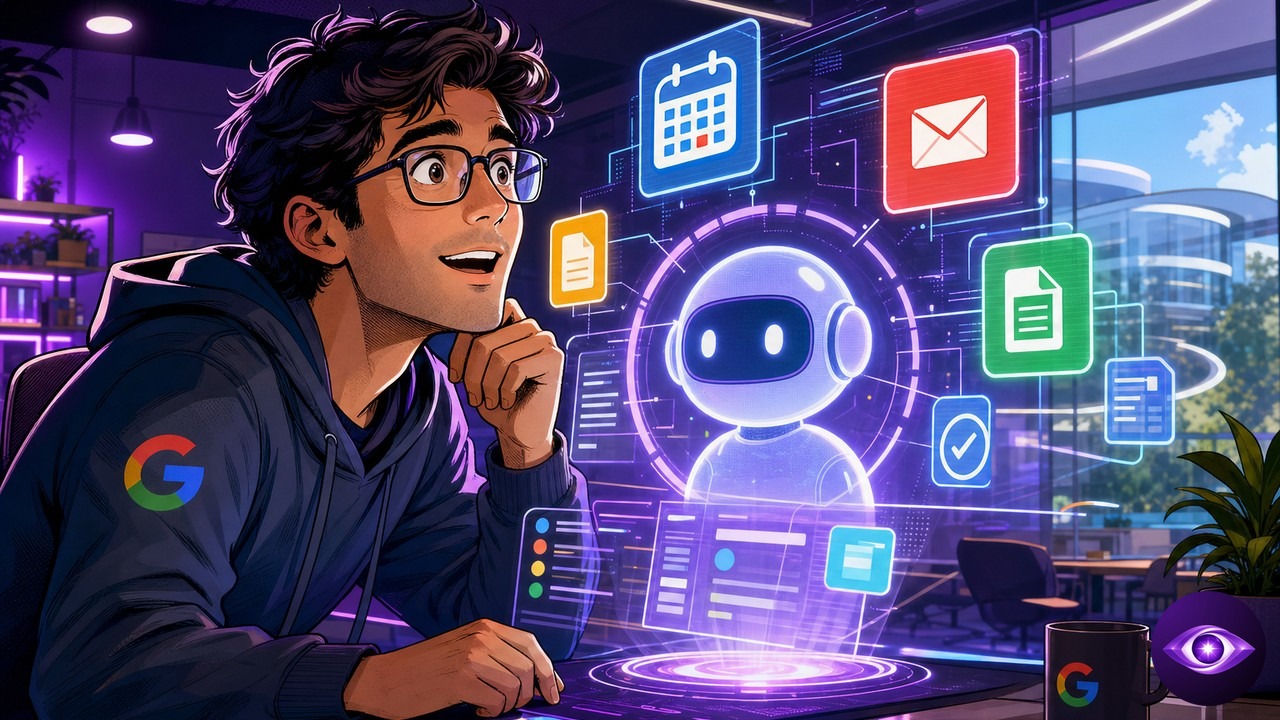
Internally, Google is developing Remy, an advanced version of Gemini designed to autonomously handle users’ digital lives. A confidential project, but one whose outlines are beginning to take shape.
Key Takeaways
- Google is internally developing an AI agent named Remy, built on Gemini
- Currently in an internal testing phase (dogfooding) before any public release
- Google I/O 2026 could be the moment of a first official announcement
Have an AI Sum Up This Article
ChatGPTA Personal Agent That Monitors, Anticipates, and Learns
Google is preparing a paradigm shift for Gemini. The company is internally developing an agent called Remy, whose ambitions are described explicitly in internal documents: a personal agent available twenty-four hours a day, seven days a week, capable of stepping in across professional, academic, and everyday contexts alike.
What Remy is meant to accomplish goes far beyond what Gemini offers today. Where the current assistant answers questions and generates content on demand, Remy is built to act proactively. According to internal notes that have surfaced, it would be capable of monitoring what matters to the user, managing complex tasks, and learning their preferences over time. The full picture is available in Google’s announcement on its 24/7 personal AI agent Gemini Spark. Google is already moving that way, Gemini 3.5 Flash already clicking through your screen.
The agent is described as « deeply integrated into Google, » implying native access to the company’s entire ecosystem: Gmail, Calendar, Drive, Search, and likely connected third-party applications. This integration is precisely what would set Remy apart from a generic AI agent: direct access to user data, without friction, without manual handling.
This is also what makes the project sensitive. An agent capable of making decisions autonomously, with broad access to a user’s digital life, raises questions that Google has not yet addressed publicly. What guardrails? What authorization levels for each type of action? The company has made no official statement on Remy.
The trend is clear. For months, the major AI players have been converging their products toward this autonomous agent model. Google is no exception. Remy fits into this dynamic, backed by the structural advantage of an application ecosystem few competitors can match.

Still Secret, But Already Visible in the Code
Remy is currently in a dogfooding phase. Google employees are the first to test it, as part of a standard internal process that precedes any public release. This phase makes it possible to identify problematic behaviors, refine the agent’s responses, and validate the most common use cases before any external exposure.
But the project has already left traces beyond internal memos. The code of the Gemini app for macOS, analyzed recently, revealed autonomous features in preparation: access to the user’s screen, mouse and keyboard control. Capabilities that correspond exactly to what a personal agent like Remy would need to execute tasks without human intervention.
This type of technical leak is not uncommon in the industry. They often precede official announcements by a few weeks. In Remy’s case, the convergence between internal documents and application code suggests a product much further along in development than Google publicly acknowledges.
As we recently covered, Gemini is also set to get a new look at Google I/O, with interface changes that align with a more active and continuous use of the assistant. Remy and the Gemini redesign appear to be part of a coordinated strategy rather than parallel initiatives.
Google’s official silence does not reflect an absence of movement, but a controlled communication strategy ahead of a probable announcement. The company has a habit of letting technical information leak before its major events, to prepare the audience without committing too early to features that may still evolve.
Also on Horizon:
- Anthropic x SpaceX: Claude Code doubles its limits
- Google I/O 2026: Gemini is getting a new look
- iOS 27: Apple Plans to Let Users Pick Their Own AI Model
Google I/O 2026: The Moment of Truth
Google I/O 2026 takes place in the coming weeks. It is traditionally the stage on which Google presents its most significant artificial intelligence ambitions, and this year, the agenda is shaping up to be particularly packed.
Remy, if Google chooses to officially unveil it, would arrive in a context of direct competition. OpenAI has launched Operator, its own autonomous agent capable of executing tasks on the web. Microsoft is rolling out its Copilot Agents across its professional products. Google holds an advantage its competitors lack: an ecosystem of applications and user data without equivalent, directly exploitable by an agent like Remy. That competition also runs on price, Google slashing its AI Plus plan to $4.99.
The question is no longer whether AI agents will establish themselves as the primary interaction layer with our digital tools. The trajectory is set. What remains open is the pace of adoption and the standards that will emerge around autonomy and user control.
A personal agent permanently available, integrated across all Google services, capable of learning and anticipating, potentially represents the most structurally significant product the company has developed since its search engine. The ambition matches the risks this type of tool carries for user privacy and autonomy.
Follow the story on Horizon.



Pingback: Google I/O 2026: Gemini is getting a new look - Horizon IA