

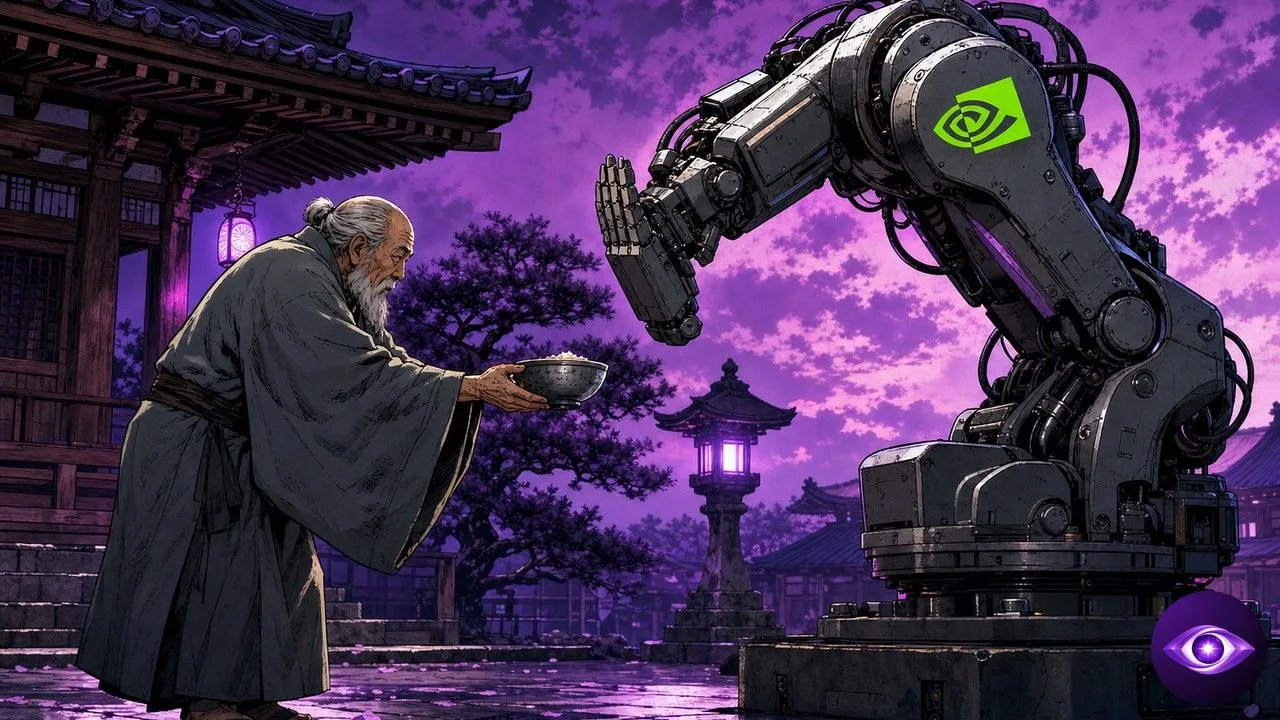
Japan wants 10 million AI robots running across 18 sectors by 2040, backed by $65 billion in public and private investment. Jensen Huang’s Tokyo visit on July 15 and 16 locked ten Japanese industrial groups onto Nvidia’s Cosmos models.
Key Takeaways
- National target: 10 million AI robots across 18 sectors by 2040.
- The Noetra programme gathers about 44 firms and up to 1 trillion yen in public funding.
- Japan is chasing more than 30% of a market valued near $133 billion.
Have an AI Sum Up This Article
ChatGPTForty-four firms and a trillion yen behind Noetra
The Noetra programme brings together roughly 44 Japanese companies, with SoftBank, Sony, NEC and Honda as core members. The state is putting in up to 1 trillion yen, or $6.2 billion over five years.
The roadmap runs in three steps. A reasoning model in fiscal 2026, an omni-modal version in 2028, then a real-world native AI built for robots in 2030.
The infrastructure tracks the same curve. The data centre planned for 2028 will run 13,750 Vera CPUs and 27,500 Rubin GPUs for 140 megawatts, a scale that puts Japan in serious sovereign territory.
Timelines like this stay exposed to the supplier. Nvidia has already slipped a full hardware generation, a delay we laid out when the next rack moved out to 2028.
The robotics plan sits inside a much larger macro ambition. Tokyo is modelling 370 trillion yen of public and private investment by 2040, about $2.3 trillion spread across 17 sectors.
The shape of the programme is worth noting. Public money lands upstream, on building the model and the infrastructure, while the industrial rollout stays on the balance sheets of the member companies.
That marks a real break from the American and Chinese paths. Where private labs set the tempo and the state follows behind, Japan writes the roadmap first and then hands out roles to its industrial champions.
A reasoning model as early as fiscal 2026 also signals that the country is not stopping at mechanics. The software layer is being treated as a sovereign component in the same way the robotic arm is.

Ten Japanese industrial groups line up on Cosmos
Ten major groups committed to building on Nvidia’s Cosmos models. Fanuc, Yaskawa, Kawasaki Heavy, Fujitsu, Hitachi, NEC, Sony, SoftBank, Kubota and the AIRoA group form the industrial base of the operation.
The makeup of that list carries the message. It holds the two largest robotic arm makers in the world, a farm machinery builder and three electronics groups, meaning the full chain from the arm to the embedded software.
The stated target assumes a market shift. Japan wants more than 30 percent of global AI robotics by 2040, in a market valued around 20 trillion yen, roughly $133 billion.
The industrial logic matches the country’s demographics. Japan is short of hands in logistics, farming and care work, and pushing AI robots into 18 sectors implies diffusion far beyond the car plant.
For Nvidia the stake runs past card sales. Making Cosmos the base layer of an entire national robotics industry means planting a software standard for fifteen years.
The trade-off on the Japanese side is real. Building industrial sovereignty on the software layer of an American supplier creates a long-term dependency that a public budget does not offset.
For European and Korean rivals, ten industrial groups converging on one base closes a door. Every year spent inside that ecosystem makes a later migration more expensive, exactly as it works in high performance computing.
The whole bet also rests on one strong assumption. It takes for granted that real-world models will deliver by 2030, in what is currently the least mature field anywhere in the chain.
More articles on Horizon
- Alibaba Ships Qwen 3.8, Its Biggest AI Model Yet
- Gemini 3.5 Pro Delayed Again as Google Rebuilds It
- Kimi K3 Closes the Gap With Top US AI Models
What happens to your role when the plant runs itself
Ten million AI robots across 18 sectors is not an assembly line story. Logistics, warehousing, farming, maintenance and care work all shift in the same move.
Nvidia’s chief executive defends an optimistic reading of this transition, and we reported it as stated when Jensen Huang argued AI is creating an enormous number of jobs. His view deserves a hearing, and it also comes from the sector’s main supplier.
The available employment data does not point one way everywhere. We showed how far the indicators diverge when one firm measured a rise while another counted net job destruction.
What sets the Japanese plan apart is that it leaves no ambiguity. A country has published a machine target per sector, a public budget, a schedule and a supplier, and that level of planning leaves workers very little room to improvise.
The most exposed roles are the ones whose value rests on repeating a gesture or a procedure reliably. The roles that hold are the ones that arbitrate, inspect, fix the unexpected and carry responsibility for a decision.
The date to watch is not 2040. It is the three steps in 2026, 2028 and 2030, because each one reaches hiring plans long before it reaches unemployment figures. Understanding which half of your work survives the removal of its repeatable part is the practical question, and the full study on what AI is actually doing to work lays out where that line currently falls.
One YouTube channel keeps returning to this question, and the subject is met head-on in this breakdown of what the Nvidia boss predicts for the job market.
Follow the story on Horizon.