

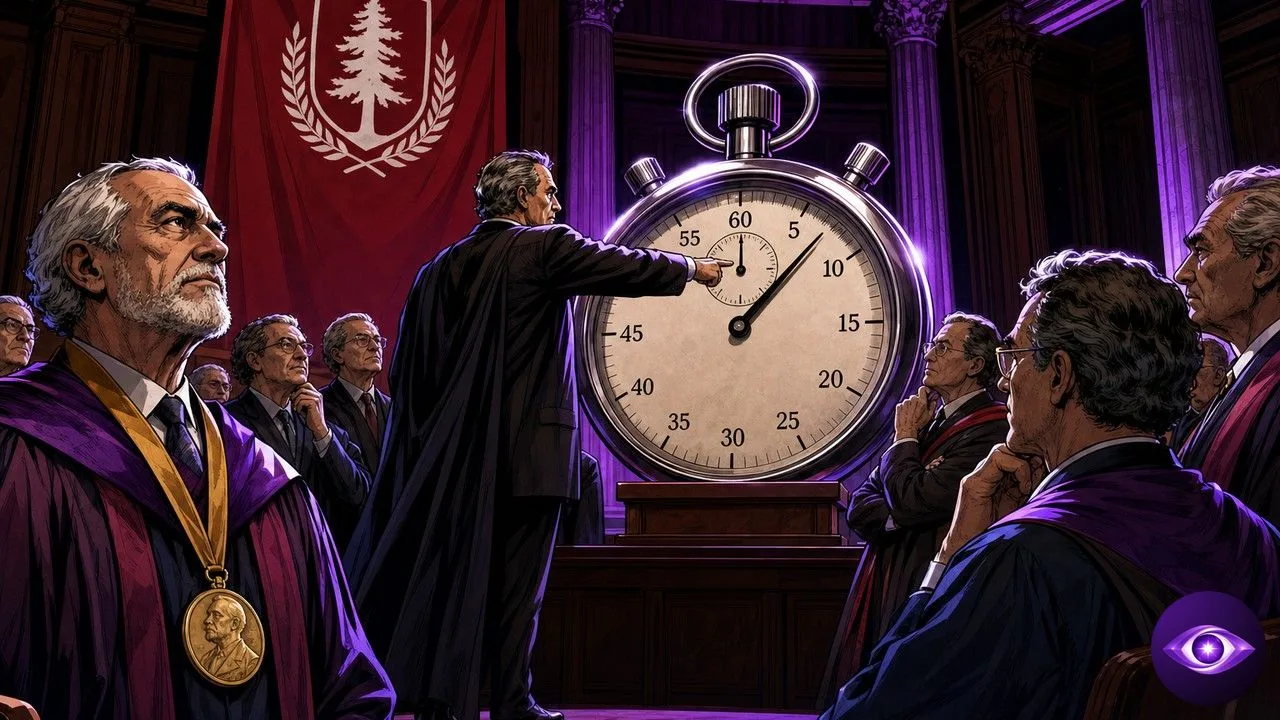
Sixteen Nobel Laureates in economics and more than two hundred researchers have signed a joint statement published by the Stanford Digital Economy Lab under the title We Must Act Now. The message is blunt: AI could become radically more powerful over the next ten years, and economic institutions no longer have the century of adjustment that steam or electricity once allowed.
Key Takeaways
- 16 Nobel Laureates in economics and 200 plus researchers signed a joint statement titled We Must Act Now, hosted by the Stanford Digital Economy Lab.
- The group argues AI may advance radically over the next decade and that the window for adapting public policy is closing fast.
- The signatories call on economists, policymakers and tech leaders to coordinate an immediate action plan.
Have an AI Sum Up This Article
ChatGPTSixteen Nobel Laureates, two hundred economists, one text
The statement went online on July 13 through the Stanford Digital Economy Lab, led by Erik Brynjolfsson. It packs a full call to action into a single page, laid out inside a statement titled We Must Act Now, hosted by the Stanford Digital Economy Lab. The signatory list is what hits first.
Sixteen Nobel Laureates in economics sit at the top of the page. They include Joseph Stiglitz, Daron Acemoglu, Paul Krugman, Ben Bernanke, Michael Spence, Simon Johnson, Paul Milgrom, George Akerlof, Philippe Aghion, Peter Howitt, Oliver Hart, Bengt Holmström, Alvin Roth, Michael Kremer, Roger Myerson and Christopher Pissarides. The inner circle also carries names like Ajay Agrawal, Anton Korinek and Tom Cunningham.
The push comes from Brynjolfsson, a long standing figure of the digital economy field at Stanford. He has argued for years that recent general purpose AI reshapes productivity shocks the economy usually studies over decades. The statement itself is signed personally by Brynjolfsson and by the leading Nobel Laureates active on technical progress, labor markets and inequality.
The intellectual density of the group is above what previous public AI letters have delivered. The Bletchley signatures, the Center for AI Safety letter or one off op eds gathered machine learning researchers and lab CEOs. Here it is the authors who write the graduate school textbooks on technical progress who are stepping in, with the same names economics students have been reading for two decades.
The dedicated site sits at wemustactnow.ai, with a Stanford contact address. No long PDF, no detailed quantitative report behind it. The text runs a few paragraphs, and that is a deliberate choice: the group is not trying to push a technical plan, it is trying to move the political and academic agenda. On the employment side, the statement builds on other quantitative work covered in our piece on the Ramp and Goldman AI jobs data.

Decades for steam, years for AI: the Korinek signal
Anton Korinek, an economist at the University of Virginia and an active co signatory, delivers in the statement the analogy that frames the whole thing. He writes that steam, electricity and computers each gave societies decades to adjust, while AI may give us only a few years. That time compression is the core of the alert.
The historical read holds. Steam took a full century to reshape British industry, electricity spread through American factories between 1880 and 1930, and the personal computer needed three decades to move from the lab to homes and then pockets. Every wave left time to redesign education pipelines, rewrite labor regulation and build the statistical indicators to track the change. That margin is disappearing.
Brynjolfsson extends the point with a second line quoted directly in the statement: AI capabilities are advancing far faster than our understanding of their economic implications. The imbalance is structural. Frontier models ship on a quarterly cycle, while large public labor surveys take years to be designed, funded and released.
The group is careful not to quantify the speed. No job displacement figure, no sector penetration rate appears in the call. That is a choice. Quantifying would have pinned the debate on a contestable projection. Staying qualitative keeps the policy conversation open, without locking decision makers into a specific range they would then have to defend.
The horizon given is the decade. AI may become radically more powerful over the next ten years, the group writes. That ten year framing lines up with the public roadmaps of the leading frontier labs and with the cumulative AI infrastructure spending scenarios on the same window. The signatories anchor their alarm on the same clock, which makes the call actionable for a ministry or a central bank.
More articles on Horizon
- LinkedIn Hosts 41% of AI-Written Long Posts
- Claude Code Now Has a Built-in Web Browser
- Anthropic Extends Fable 5 Promo Through July 19
What the group asks, and who gets the ask
The text names three target audiences: economists, policymakers and tech industry leaders. Each is asked to do a specific piece. Economists should deepen the research on macro and distributional implications. Policymakers should build the institutions and policies that ensure AI complements human capabilities. Tech leaders should align their rollouts with that frame. The share of work is explicit.
Daron Acemoglu, quoted on the page, sums it up in one line: he is glad to join the other experts calling for the urgent need to redirect AI so risks are minimized. The verb redirect matters. The group is not asking to slow AI down, it is asking to change its trajectory, with documented economic and institutional tools.
The competitive backdrop is loud. The call lands as Anthropic has publicly conceded that Claude is used far more for office work than for coding, which shifts the read on sector impact. It also lands after the financial noise around OpenAI, which is pushing credit rating agencies to reassess the infrastructure commitments taken by Oracle. The economics group positions itself right in that zone of uncertainty.
On deployment, Ford’s decision to rehire three hundred and fifty engineers after a generation of heavily AI assisted code failed on quality illustrates the type of incident the Stanford call is trying to help frame. We covered that case in our piece on Ford rehiring its engineers. The question is no longer whether AI is reshaping jobs, but how fast the institutions can absorb the reshape.
The political follow up is open. A Stanford statement does not mechanically produce a European directive or a US executive order. But when the signatures read Stiglitz, Krugman, Bernanke, Acemoglu and thirteen more Nobel Laureates of the same rank, the media and institutional window closes more slowly. The coming weeks will show whether the text becomes a reference for finance ministries or stays in the academic footnotes.
The real test is the budget calendar. The European autumn finance window and the US budget vote are the next two moments where an AI economy preparation plan could slide into existing research, continuing education or public statistics lines. Without commitment at those points, the call remains a strong cultural signal without a fast operational follow through.
Follow the story on Horizon.


