

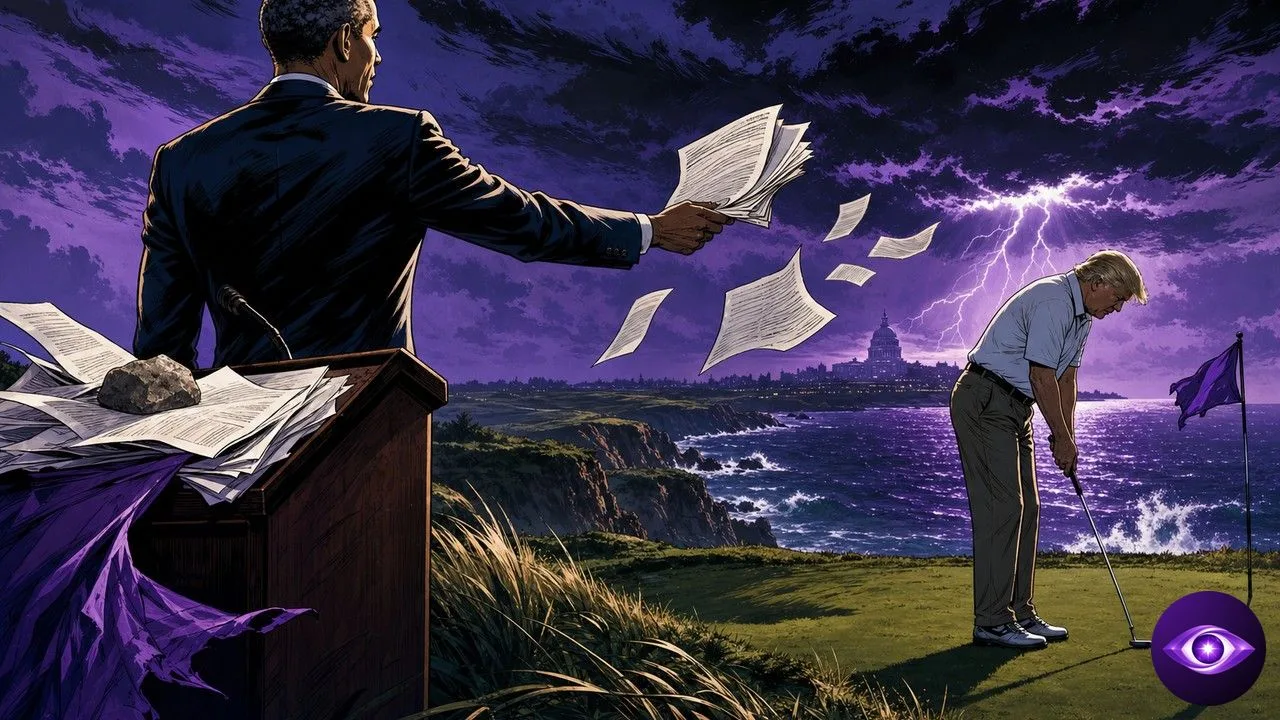
Interviewed by Hakeem Jeffries at a Democratic fundraiser on September 13, Barack Obama told his party to make artificial intelligence a central agenda item and to build a framework before it wins back the House. A day later, speaking from Ireland, Donald Trump waved away the idea of holding the technology back.
Key Takeaways
- Obama calls it dangerous to let the technology move this fast in private hands.
- He turns down both labels in the debate and says he acts as a sounding board for lab executives.
- Trump answers that he will not hand America’s lead over to China.
Have an AI Sum Up This Article
ChatGPTWhat Obama Asks of His Party Before the Midterms
The remarks came in front of Democratic donors, in an interview format run by the House minority leader. Obama set a simple instruction: artificial intelligence belongs on the party’s central agenda, backed by a very clear plan covering the economic impact and the safety side.
His hardest line lands on pace and on ownership. Obama describes a technology moving very fast in private hands, and calls the situation dangerous if nobody gets on top of it. The White House still vetted the GPT-5.6 rollout customer by customer, which proves a lever already exists.
The method fits in one sentence. Put together a framework for a very public conversation, once the House majority is back. That puts the timing squarely inside the electoral calendar and signals that no text is coming before it.
Obama took care to shake off both established camps. He turns down the accelerationist label along with the doomer one, and points to concrete upside, starting with drug research moving fast enough to reach diseases that have no answer today.
The economic half of that plan is the harder one to write. Safety rules can borrow language from existing safety regimes, while the employment question forces a party to say out loud which jobs it expects to disappear and what it intends to do about them.
The most revealing detail concerns who he talks to. Obama says he acts as a sounding board for people running the sector, and cites conversations with the head of Anthropic and the head of OpenAI.
A former president with that level of access carries a specific kind of weight. He has no vote, no veto and no agency to run, so what he offers his party is framing, and framing is exactly what Democrats currently lack on this file.
The timing puts him forty-eight hours behind a call for restraint from inside the industry. Anthropic’s founder committed his company to letting outside evaluators into its systems, then asked governments to coordinate on the rest.

Trump Answers From an Irish Golf Course
The executive branch replied from Ireland, on the sidelines of the Irish Open, in an exchange with reporters. Trump played down the need to check the development of artificial intelligence and pulled the subject back to the contest with China.
His phrasing sums up the doctrine: whoever wins with AI wins. The president grants that guard rails are possible, then stops short of naming a single rule.
The rest of his answer moves the argument onto motives. Trump puts the warnings about speed and thin oversight down to negative forces he leaves unnamed.
What the answer leaves out is as telling as what it contains. No agency is named, no threshold is put forward, and the burden of proof sits with whoever asks for a rule rather than with whoever ships a model.
Diplomacy gives him another reason to hold that line. Xi Jinping is due to meet Trump in the United States before the end of the month, with artificial intelligence among the files on the table.
This administration has already reached for regulatory levers when national security was in play. Control runs through channels that never touch a statute.
Read together, the two positions are less opposed than they look. Both men treat the technology as a matter of state, and they split on the instrument rather than on the stakes.
More articles on Horizon
- Astra Agent Runs a Shop and Flies a Drone
- OpenAI Asks Congress If Slowing AI Down Is Legal
- Claude Max Buyers Sue Anthropic Over Usage Limits
What the Missing Framework Changes for Deployers
For a team shipping models in the United States, the sequence confirms the regime in force. No new federal obligation is coming before the midterms, and the real constraints keep arriving through contracts, insurers and procurement desks.
That uncertainty carries an operational cost. A compliance setup built for a federal framework that never arrives ends up assembled from state rules that diverge, and every month of drift adds a layer to that debt.
Companies in the sector priced this vacuum in long ago. Their public affairs teams work legislators state by state, where texts actually move, and treat Washington as a watching brief instead of a negotiation.
Procurement is where the effect shows up first. A federal buyer with no statute to point at writes its own clauses, and vendors end up negotiating safety commitments contract by contract with terms that vary from one agency to the next.
On the lab side, the gap between the two speeches becomes an asset. The self-regulation announced this week fills the space politics leaves open, and sets the bar itself while no authority does.
European teams read the same sequence differently. A company already building for the AI Act carries its compliance work across the Atlantic at little extra cost, and an American framework arriving late would mostly reshuffle who bears that cost.
This year’s precedents show Washington preferring direct holds to general law. The administration looked at taking an equity stake in OpenAI, an approach that buys influence without creating an obligation the whole sector can be held to.
The next signal worth watching is what the Democratic framework Obama asked for actually contains. A document setting thresholds and audit duties would change the nature of the debate, while one more statement of intent leaves the sector writing its own rules until the next Congress.
Follow the story on Horizon.