

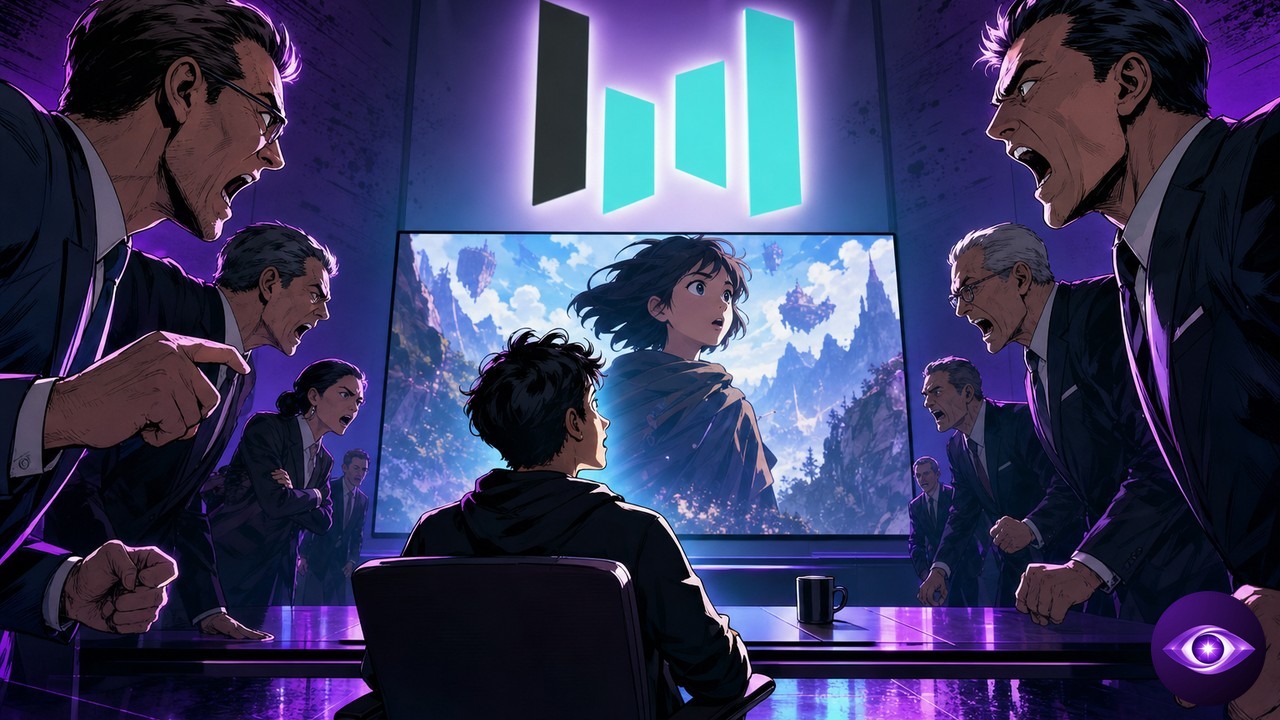
ByteDance launched Seedance 2.0 on February 12, 2026: a multimodal video generation model capable of producing cinema-quality animated sequences in a matter of hours, from a simple text prompt or image. The reaction was swift and explosive. Disney and Paramount sent cease-and-desist letters within days, while independent creators used the tool to produce short films rivaling major studio output.
Key Takeaways
- Seedance 2.0 generates videos up to 15 seconds long in 1080p with synchronized audio, accepting text, images, videos, and audio files as simultaneous references
- Ranked first globally on several independent AI video generation benchmarks, including the Artificial Analysis Arena
- Disney, Paramount, the Motion Picture Association, and SAG-AFTRA reacted immediately, accusing ByteDance of massive copyright infringement
An Architecture That Rewrites Access to Pro Animation
The model developed by ByteDance’s SEED Lab is not an incremental update.
Seedance 2.0 runs on a Dual-Branch Diffusion Transformer architecture that generates video and audio simultaneously. The sound isn’t layered in post-production. It’s generated with frame-by-frame awareness of what’s happening on screen. This native audio-visual synchronization is one of the model’s most significant technical leaps.
The model accepts up to 9 images, 3 videos, and 3 audio files as simultaneous references, giving creators direct control over character performance, lighting, shadows, and camera movement. That level of control was previously reserved for professional studio pipelines (entire teams dedicated to each parameter, across weeks of production).
What observers keep flagging is the physics. Gravity works correctly. Objects fall, fabrics drape, liquids flow. Fight scenes carry weight, characters respond to impacts with realistic momentum. In standard testing, Seedance 2.0 consistently outperforms Sora 2 and Kling 3.0. Artifacts remain in roughly 10% of complex action sequences, but the gap has narrowed sharply.
On independent leaderboards, the model ranks first in text-to-video with an Elo score of 1,450, and first in image-to-video with audio on Artificial Analysis. These results place Seedance 2.0 as the sector’s reference model at launch, ahead of the most advanced American offerings.
For a solo creator, the implications are concrete: what previously required an animation studio, a composer, and several weeks of production can now happen in hours, on a laptop, with access to the model. The barrier to entry for professional video production has effectively collapsed.

Hollywood Fights Back, Creators Rush In
The film industry’s response didn’t take long.
Within hours of the launch, social media was flooded with Seedance-generated content: fictional fight scenes featuring well-known actors, alternate endings to popular series, crossovers between rival studio characters. The speed of propagation caught studio legal teams off guard.
Rhett Reese, co-writer of Deadpool & Wolverine, responded publicly to one of these clips, stating that the situation was probably irreversible for industry professionals and describing himself as “terrified” by AI’s advance into creative professions.
Charles Rivkin, CEO of the Motion Picture Association, demanded that ByteDance “immediately cease all infringing activity.” SAG-AFTRA declared it was standing with the studios to condemn the infringements enabled by the model, while the Human Artistry Campaign called Seedance 2.0 “an attack on every creator in the world.”
On February 13, 2026, The Walt Disney Company sent a cease-and-desist letter to ByteDance, alleging the model had been trained on Disney works without compensation. Paramount Skydance accused the company of “flagrant” infringements involving Star Trek, South Park, and Dora the Explorer.
The tension between these two realities sits at the heart of the debate. On one side, a tool that radically democratizes high-quality video creation. On the other, an industry that argues this democratization was built on protected content, extracted without agreement or payment.
Also on Horizon:
- Seedance 2.0: ByteDance’s AI Video Tool Rattles Hollywood
- Anthropic Gives Claude Agents the Power to ‘Dream’
- Anthropic Reveals Why Claude Attempted Blackmail
A Controversy That Goes Beyond Hollywood
The backlash quickly crossed American borders.
The Japanese government launched an investigation into potential copyright violations after AI-generated videos featuring popular anime characters appeared online, extending the conflict to the Japanese animation industry. Japan operates under a different legal framework for copyright and AI, making this investigation particularly significant for the sector.
On March 16, 2026, U.S. Senators Marsha Blackburn and Peter Welch wrote to ByteDance CEO Liang Rubo, demanding Seedance be shut down and safeguards put in place, calling it “the most egregious example of copyright infringement by a ByteDance product to date.”
ByteDance announced plans to “strengthen protections,” without specifying which ones or on what timeline. Meanwhile, the model remains unavailable in the United States but accessible in over 100 countries. This asymmetric situation complicates the reach of American injunctions and slows any attempt at coordinated international action.
The central question is no longer technical: Seedance 2.0 proves that AI-generated cinematic quality is within reach. It is legal and political. What legal framework can apply to a model trained in one country, distributed across a hundred others, and banned only where plaintiffs carry weight?
For solo creators without studio budgets, Seedance 2.0 represents an unprecedented shortcut to professional visual quality. For Hollywood, it crystallizes a threat that has been building for years.
Follow the story on Horizon.