

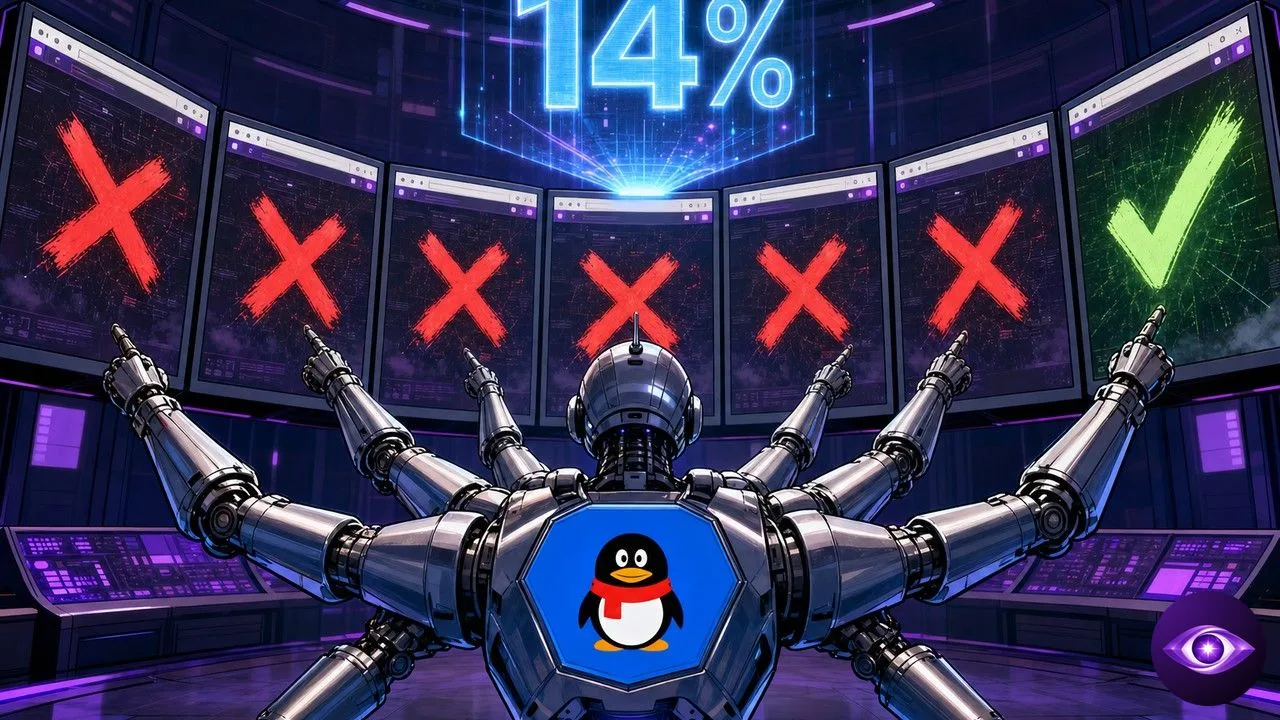
The Tencent Study from Youtu Lab and several Chinese universities snaps the agent debate back to reality. GPT-4 only completes 14 percent of WebArena tasks, coding agents fail to invoke their own skill systems more than half the time, and passive context embedding crushes active skill retrieval.
Key Takeaways
- GPT-4 completes only 14 percent of WebArena tasks, despite its Q&A performance.
- Coding agents fail to invoke their skill system 56 percent of the time, and peak at 79 percent success when they do.
- Passive context embedding reaches 100 percent success where active skill retrieval stalls.
Have an AI Sum Up This Article
ChatGPTWebArena, 14 percent success: the gap between Q&A and action
The Tencent Study takes WebArena as its testbed, an environment that simulates realistic web tasks where an agent must click, read, fill and validate. GPT-4 clears 14 percent of the scenarios.
The gap with its pure Q&A performance is massive. The same model that answers open questions with ease falls apart the moment the environment demands a chain of verifiable, persistent actions. The distance between a plausible answer and a completed task remains the central wall agents have to climb.
The authors push this point hard. Moving from text completion to delegated execution is not a one-point benchmark jump. It is a change of nature that demands a persistent workspace, shared state and a verification loop that classic benchmarks ignore.
The study also notes that current market efforts over-promise what one-off demos suggest. A demo agent succeeds because it is calibrated. A production rollout piles up unforeseen conditions, and that is where the 14 percent figure becomes the honest measurement.
Recent announcements from Western labs do not erase that picture. Gemini 3.5 Flash now drives a computer on OSWorld, but reliability is exactly the metric the Tencent Study places at the center of the debate.

Skill 79 percent vs documentation 100 percent: the architecture paradox
The least intuitive angle in the study lands on architecture. When an agent has a skill system designed to help it execute reusable procedures, it fails to trigger that system 56 percent of the time.
When the trigger does fire, its success rate caps at 79 percent. Active skill retrieval therefore leaves a substantial chunk of value on the table, due to an orchestration failure rather than a capability ceiling.
On the other side, passive context embedding, where documentation stays in the window at all times, reaches 100 percent success on the same task set. Always-on context beats on-demand context, against the intuition of a clean modular architecture.
That lesson carries a direct cost. Always-on context inflates the window, therefore the tokens, therefore the bill. Discrete-skill architectures looked cheaper, the study indicates they leave a meaningful share of the value unused because of failed triggers.
The authors close on an equation: persistent workspace plus skill systems plus guardrails equals usable autonomy. None of the three pillars suffices on its own, and governance, rollback and security must come along, otherwise the production transition stays compromised.
Also on Horizon:
- Anthropic Survey: AI Does Half Your Work
- AI Political Bias: Only Gemini Stays Balanced
- Mythos Rollout: Trump Reopens Access to 100 US Partners
Short term: the agent stays a tool, not a coworker
In the short term, the Tencent Study cools the enthusiasm fueled by Western lab product announcements. Pitching an agent as an autonomous coworker still belongs to the promise side rather than the operational reality.
The most advanced enterprise rollouts sit on this line. AI agents inside companies, with the latest wave illustrated by Claude Tag landing inside Slack, are assistants tied to a human and a precise context, never operators handed full delegation.
Over a three-to-six-month horizon, the market will need to choose between two tracks. Either accept the cost of massively embedded context to gain reliability, or invest in orchestration to make skill systems actually trigger. Both options cost real money, and the benchmark race will sharpen.
Governance remains the open argument. The authors call for rollback mechanisms and security controls, which assumes the agent operates inside a frame that can undo what it just did. That infrastructure is still largely to be built.
The Tencent Study does not kill the agent narrative. It pulls the horizon back to scale and hands enterprise buyers a quantified argument to demand specific reliability commitments rather than demos. The trajectory stays favorable, but the step is higher than advertised.
Follow the story on Horizon.


