

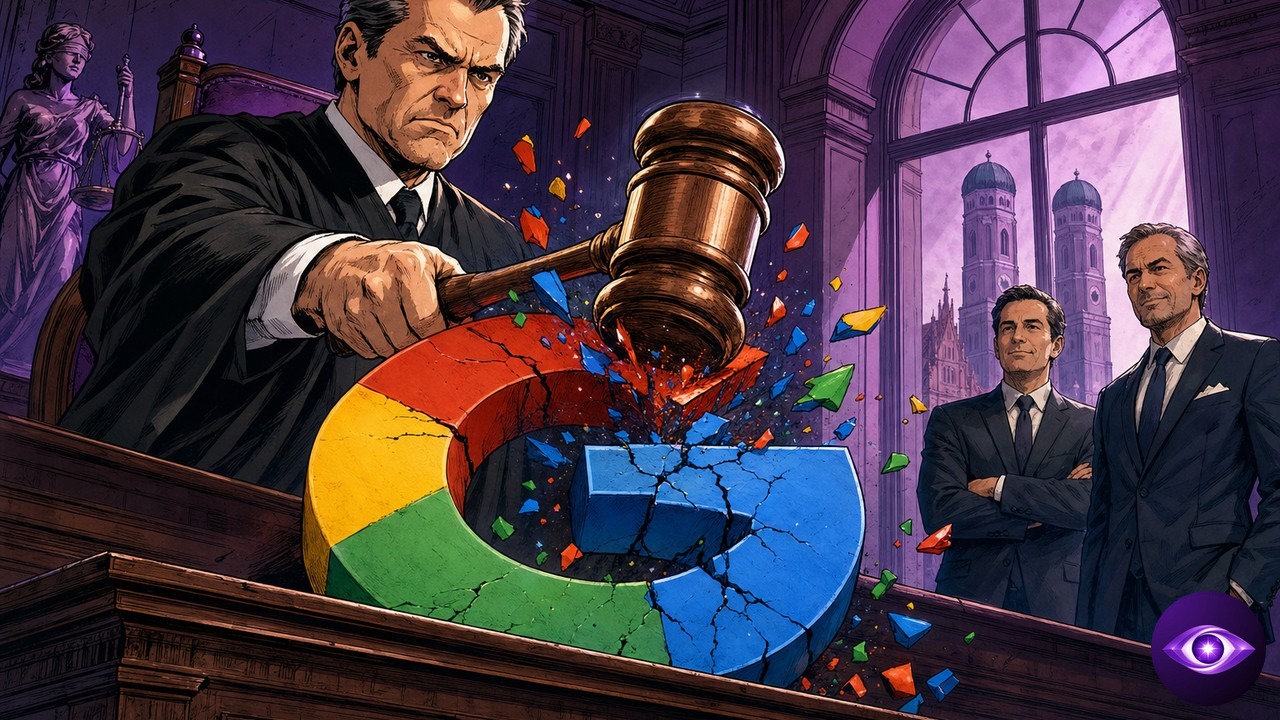
The Munich Regional Court rules that Google AI Overviews are Google’s own words, not neutral search snippets. A temporary injunction blocks Google from repeating false claims about two Munich publishers. OpenAI and Perplexity are next on the list.
Key Takeaways
- Munich says Google now speaks instead of just indexing.
- Google pays 80 percent of the legal fees, each plaintiff 10 percent.
- The same logic could apply to OpenAI and Perplexity.
What Munich actually ruled
The Munich Regional Court issued its decision on May 28, 2026, in case 26 O 869/26. The case pitted two Munich publishers against Google after several false answers generated by Google AI Overviews. The temporary injunction bars Google from repeating those claims.
The judges found that Google AI Overviews tied the publishers to scams and subscription traps. None of the indexed sources contained those accusations. For the court, those statements belong to Google itself.
The reasoning fits in one sentence. The AI summary is “understandable on its own” and constitutes “a self-contained statement”, with no reference to other possible interpretations. That alone is enough to push Google from host to author.
The cost split signals the scale of the loss. Google bears 80 percent of legal fees, each plaintiff just 10 percent. That ratio is unusual in this kind of dispute, and it carries symbolic weight as much as financial weight.
The injunction is provisional but takes effect right away. Google must prevent the same claims from reappearing in Google AI Overviews without waiting for a full trial. It is the first European decision of this caliber on an AI summary.

From search engine to publisher, what changes for Google
The legal status of Google AI Overviews just shifted in Germany. Until now, Google relied on search engine case law to claim indirect liability only. Munich cuts that link and places AI summaries in the editorial content bucket.
The business model of AI Overviews depends on how often they show up. They sit at the top of the page, capture attention and shorten clicks to publisher partners. When each summary becomes a statement Google is on the hook for, the risk compounds at the same pace.
In the short term, Google has to tighten its guardrails. Stricter filtering, faster human review and probably preventive takedowns on sensitive topics the moment a doubt appears. The same logic Google already applies to defamatory content on YouTube.
In the medium term, the math changes for publishers. If Google answers in their place and uses its own voice, the pressure to share ad revenue grows. The European debate on content remuneration just gained one more argument, in line with the Apple settlement over false AI advertising.
It also hits at the wrong time for Google’s pricing strategy. Cheaper consumer tiers are now in play, as the recent Google AI Plus price drop to $4.99 showed. AI margins are a real topic, and every lawsuit is one more line on the cost side.
Also on Horizon:
- Milei pushes AI-only companies, no humans required
- Warner Music grabs Sureel AI to police generative tracks
- xAI Grok engineer sues over firing for safety alarms
Knock-on effect on OpenAI, Perplexity and generative AI
The scope of the case goes beyond Google. The court points out that at the scale of a search engine handling billions of queries, even a 91 percent accuracy rate produces millions of wrong answers every hour. The same reasoning transfers to OpenAI and Perplexity without any tweak.
OpenAI rolls out more and more summaries and synthetic answers through ChatGPT Search. Perplexity built its whole product on that surface. Both have so far limited their legal exposure by framing themselves as assisted research tools. Munich pushes a different signal.
Europe will likely be the testing ground. The terrain is already prepared by the AI Act and by the Digital Services Act. A German judge can now lean on this decision to qualify a model’s output as editorial speech, and to grant fast injunctions.
In the short term, European publishers will test other AI providers on the same playbook. A coordinated complaint would be the natural next move. Legal costs then stack on top of compute costs and warp the unit economics of consumer AI products.
In the medium term, Google AI Overviews and their peers may have to wear an editorial badge. A transparency notice, full source traceability and a clear user recourse. The standard is taking shape, and this time it comes from a court, not a regulator.
Follow the story on Horizon.