

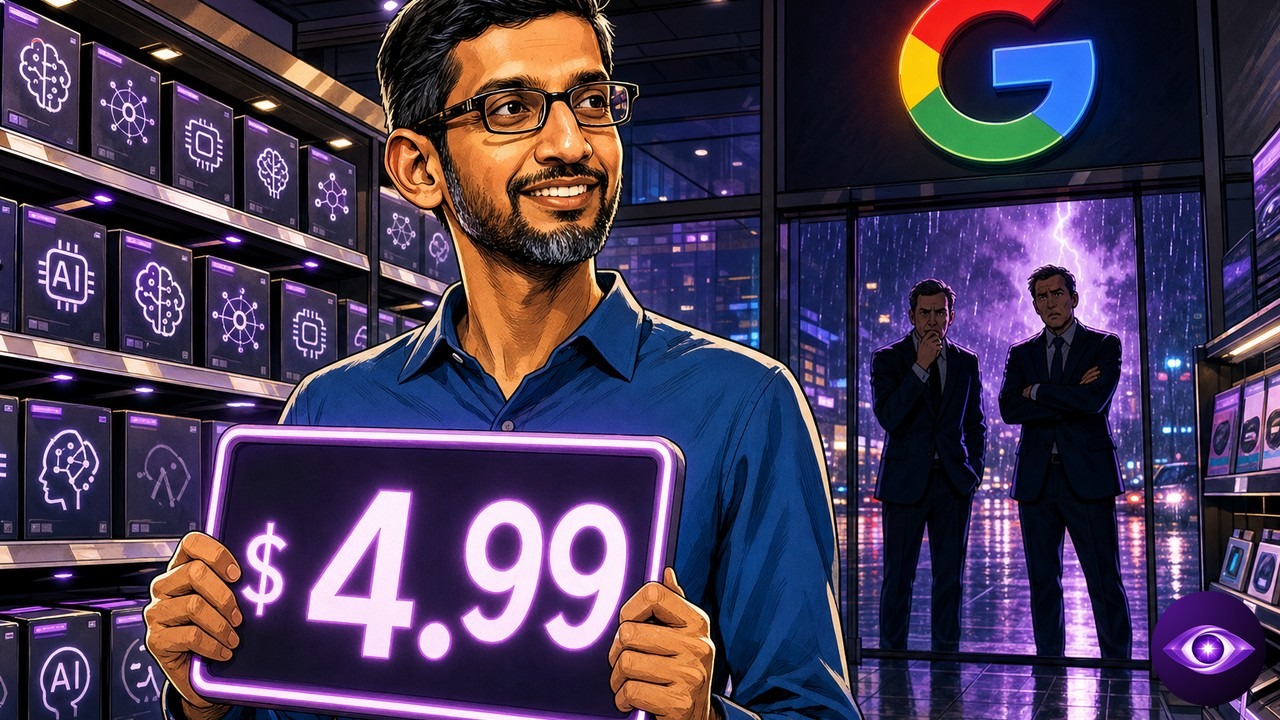
Google AI Plus is cut from $7.99 to $4.99 per month in the United States, with storage doubled to 400 GB. The sub-$5 tag, until now reserved for emerging markets, lands on American soil. The move puts OpenAI and Anthropic under direct pressure just months before their respective IPOs.
Key Takeaways
- Google AI Plus drops from $7.99 to $4.99 per month, with storage doubled to 400 GB
- The emerging-market price (ChatGPT Go in India, AI Plus in India) now lands on the US market
- OpenAI and Anthropic are heading into IPO season without an equivalent pricing answer
Have an AI Sum Up This Article
ChatGPTGoogle AI Plus sliced overnight
The budget tier of Google’s lineup just shifted. Google AI Plus drops from $7.99 to $4.99 per month in the United States, a 37.5% mechanical cut. The rollout is scheduled within days, with no transitional pricing for existing subscribers.
Storage doubles in the same move. Google AI Plus subscribers go from 200 GB to 400 GB at the lower price. The company degrades no peripheral service, segments no model access, and trims no usage quota. It is a clean cut with no offsetting downside for the end user.
The lineup stays structured in three layers. Plus at the entry, Pro in the middle, Ultra at the top. The new grid mechanically widens the gap between the budget tier and the rest, pushing users to compare Google AI Plus against rival subscriptions that have stayed around the 20-dollar mark.
The timing, just ahead of OpenAI’s and Anthropic’s IPO windows, is not coincidental. Google sends a signal to markets as much as to users. The model layer is now treated as a mass-consumer product, with low prices and aggressive bundling.

The emerging-market playbook lands in the US
The sequence started far away. In August 2025, OpenAI launched ChatGPT Go at roughly $4.60 per month in India, the first sub-5 dollars plan from a major player. Google responded in December 2025 with a sub-$5 AI Plus plan on the same market.
What Google is doing today is importing the India-calibrated pricing grid into the United States. The “undercut, bundle, capture users” strategy moves from emerging-market test to mainstream playbook on the premium core market.
Anthropic sits in a different position. The company has introduced no budget tier, no localized grid, and no plan below 10 dollars on any market. Its enterprise and tech-product positioning still holds, but the window to stay on that lane without reacting is narrowing fast.
In the short term, the Google AI Plus move forces rivals into three options. Follow the cut and compress their margins. Bundle aggressively with other services. Or commit to an isolated premium positioning that will become harder and harder to defend commercially. At the same time, Google is building Remy, a personal AI agent designed to operate 24/7, reinforcing the company’s push to make AI ubiquitous and cheap. For context, see our earlier piece on Horizon: Google Is Building Remy, a Personal AI Agent 24/7.
Also on Horizon:
- China cuts 12,000 university degrees made obsolete by AI
- 79% of parents already use AI to raise their kids
- GPT-5.5 Instant beats doctors on health answers
Commoditization is closing in on foundation models
The analysis is coming straight from investors themselves. According to Chi-Hua Chien, managing partner at Goodwater Capital, infrastructure companies always end up aggressively commoditized, because the end customer is trying to move its bits as cheaply as possible.
The parallel he draws is brutal. Cisco, Oracle, and Akamai each had their dominance phase, then a margin compression once the underlying infrastructure went mainstream. Foundation model makers like OpenAI and Anthropic would be on the same curve, with the premium window closing faster than expected.
The IPO timing weighs heavily. OpenAI and Anthropic need premium valuations to justify their raises and the comparables their bookrunners will pitch to institutional investors. A price war pulled by Google AI Plus mechanically erodes the long-term gross margin assumptions baked into those decks.
Over the medium term, the trajectory will be set by ability to monetize beyond the API and the consumer subscription. Commercial agents, vertical integrations, tool marketplaces, multi-year enterprise contracts. Players stuck on the “charge per token” model will be the most exposed to the compression that Google AI Plus just kicked off.
The remaining unknown sits with Apple and Microsoft. Neither has reacted publicly to the announcement. Their arbitration, especially on the M365 Copilot and Apple Intelligence bundles, will set the real depth of the price war over the next six months.
Follow the story on Horizon.



Pingback: Google Assistant Shuts Down on September 4 - Horizon IA
Pingback: Google Search: The End of the Classic Search Engine - Horizon IA
Pingback: Google Is Building Remy, a Personal AI Agent 24/7 - Horizon IA