

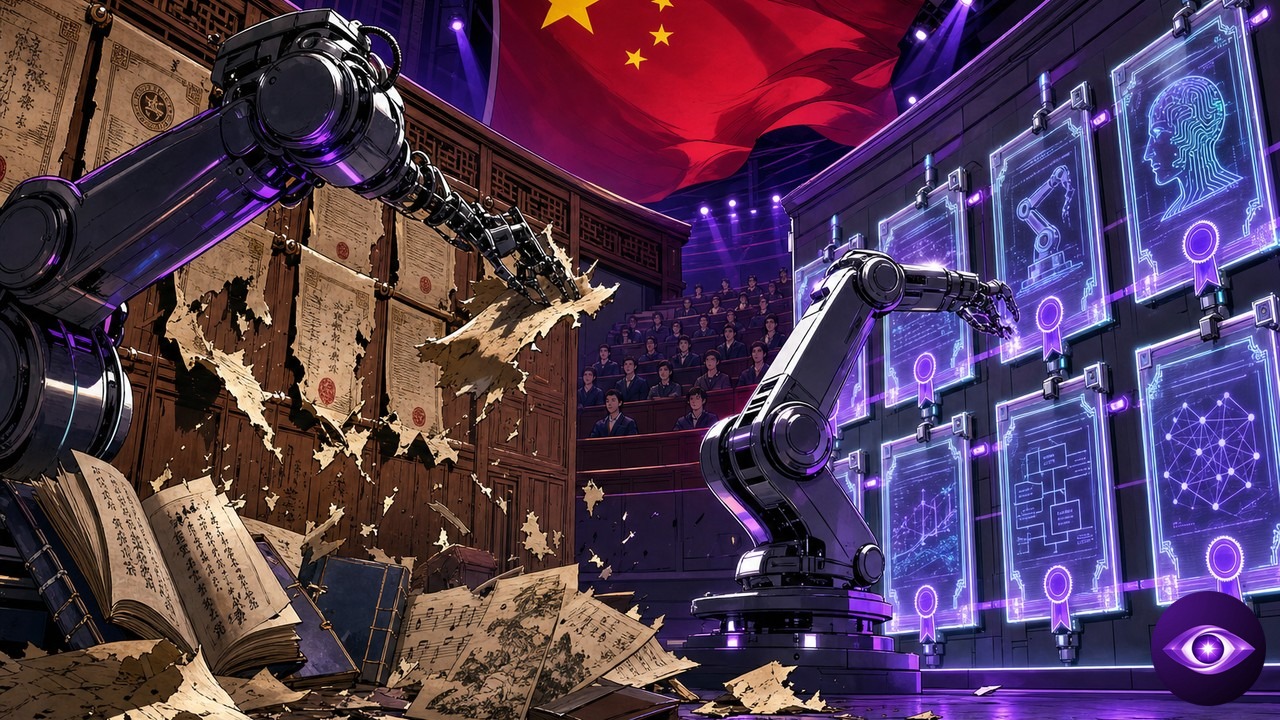
China’s Ministry of Education has revoked 12,200 university degree programs between 2021 and 2025, more than 30% of the national offering, replacing them with 10,200 new majors built around AI, robotics and semiconductors. The overhaul lands as 12.7 million young Chinese hit a saturated job market.
Key Takeaways
- 12,200 degree programs cut in China between 2021 and 2025, 10,200 created
- New majors: AI, robotics, semiconductors, embodied intelligence
- 12.7 million graduates in 2026 against a youth unemployment rate above 16%
Have an AI Sum Up This Article
ChatGPTA 30% rewire of China’s university system
Over four years, Beijing has revoked or suspended 12,200 undergraduate degree programs across the national university network. Over the same period, 10,200 new programs were created. In total, more than 30% of China’s academic offering has been reshuffled.
The disciplines targeted by the cuts are precise. Arts, humanities, foreign languages and management account for the bulk of removals, judged oversized or weak on employment outcomes. China’s Ministry of Education, whose figures were relayed by Xinhua, openly calls these programs obsolete.
The scale is unprecedented. No major higher education system has rotated its degree offering this fast over such a short window. The move is centrally driven and applied uniformly across the entire university network.
The timing mirrors Beijing’s economic strategy. While the new programs are built for the AI economy, the closed disciplines are the ones whose graduates struggle to fit into an economy that now favors the technical and the industrial.

AI, robotics and chips replace the humanities
The 10,200 new programs cluster around tightly chosen fields. Artificial intelligence, robotics, semiconductor engineering, machine learning, data science and manufacturing automation dominate the new offering.
Nine universities go further with embodied intelligence majors, a discipline that fuses robotics and AI for autonomous physical systems. The choice dovetails with the national industrial priority of pushing next-generation AI into the real economy.
This specialization positions China as a direct competitor of the United States on AI skills training, but also on training for infrastructure technologies carried by Chinese players like DeepSeek. The downstream of the chain is taking shape: training people for use and industrialization, not only for fundamental research. For context, see our earlier piece on Horizon: DeepSeek Raises $7.4B at $50B Valuation.
Beijing keeps the steering wheel. As in the Meta Manus case, the Chinese state does not just absorb AI. It actively steers its human resources into the sectors it wants to see win.
Also on Horizon:
- Anthropic Signs Samsung, LG and NAVER in Korea
- DeepSeek Raises $7.4B at $50B Valuation
- OpenAI Lost $34B in the Year Before Its IPO
A delayed bomb on the job market
The timing of the program ties as much to supply as to demand. 12.7 million graduates are expected on the Chinese job market in 2026, an all-time high. At the same time, youth unemployment in China sits above 16%.
The pressure pushes Beijing to realign the training supply with economic demand as fast as possible. Graduates from the cut programs are left with skills brutally devalued, in an economy that openly tells them their diploma no longer leads anywhere.
In the short term, the shift creates a cohort of losers. Students already enrolled in the closed programs are forced to switch into the new disciplines or exit the system with a diploma that weighs less than before. The social cost is indirect but real.
In the medium term, the overhaul will change the very profile of the Chinese workforce. If the strategy holds, the country will be producing cohorts of millions of young people trained in AI and robotics within five years, just as Western democracies still hesitate over what their own programs should teach.
Follow the story on Horizon.



Pingback: Warner Music grabs Sureel AI to police generative tracks - Horizon IA
Pingback: Google AI Plus drops to $4.99 in US price war shot - Horizon IA
Pingback: ClickUp Fires 22% of Its Staff and Deploys 3,000 AI Agents - Horizon IA
Pingback: Alexa Podcasts: Amazon Generates Audio Episodes on Demand - Horizon IA
Pingback: Anthropic x SpaceX: Claude Code doubles its limits - Horizon IA
Pingback: GPT-5.5 Instant: OpenAI Swaps ChatGPT's Default Model - Horizon IA
Pingback: Jensen Huang from Nvidia: AI Is Creating 'An Enormous Number of Jobs' - Horizon IA