


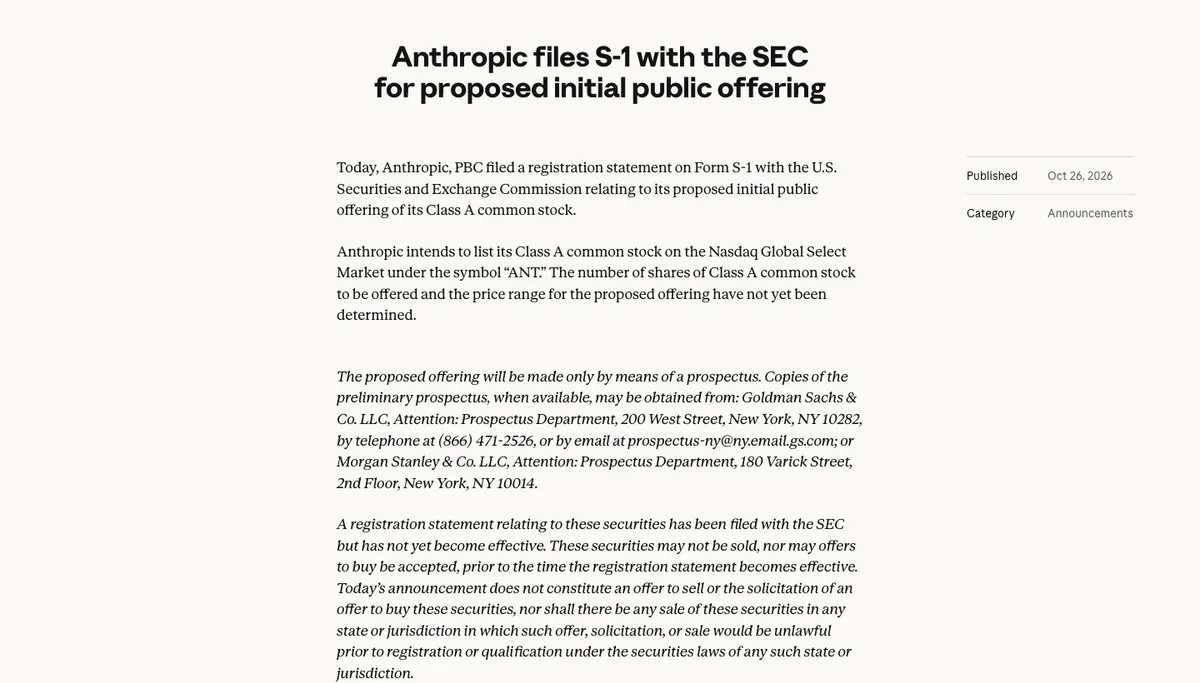
The Anthropic prospectus filed with the SEC on October 26 sets up a Nasdaq listing under the ticker ANT. It shows $16.3 billion in revenue for the first half of 2026 and a first operating profit in the second quarter, set against compute commitments of $780 billion to $810 billion.
Key Takeaways
- Anthropic made its S-1 public on October 26, with Goldman Sachs and Morgan Stanley leading the deal and no share count or price range set yet.
- First-half 2026 revenue reached $16.3 billion, up from $1.2 billion a year earlier.
- The seven co-founders keep 50.1% of the voting power, and the Long-Term Benefit Trust will appoint most of the board.
Have an AI Sum Up This Article
ChatGPTWhat the Anthropic Prospectus Says About the Books
Anthropic confirmed the filing in a short announcement posted on its newsroom on Monday. The company plans to list Class A shares on the Nasdaq Global Select Market under the symbol ANT, with Goldman Sachs and Morgan Stanley running the offering. The number of shares and the price range are still open.
The document lands almost five months after the confidential draft Anthropic sent to the SEC in early June, and a month after the listing slipped to an expected November date. With the Anthropic prospectus now public, investors get their first look at the lab’s detailed accounts.
The growth curve is steep. The full S-1 posted on the SEC’s EDGAR database puts first-half 2026 revenue at $16.3 billion, against $1.2 billion in the same period of 2025. The second quarter alone brought in $11.6 billion, while the whole of 2025 produced $4.6 billion.
That second quarter also delivered Anthropic’s first GAAP operating profit, at $974 million. Across the full half-year, the Anthropic prospectus narrows the operating loss to $693 million, from $2.1 billion a year earlier.
The net loss for the half came to $80.7 billion. Most of it stems from non-cash accounting adjustments tied to the company’s convertible debt, which makes the headline figure a poor guide to how the underlying business runs.
The filing fits the trajectory we tracked over the summer, when Anthropic’s revenue reached a $65 billion annual pace at the end of July. The Anthropic prospectus now backs that climb with audited numbers.

Claude Code Keeps the Biggest Customers Spending
The Anthropic prospectus lays out a three-layer business: frontier models, the Claude Platform for developers, and first-party apps such as Claude Code and Cowork. The pitch to investors rests on how tightly those layers lock together inside large accounts.
At the end of September, more than 11,900 customers were spending at least $100,000 a year, about 1,900 were above $1 million and roughly 250 had crossed $10 million. Over half of the $100,000-plus customers now use both the platform and the apps, up from around 30% at the end of 2025.
Net revenue retention sat close to 900% in the third quarter. Put simply, customers that were already on board a year earlier now spend roughly nine times as much as a group.
Claude Code does a lot of that work. The top 5% of Claude Enterprise users on the coding tool spend about 20 times more per month than an average enterprise user who never touches it, a gap the filing puts front and center.
For engineering teams, the takeaway is practical: the bill rises with the amount of code the tool writes, since 80% of Anthropic’s revenue comes from usage-based billing on tokens consumed.
Distribution also runs through AWS, Google Cloud and Microsoft Azure under joint go-to-market deals. Anthropic keeps the direct relationship with each customer and pays the cloud providers a fee, a setup the Anthropic prospectus describes in detail.
More articles on Horizon
- ChatGPT Locked Chats Hide Conversations Behind a PIN
- Odyssey-3 Builds a World You Can Explore From One Sentence
- Meta Launches Muse Wonder, an AI Model That Remembers You
$780 Billion in Compute Deals and Founders in Control
The other side of the ledger is stark: Anthropic’s compute capacity contracts add up to $780 billion to $810 billion, spread across Broadcom, Google, Amazon and Microsoft. Those long-term commitments behave like fixed costs, while revenue moves with usage.
The risk factors section of the Anthropic prospectus comes back to that dependence. The lab concedes that cloud partners who also see it as a rival could make compute harder to secure.
Customer concentration makes the list too, with the company warning that a sharp spending cut by one or more of its largest customers could hurt the business. That risk already has names attached, since Microsoft and Meta scaled back their Claude usage in early October, Claude Code included.
On governance, the seven co-founders, among them Dario and Daniela Amodei, will control an entity called Founder LLC holding 50.1% of the voting power. The Long-Term Benefit Trust, set up in 2023, will appoint most board members, and the founders’ votes will be decoupled from their economic stake.
For rival labs, the filing becomes the benchmark. Wall Street expects a valuation near $2 trillion, up from about $965 billion in the last private round, a figure first floated when the Anthropic IPO was pitched at $2 trillion in late August. Any competitor heading for its own listing will now be measured against public accounts.
The timetable is still open, and the Anthropic prospectus leaves the date and price blank for now. The lab itself warns that it may never reach or hold on to profitability, which turns the next few quarters into a live test of a business funded by usage.
Follow the story on Horizon.