

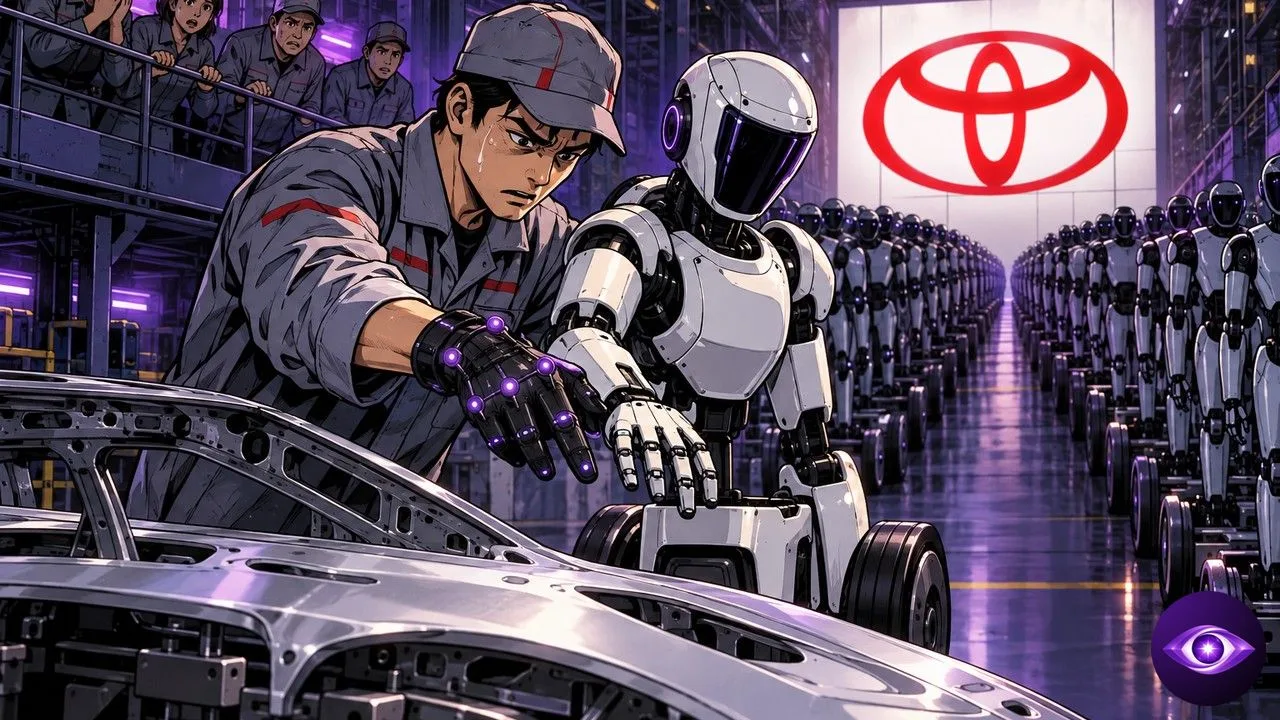
Toyota plans to spend 1 trillion yen a year, about $6.4 billion, from 2028 to roll out as many as 400,000 robots across the group. First reported in September, the plan took on a new dimension with details published by the Financial Times on October 26: Toyota wants to become a global robotics company, and its own workers are the ones training the machines.
Key Takeaways
- Toyota is aiming for roughly 400,000 humanoid and conventional robots, funded with 1 trillion yen a year from 2028.
- Workers fitted with finger-tracking devices are teaching the robots assembly-line tasks.
- Goldman Sachs analysts think Toyota could take 3% to 8% of the humanoid robot market by 2035.
Have an AI Sum Up This Article
ChatGPTInside Toyota’s $6.4 Billion-a-Year Robot Plan
The plan was first laid out on September 21 by trade publication Just Auto, which reported humanoid robots heading into the group’s plants worldwide from 2028. The budget stands at 1 trillion yen a year, around $6.4 billion.
The long-term target is about 400,000 robots. Korean outlet Digital Today broke that down as 150,000 machines in car plants and 250,000 at the group’s parts and materials sites. The total mixes humanoids with conventional robots, and the carmaker has not said how many will be humanoid.
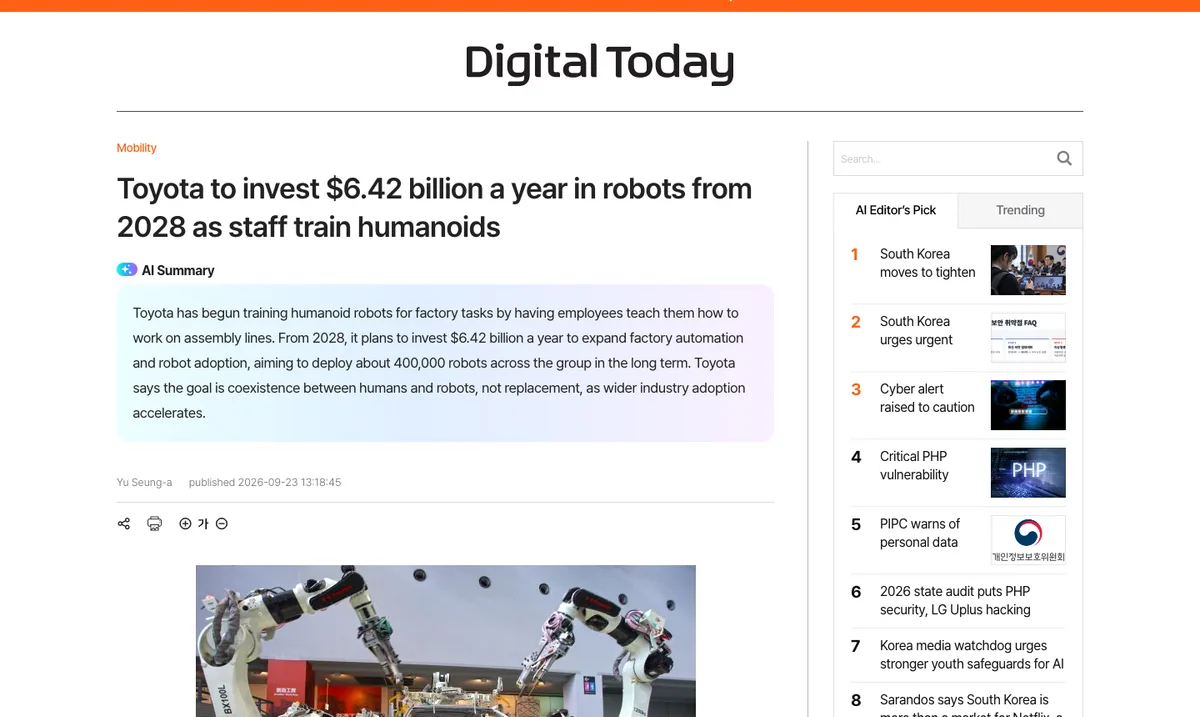
On October 26, the Financial Times added the strategic layer, picked up in The Decoder’s write-up of the $6.4 billion annual bet. The report casts Toyota as set on turning itself into a global robotics company.
A company executive said the group’s own factories come first because the environment there is easier to control. That keeps the risk contained, since a plant run end to end by the carmaker doubles as a test bed.
The group also leans on Walden Robotics, its AI robotics unit, which raised $300 million in July at a $1.1 billion valuation.
Investors are wary. Some point out that the carmaker has fallen short before with hydrogen cars and solid-state batteries, two technology bets launched with similar ambition.
The scale is still new territory for an automaker. Annual spending of this size on automation and robots puts factory equipment on the same footing as new vehicle programs, and turns robotics into a permanent budget line.

Workers Teaching Their Moves to Machines
The robot at the center of the program is called ELEY. Just Auto describes it as a battery-powered wheeled machine weighing about 50 kilograms, able to pick parts from boxes and place them where needed, or fold fabric.
The form factor matters. A 50-kilogram robot on wheels can move around an existing plant without the lines being rebuilt, which fits the decision to bring machines in during factory upgrades.
The training method is the most telling part of the plan. Digital Today reports that employees wear devices that mirror the movements of their fingers to teach robots assembly tasks.
The group then plans to pool the data from those movements to program new robots. Down the line, it even envisions settings where robots train new hires.
Robots will arrive as plants are upgraded, when new models launch or capacity expands, and they will share work areas with people, a setup the group presents as the core principle of the program.
Senior vice president Hiroki Nakajima framed the goal as a world where robots coexist with humans and do not replace them. Toyota points to skilled-worker shortages and an aging workforce, pressures felt across the auto industry.
The demographic argument holds up in Japan and elsewhere, and it explains why the official message stresses support for workers over substitution. What it leaves open is how the workload will be split between people and machines once 400,000 robots are on the floor.
For production teams, the shift is already tangible. A worker’s know-how becomes data, captured, stored and reused to run machines that no longer need that worker to learn the next movement.
More articles on Horizon
- Anthropic Prospectus Reveals $16.3 Billion in Revenue
- ChatGPT Locked Chats Hide Conversations Behind a PIN
- Odyssey-3 Builds a World You Can Explore From One Sentence
Are Toyota Workers Training Their Own Replacements?
Toyota has company in this race. Hyundai plans to deploy up to 25,000 Boston Dynamics Atlas humanoids at Hyundai and Kia plants from 2028, and Chinese automakers Xpeng and Nio are building humanoids of their own.
Goldman Sachs analysts estimate Toyota could capture 3% to 8% of the humanoid robot market by 2035, up against Tesla, Xpeng and Hyundai. A share like that assumes the carmaker eventually sells robots outside its own plants, a step the group has not spelled out.
For rivals, the signal is about scale. A group that trains robots on its own lines, with its own workers, builds a store of industrial movement data that standalone robot makers lack. Factory know-how becomes an asset in its own right, and automakers that fail to capture it will end up buying it.
The trend reaches well past cars. In Japan, AI-powered robots are set to spread across 18 sectors backed by $65 billion in investment, and the carmaker’s plan becomes its most visible industrial showcase.
The coexistence message leaves one question hanging: how many production jobs the plants will keep once the robots are trained. A worker who passes a movement on to a machine supplies what it needs to repeat that movement without them, and Toyota has published no figure on how many factory jobs it plans to retain.
Other manufacturers show that automation can also retreat. At Ford, 350 senior engineers were rehired after an AI quality-control system fell short, a reminder that automation can be rolled back when it disappoints and that the human expertise it was meant to absorb keeps its price.
For a factory worker, the window before 2028 counts double. The tasks the plan hands to robots are known: grabbing parts, placing them, folding fabric. The ones it leaves out, such as supervising the machines or maintaining them, mark the ground where a Toyota employee has the most reason to stand.
The timeline leaves little slack. With robots entering plants as they are upgraded, every new model the group launches from 2028 onward could come with a line where the machine learned its job from the workers who held it before.
Follow the story on Horizon.