

Key Takeaways
- Jensen Huang argues AI generates employment through large-scale hardware infrastructure construction
- He distinguishes between automating specific tasks and eliminating entire job functions within an organization
- Academic and financial estimates still project 15% of American jobs could be displaced by AI
The Milken Offensive
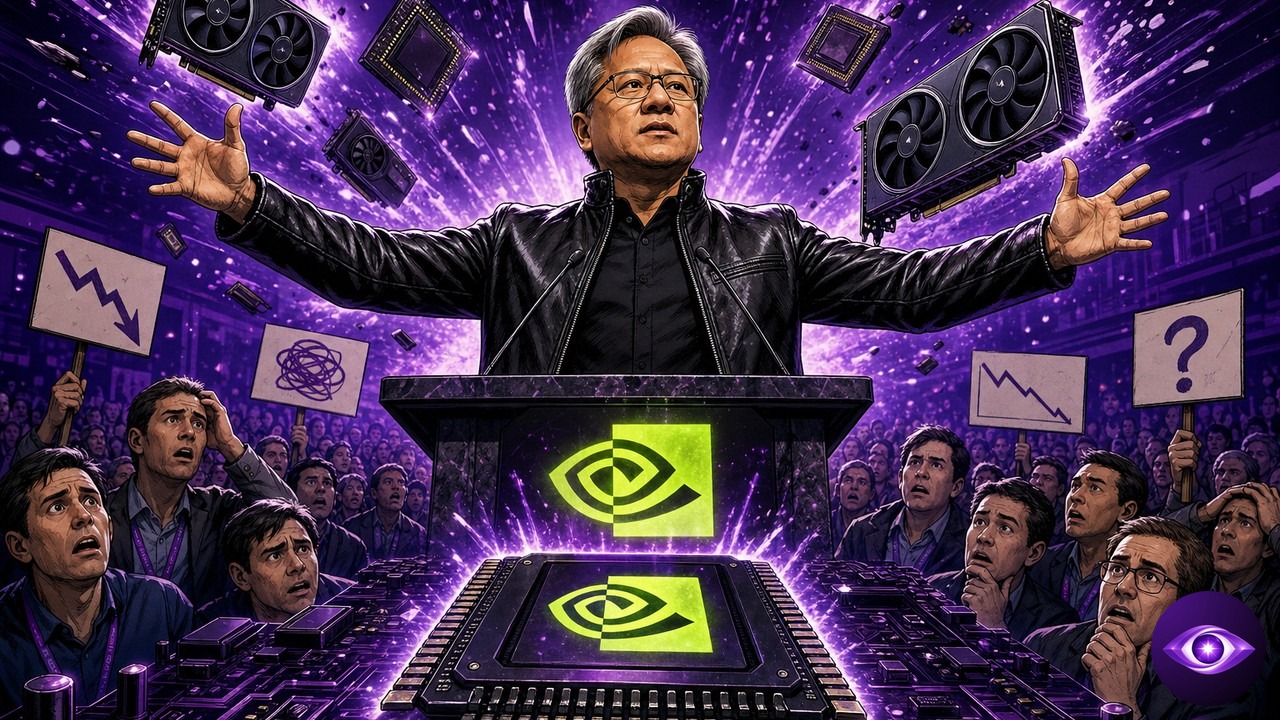
The conversation took place Monday evening at a Milken Institute event, one of the most influential economic policy forums in the United States. Speaking with MSNBC anchor Becky Quick, Jensen Huang laid out a thesis that sounded straightforward: AI industrializes, it does not de-industrialize.
According to Huang, scaling AI requires building new industrial factories producing hardware that functions as critical infrastructure. Those factories need workers. The broader AI industry does too. This framing positions Nvidia at the center of a narrative where hardware equals job creation.
Huang also cast his argument in political terms, stating that AI represents “the United States’ best opportunity to re-industrialize.” The phrase speaks directly to ongoing concerns about American deindustrialization and frames Nvidia as a lever of national economic sovereignty.
The fact that the world’s largest AI chipmaker is publicly countering fears of job displacement is as much a political signal as an industrial one. Huang spoke against a backdrop of growing social anxiety about AI’s impact on employment, and the Milken stage was a deliberate choice.
The Milken Institute is not a neutral stage. It is a forum frequented by economic policymakers, investment funds, and corporate executives. Addressing this audience on the topic of employment means calibrating a message for the very people who make large-scale hiring and automation decisions.

Task vs. Job: The Core Argument
At the heart of Huang’s remarks is a specific conceptual distinction. In his view, people “misunderstand that the purpose of a job and the task of a job are related” but they are not the same thing. Automating a specific task within a role does not eliminate the role itself.
The argument has historical grounding. Prior waves of automation often transformed jobs rather than eliminated them en masse. Productivity gains funded the creation of new sectors, and entirely new functions emerged that did not previously exist.
But that historical pattern does not guarantee that generative AI, which targets high-value cognitive tasks previously insulated from automation, will follow the same trajectory. Earlier automation targeted physical or repetitive work. Today’s AI targets writing, analysis, code, legal research, and accounting. The terrain is fundamentally different.
Huang also raised concerns about public perception, warning that “science fiction stories” about AI are making people unnecessarily afraid of the technology. A remark that says as much about Nvidia’s commercial interests as it does about actual labor market dynamics.
Also on Horizon:
- China cuts 12,000 university degrees made obsolete by AI
- 79% of parents already use AI to raise their kids
- GPT-5.5 Instant beats doctors on health answers
When the Numbers Push Back
What Huang’s Milken address does not resolve is the data. Reputable financial and academic organizations estimate that as many as 15% of U.S. jobs could be eliminated over the next several years due to AI. That figure is not coming from the fringes.
Taken at face value, it means tens of millions of positions disappearing. Huang’s task-versus-job distinction is insufficient to absorb displacement at that scale, even accounting for jobs created across the hardware supply chain. The first concrete waves confirm the trajectory: Meta announced 8,000 job cuts to fund its 145 billion dollar AI budget.
The contradiction is striking: the AI industry has itself generated alarmist rhetoric about existential risks, in part as a positioning tool. Seeing the same players now downplay job displacement risks reveals something about the position they are in. On the worker side, an Anthropic survey published since shows 64 percent fear AI for their job.
In the short term, Huang’s message serves two goals: reassure governments and regulators about AI’s social impact, and protect institutional demand for Nvidia hardware. An AI perceived as a threat to employment invites tighter regulation, which would directly affect the revenue of the world’s leading GPU manufacturer.
In the medium term, the real question remains unanswered: will the jobs created across the AI value chain compensate, in number and in skill level, for those automation displaces? This is not a theoretical question. It is what will play out across developed-economy labor markets over the next few years.
Follow the story on Horizon.