

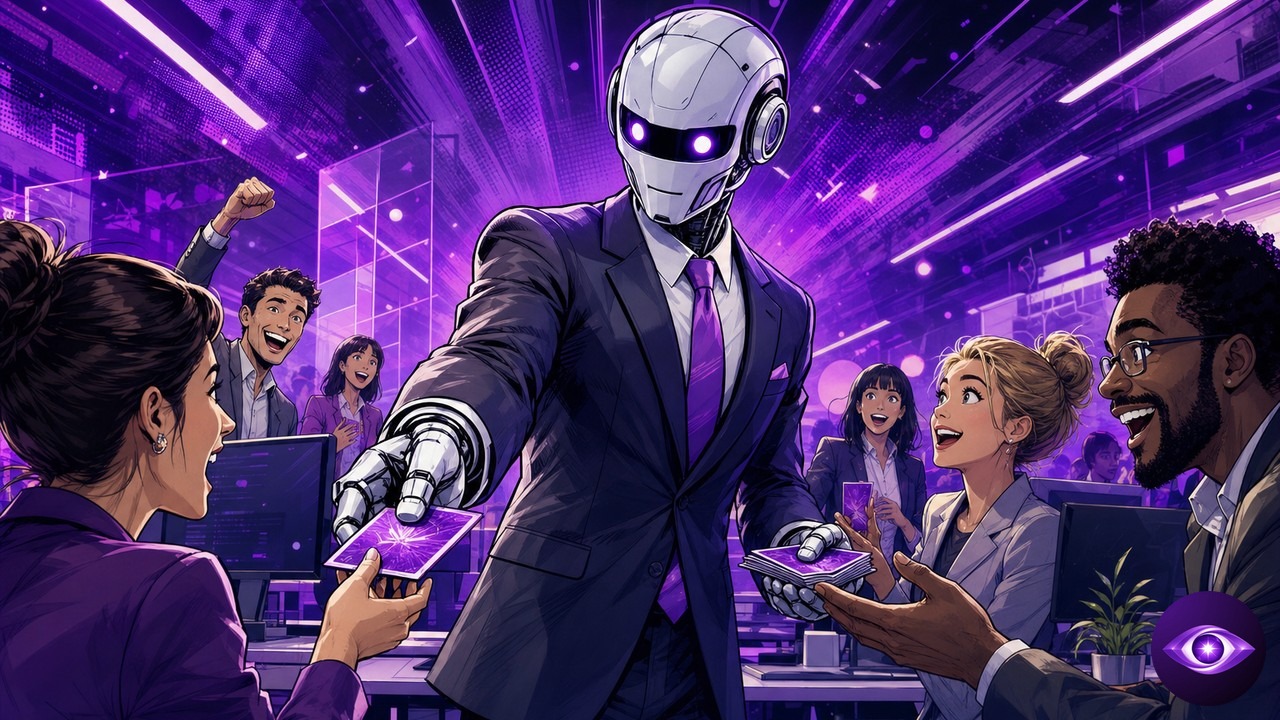
On April 22, 2026, OpenAI launched Workspace Agents in “research preview”: AI agents designed to operate at the level of an entire team inside enterprise tools. Custom GPTs will be deprecated on August 26, 2026. This is not a product update. It is a shift in paradigm: OpenAI moves from individual assistant to organizational agent, taking direct aim at Microsoft and Salesforce territory.
Key Takeaways
- Workspace Agents replace Custom GPTs, which are deprecated on August 26, 2026
- 60+ enterprise connectors at launch: Slack, Google Workspace, Salesforce, Notion, GitLab
- Free until May 6, 2026, then pay-per-use credit billing
Have an AI Sum Up This Article
ChatGPTWhat Changes Compared to Custom GPTs
Custom GPTs had a structural limitation: they were tied to individual users, had no write access to external tools, and offered no admin controls whatsoever. A custom GPT could not act on behalf of a team, let alone integrate autonomously into a company-wide workflow.
Workspace Agents are built to operate at organizational scale. They run in the background in the cloud, continue working after the user has closed their session, and can be shared across an entire team rather than kept by one person. Permission controls let admins define exactly what each agent can and cannot do. OpenAI is pushing agents on every front, also speeding up its AI voice by 25%.
Memory is also built in: agents improve through correction. When a user approves or rejects a proposed action, the agent incorporates that feedback into future interactions. This is no longer a single-use tool. It is a system that refines itself over time.
OpenAI has planned the transition for existing users. Current Custom GPTs will be automatically converted to Workspace Agents before the August 26 deprecation date. The break is clean: OpenAI is closing the chapter on personalized GPTs to focus its roadmap entirely on the enterprise market.
Workspace Agents also inherit task-execution capabilities from Codex, OpenAI’s cloud coding agent, going well beyond what Custom GPTs could do on text alone. The full picture is available in OpenAI’s announcement introducing workspace agents in ChatGPT. That same Codex is now targeting office jobs across enterprises.

Integrations and Pricing
At launch, Workspace Agents connect to over 60 enterprise connectors and 90 plugins. Available integrations cover most of the standard tech and commercial team stack: Slack, the full Google Workspace suite (Gmail, Drive, Calendar, Docs, Sheets), Salesforce, Notion, Atlassian Rovo, CircleCI, GitLab, and custom MCP servers.
One notable blind spot: Microsoft 365 is largely absent from the launch. Only SharePoint is available. Teams, Outlook, Word, and Excel are not integrated. In a context where OpenAI is directly competing with Microsoft 365 Agents on enterprise turf, this gap is both awkward and telling of commercial tension between the two partners.
The free phase ended on May 6, 2026. Billing now operates on a pay-per-use credit model with no minimum commitment. The exact credit rate has not been publicly disclosed. Access is restricted to ChatGPT Business (20 dollars per user per month), Enterprise, Edu, and Teachers plans. Plus, Pro, and Free plans are excluded.
Protections against prompt injection attacks are built into the system. Agents request human approval before executing sensitive actions (such as sending emails or modifying shared files). This validation layer is a clear signal aimed at CISOs who remain skeptical of autonomous agents.
Also on Horizon:
- China cuts 12,000 university degrees made obsolete by AI
- 79% of parents already use AI to raise their kids
- GPT-5.5 Instant beats doctors on health answers
What This Reveals About OpenAI’s Strategy
The launch of Workspace Agents is not a product addition. It is a strategic repositioning. OpenAI is entering the enterprise automation platform space, a market that Microsoft, Salesforce, ServiceNow, and SAP have occupied for years. The stated differentiation is a “dynamic exploration” approach versus the rigid governance of legacy solutions.
In the short term, companies that relied on Custom GPTs will need to migrate and adapt their workflows. For technical teams, the transition is likely smooth. For less technical business teams, ramping up on Workspace Agents requires a meaningful configuration effort. That shift toward the agent has since been confirmed by the ChatGPT Agent app that replaces the classic chat interface.
Over the next several months, OpenAI is playing a high-stakes hand. The enterprise AI agent market is the hunting ground of its main competitors, and IT budgets are controlled by long-standing Microsoft and Salesforce partners. Convincing CIOs to shift critical workflows to OpenAI agents requires a level of trust that Custom GPTs never needed to establish. That enterprise push also plays out as an API price war against Anthropic.
The compliance API, RBAC controls, and human approval mechanisms are all signals directed at security and compliance departments. OpenAI knows that the real barrier to enterprise adoption is not model performance. It is governance.
Follow the story on Horizon.



Pingback: ChatGPT Business Adds a $125 Premium Seat - Horizon IA