

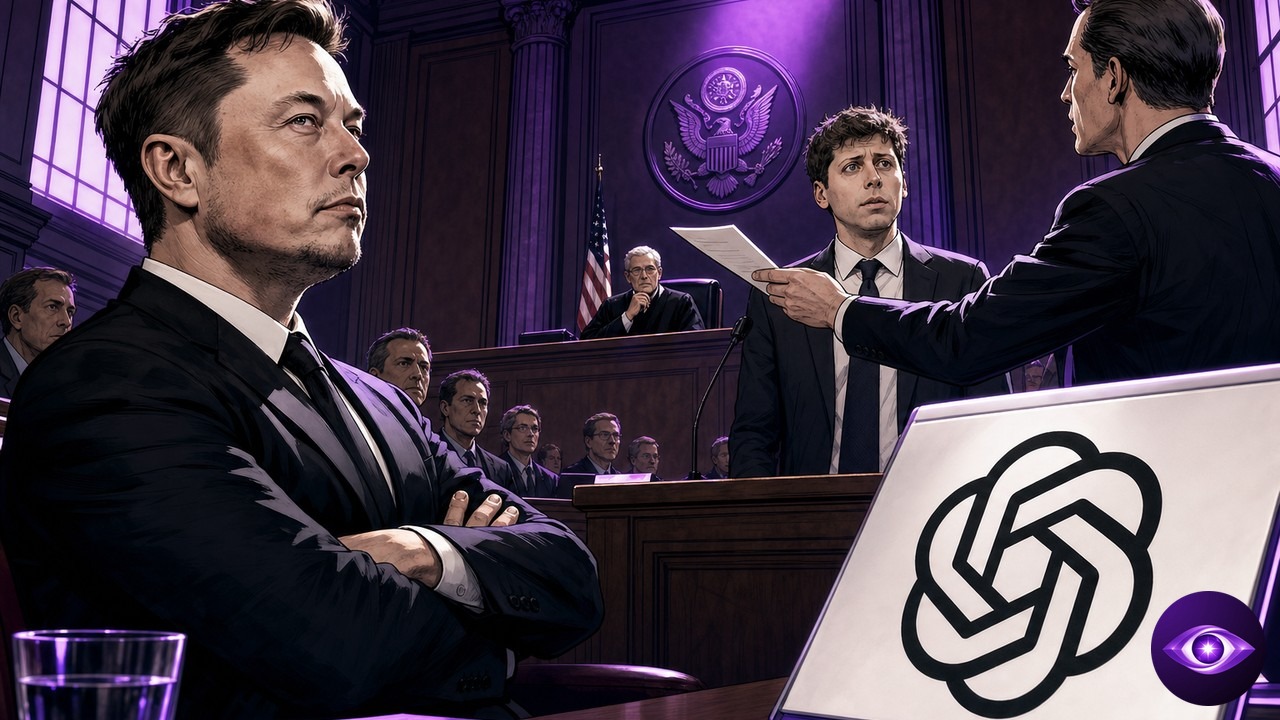
The closing arguments in the Elon Musk vs OpenAI trial put Sam Altman’s credibility under direct fire. Contradictions between his congressional testimony and his indirect stake in OpenAI through Y Combinator became the focal point of the final hearing. The question emerging from this courtroom runs deeper than the verdict: can the leaders of private AI companies be taken at their word?
Key Takeaways
- Closing arguments surfaced a contradiction between Altman’s congressional testimony and his passive investor status through Y Combinator
- Both Musk and Altman faced credibility challenges at the stand, but responded in strikingly different ways
- The trial makes visible a structural gap: private AI companies lack adequate transparency mechanisms relative to their public influence
Have an AI Sum Up This Article
ChatGPTA Congressional Statement Put to the Test
During closing arguments, Elon Musk’s attorney Steve Molo zeroed in on a specific statement Sam Altman made before Congress. Altman had claimed he held no financial interest in OpenAI. Molo pointed out that Altman held a passive investor status through Y Combinator, the startup accelerator he formerly led, which had stakes in OpenAI. For context, see our earlier piece on Horizon: OpenAI Verdict: Musk Loses, IPO Path Now Clear.
When confronted, Altman replied that “everybody understands what it means to be a passive investor in a VC fund.” The response did little to ease the tension. Is the distinction between a direct stake and an indirect exposure a legitimate nuance, or a way to sidestep a straightforward question? That ambiguity became the centerpiece of the closing arguments. The equity question lingered, Altman in fact holding a stake in OpenAI.
Testifying before Congress carries a specific form of public accountability. If imprecision goes unchallenged in that context, the statements of AI executives lose part of their value as a reference point. This trial is testing exactly that: whether a public declaration from an AI industry leader carries real weight, or can be walked back with a technicality.
This is not the first time Altman’s statements have come under the microscope during this trial. Earlier hearings had already uncovered deep internal tensions at OpenAI, with former board members describing a culture of concealment and a lack of candor from leadership. The closing arguments amplified what those earlier sessions had already suggested.
This trial is not just a dispute over whether OpenAI broke its original contract with its founding mission. It is putting the word of a man who runs one of the most influential AI organizations in the world to the test in front of the institutions meant to oversee it. That combination is new, and its consequences will extend well beyond the courtroom. The trial also aired the risks, an expert warning of an AGI arms race.

Two Men on Trial: Credibility From Both Sides
Altman was not the only one whose statements were scrutinized during this trial. Elon Musk’s own declarations were also questioned at the stand. The two protagonists responded in markedly different ways to the questions put to them, and that difference in posture became, in itself, an argument during the closing phase.
Altman, as the active CEO of OpenAI, carries a different weight in this dynamic. His statements have direct consequences on strategic decisions, on partnerships, and on market confidence. A contradiction made before Congress lands differently than a claim made by a plaintiff. Musk’s role in this case is that of a founder contesting a breach. Altman’s role is that of an executive answering for his conduct. The full picture is available in OpenAI’s official page on the Musk legal proceedings.
The trial points to a structural problem. The companies shaping AI at a global level remain, for the most part, private entities. Their internal governance, their potential conflicts of interest, and the financial positions of their executives are largely shielded from public view, ordinary shareholders, and the democratic institutions that would theoretically hold them to account.
In that vacuum, trust becomes the primary control mechanism. Trust in the founders, in the boards, in public statements. A fragile mechanism, as this trial makes plain. The real question is not just “what did Altman tell Congress?” It is “why does no formal framework exist to verify what AI executives say?”
When private companies wield massive public influence, and the only available guarantee is the word of their leadership, a contradiction in a courtroom does not stay inside the courtroom. It ripples through how the entire sector is perceived. This trial is the most concrete demonstration of that dynamic yet.
Also on Horizon:
- ChatGPT Finance: Connect Your Bank Accounts to AI
- Codex Goes Mobile: OpenAI Puts AI Coding in Your Pocket
- ChatGPT vs. Apple: OpenAI Mulls Legal Action Over Siri Deal
What This Trial Reveals About AI Governance
In the short term, the verdict will not change OpenAI’s structure or its development pace. What is at stake is Sam Altman’s public credibility and, by extension, OpenAI’s standing with regulators, legislators, and institutional partners currently in active discussions with the company.
A reputation damaged before Congress or in a courtroom can have weight far beyond the legal sphere. Governments and regulators deciding how far to extend their trust to OpenAI are watching these proceedings carefully. The CEO’s credibility is not separate from how the organization is valued by those who have to deal with it.
Over the medium term, this trial will feed into broader debates on the governance of private AI companies. In Europe, the AI Act already mandates transparency obligations on high-risk systems. In the United States, legislative discussions around AI governance had so far lacked a concrete, high-profile case to gain momentum. This trial provides one.
It demonstrates that the public statements of AI executives can be subjected to judicial scrutiny, and that the opacity of private structures can, over time, work against them. The pressure for greater transparency will only build, regardless of what the court decides.
Whatever the outcome, one result is already locked in: the question of trust in large AI companies is no longer an academic debate. It is now a courtroom argument, and that shift will not end when the judge delivers a ruling.
Follow the story on Horizon.



Pingback: Apple Rebuilds Siri on Gemini and Bets Everything on Privacy - Horizon IA