

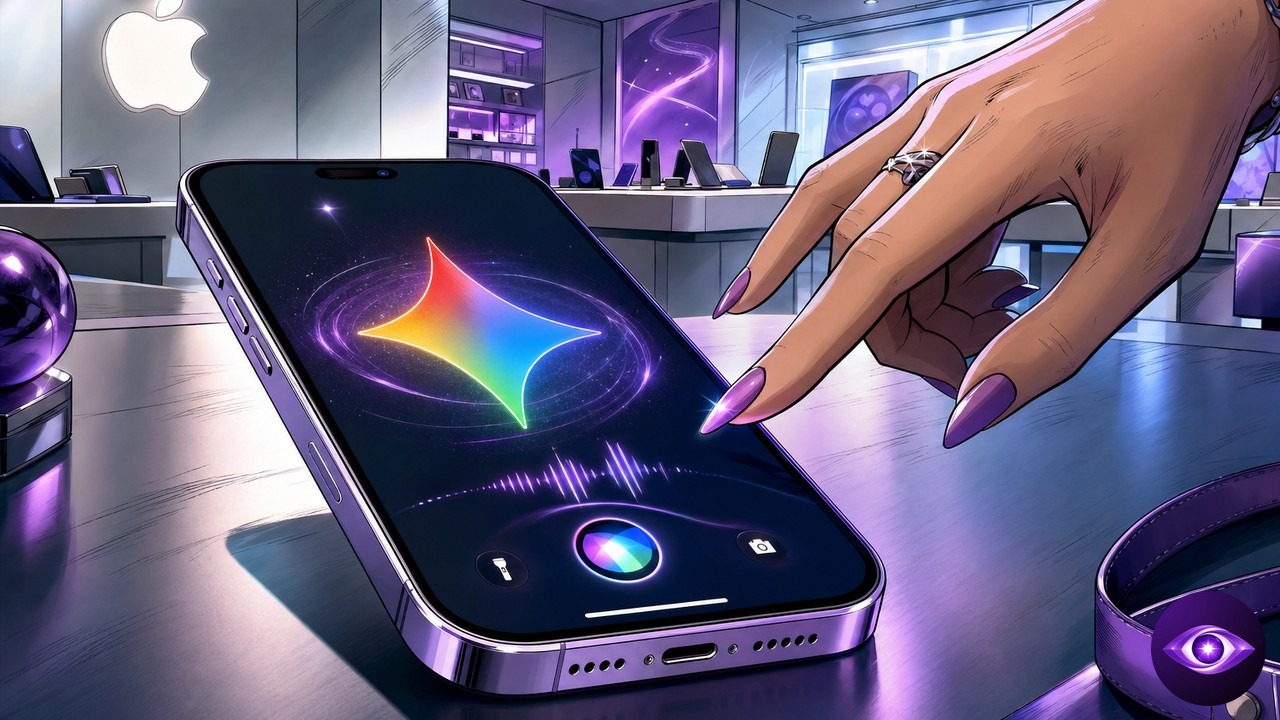
Apple will unveil a completely rebuilt Siri at WWDC in June, powered by Google Gemini and available for the first time as a standalone app. Privacy is positioned as the central selling point. The real test: can Apple close a two-year gap against its competitors with this argument alone?
Key Takeaways
- Siri will run on Google Gemini and launch as a standalone app at WWDC in June 2026
- Users will be able to auto-delete conversations after 30 days, one year, or keep them indefinitely
- Apple is positioning this rebuild as the most privacy-respecting AI assistant on the market
Have an AI Sum Up This Article
ChatGPTGemini Under Siri’s Hood
Apple has made a decisive choice: handing the Siri rebuild to Google Gemini. It marks the first time Apple has openly relied on an external model to power its voice assistant. WWDC in June 2026 will be the official stage for this strategic pivot, which observers had been anticipating for months. For context, see our earlier piece on Horizon: Siri AI: Apple rebuilds the assistant at WWDC 2026.
The new Siri will arrive as a standalone app, something Apple has never offered before. A direct conversational interface, modeled after the leading AI chatbots on the market. This is no longer just a voice assistant baked into the system. It is a dedicated interaction layer, built to stand on its own.
The backdrop matters. OpenAI was reportedly considering legal action against Apple over the failed ChatGPT integration into Siri, with revenues falling far short of projections and features buried deep inside iOS. Apple’s response is to bypass the dispute entirely and move to Gemini.
The arrangement is a clear division of labor: Apple controls the experience, Google provides the engine. For Apple, this means giving up some technological ground while keeping full ownership of the interface and data policy. It is a trade-off that prioritizes speed over independence.
This collaboration between two long-standing rivals in tech is unprecedented in scale. It signals just how urgent the situation has become for Apple. Two years after the first Apple Intelligence announcements, the company still has no credible conversational AI product to put against its competitors. This launch is a direct answer to that gap.

Privacy as the New Competitive Edge
Privacy is at the heart of this launch. Apple plans to make it “a major theme” at the WWDC unveiling, with executives arguing for “a more privacy-friendly approach than most other AI companies.” This is a deliberate positioning, not a footnote in the terms of service. That requirement weighs on the rest of the roadmap too, since Apple delayed its AI glasses over privacy concerns.
The central mechanism is automatic conversation deletion. Three settings: erase after 30 days, after one year, or keep indefinitely. The system mirrors the auto-delete options already available in Apple Messages. It is a smart design choice, anchoring Siri in familiar behavior rather than asking users to navigate unfamiliar privacy settings.
Competing platforms offer less transparent data retention policies for mainstream users. Apple is building a concrete differentiator here, not just a marketing angle. The level of control on offer sends a clear signal to a user base that has come to expect data protection as a default, not a premium feature.
The context makes this positioning even more loaded. Apple had already paid $250 million to settle a class action over misleading Apple Intelligence promises. Trust needs rebuilding, and privacy is the lever Apple has chosen to do it. Apple started from behind on AI, having paid $250M over false AI advertising.
There is an inherent tension in the pitch, however. A model running on Gemini, meaning Google’s infrastructure, wrapped in Apple’s privacy promise: the consistency of that message will need to be demonstrated in practice, not just announced on stage. The most attentive users will ask the question immediately. The full picture is available in the joint Google-Apple announcement on the Gemini-Siri partnership.
Also on Horizon:
- Elon Musk vs OpenAI: Trust at the Heart of the Verdict
- ChatGPT Finance: Connect Your Bank Accounts to AI
- Codex Goes Mobile: OpenAI Puts AI Coding in Your Pocket
Short and Medium-Term Implications
In the short term, the WWDC presentation is everything. Apple has weeks to turn an announcement into real adoption. Comparisons with other AI assistants will be instant. Users will run their own tests on day one. The experience will need to match the story being told.
For developers in the Apple ecosystem, this shift raises open questions about Siri’s API and third-party integrations. A Gemini-powered Siri could become a serious integration point for sophisticated in-app use cases, provided Apple opens the right access. Nothing has been confirmed on this, but it is the next logical step. Apple may also open the choice, letting users pick their own AI model on iOS 27.
Over the medium term, this move redraws alliances across the AI sector. Apple and Google were operating on very distinct technological footing. This technical partnership, however partial, shifts the balance. It also reinforces Gemini’s position as a go-to engine for third parties, at a moment when GPT is navigating strained relations with Apple.
For the millions of users who had quietly stopped using Siri, the question is not technical. It is about credibility: will a Gemini-powered Siri, wrapped in Apple’s privacy promise, actually feel trustworthy? Apple has spent years building that credibility. It is now deploying it to close a two-year gap in the AI race.
If the execution holds, this launch could mark Apple’s real return to the conversation around mainstream AI. A return its user base has been waiting for.
Follow the story on Horizon.



Pingback: iOS 27 Finally Lets You Reshape Siri's Voice - Horizon IA
Pingback: Siri AI on iPhone Leaves EU Users Waiting - Horizon IA