

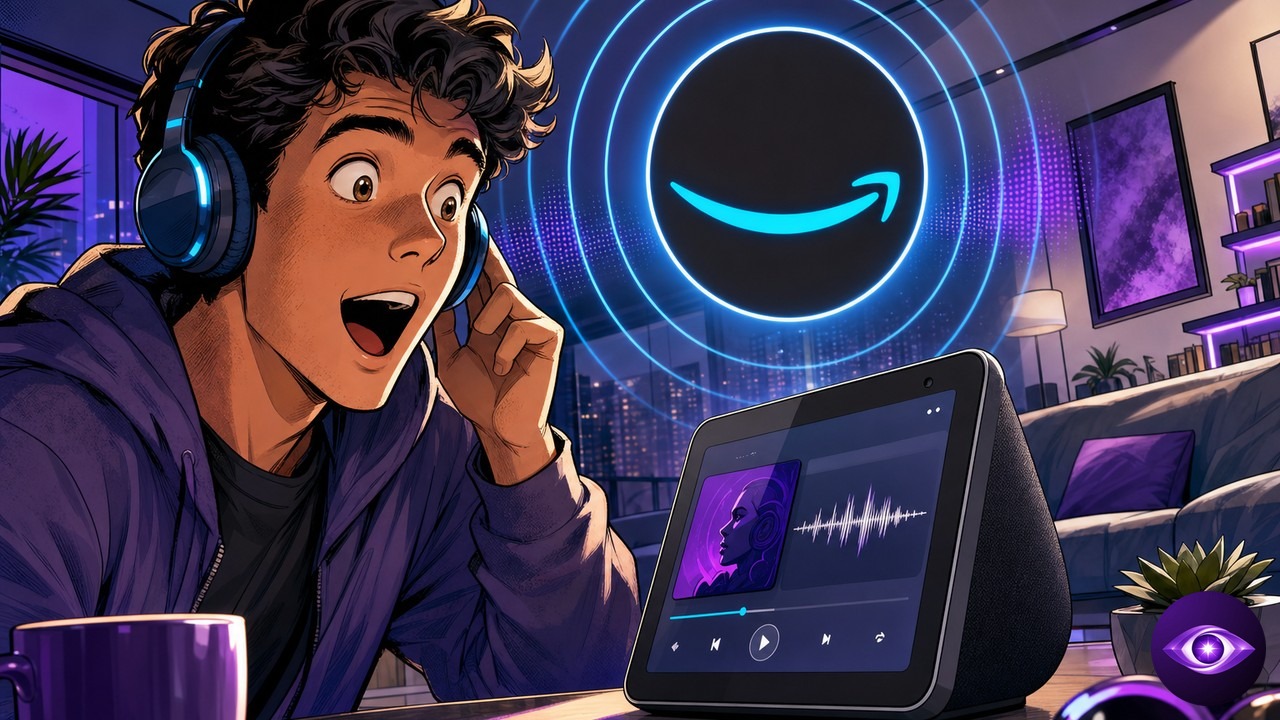
Amazon launched Alexa Podcasts on May 18, 2026, a new Alexa+ feature rolling out to U.S. customers that generates personalized audio episodes from a user-defined topic. The system researches the subject, delivers a preview, and produces a narrated episode based on preferred length and tone, all within the Alexa app.
Key Takeaways
- Alexa Podcasts generates audio episodes on demand from a single topic prompt
- Amazon has partnered with AP, Reuters, The Washington Post, and over 200 local outlets for real-time sourcing
- Podcasters and audio creators are beginning to assess the implications of the format
Have an AI Sum Up This Article
ChatGPTAn on-demand audio generator built into the assistant
The mechanic is straightforward. The user asks Alexa+ to generate an episode on a chosen topic. The assistant researches available information, builds a narrative structure, and presents a preview before finalizing the episode. Users can adjust length, tone, and depth before the final version is produced.
Finished episodes are narrated by AI-generated voices and saved directly to the Music and More section of the Alexa app. Echo Show devices notify users when an episode is ready. The content is available for replay through the app on any connected device.
The rollout is limited to U.S. customers for now, with no announced timeline for international expansion. Alexa Podcasts is part of the Alexa+ subscription tier and is not available in the base version of the assistant.
The launch reflects a broader Amazon strategy to position Alexa+ as a content-generation tool, not simply a search interface or smart home controller. Amazon is also exploring adjacent formats, including personalized news briefings and episodes built from documents provided by the user.
As we noted in our piece on Alexa for Shopping, Amazon has been steadily expanding Alexa’s AI capabilities over recent months, moving the assistant further into editorial and informational territory beyond product search and device control.

Media partnerships as the credibility anchor
Amazon has assembled a network of media partnerships to support the accuracy of generated episodes. The list includes Associated Press, Reuters, The Washington Post, Time, Forbes, Business Insider, Politico, USA Today, Condé Nast, Hearst, and Vox Media. More than 200 local U.S. newspapers are also part of the arrangement for regional coverage.
These partnerships are designed to feed the system with verified, real-time information. They place Amazon in a different position from a raw generative model with no editorial anchor: the platform relies on identified sources rather than autonomous generation without factual grounding. The full picture is available in Amazon’s announcement of Alexa Podcasts with AI-generated audio episodes.
This choice responds directly to the criticism that followed early experiments with AI-generated content in the news industry. Hallucinations, factual errors, and misattributions damaged the credibility of first-generation text tools. Amazon is attempting to address those failure modes before they become a reputational problem.
The accuracy question remains open for complex, nuanced topics. Partnerships secure access to recent data, but they do not resolve the interpretation and contextualization challenges that automated audio narration creates when handling sensitive news events or fast-moving stories.
The terms of these partnerships have not been made public. It is unclear whether the outlets receive per-episode compensation, data access in return, or a more conventional licensing arrangement. This ambiguity around the economics between media companies and AI platforms is far from unique to Amazon.
Also on Horizon:
- China cuts 12,000 university degrees made obsolete by AI
- 79% of parents already use AI to raise their kids
- GPT-5.5 Instant beats doctors on health answers
What this format changes for creators and the audio industry
In the short term, Alexa Podcasts targets users who want structured audio content without navigating an existing catalog. The positioning is not a direct attack on professional podcasters, but rather a fast-consumption format sitting between a voice briefing and a full podcast episode.
Over the medium term, the impact on independent creators is worth watching. If Amazon broadens the format and the range of available topics, some of the audience currently turning to general-interest information podcasts could migrate toward on-demand AI-generated content. Creators whose value rests on curation and factual narration face the most direct exposure to this shift.
Ethical questions are also being raised. Automatically generated audio content that mimics the conventions of professional podcasting creates transparency obligations: listeners should know they are hearing a fully AI-produced episode, and it remains unclear what disclosure standards will apply to this format. The debate echoes the broader Amazon Alexa shift, now extending to shopping via the AI-powered search bar.
Apple Podcasts, Spotify, and other audio platforms are watching this launch closely. None has yet deployed a comparable tool integrated directly into the listening experience. Amazon has a distribution advantage through the Echo ecosystem, but perceived quality and the attachment audiences have to recognizable human voices will remain a strong differentiator for established creators.
Follow the story on Horizon.