

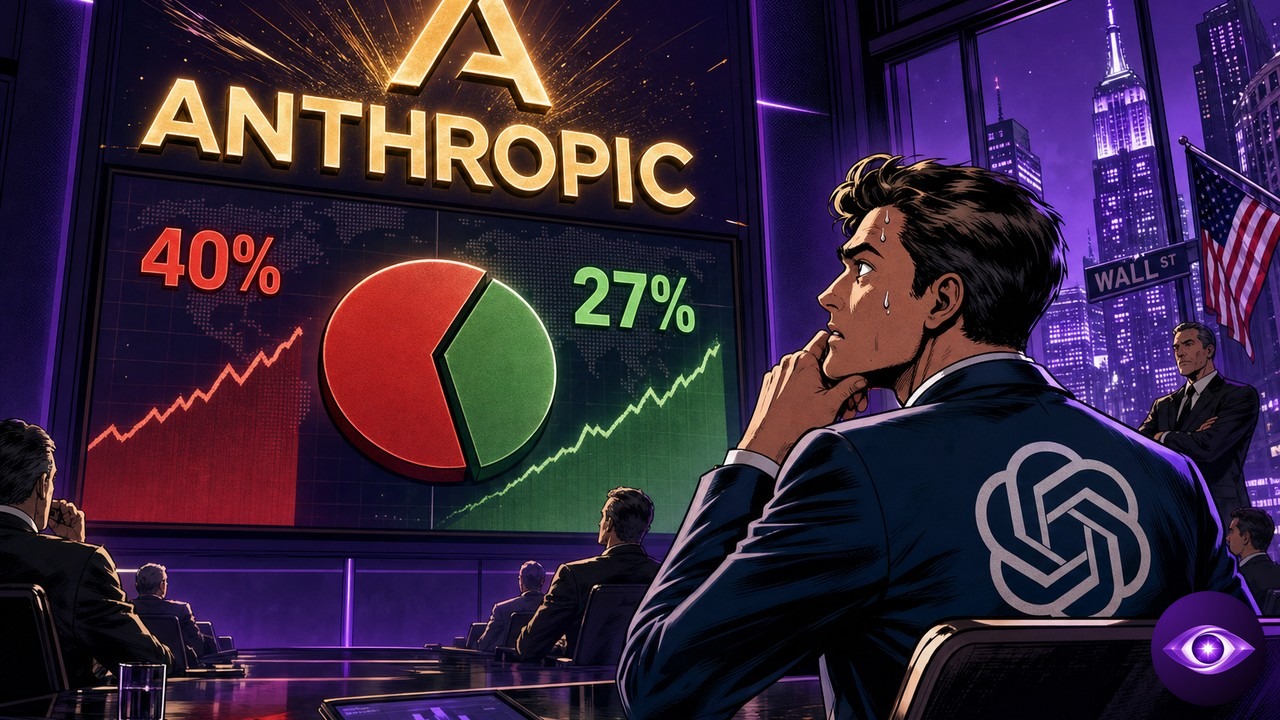
For the first time, Anthropic has captured more enterprise LLM spending than OpenAI, with 40% of the market against 27%, according to Menlo Ventures data reported by VentureBeat. OpenAI’s share has fallen from 50% in 2023 to 27% at the end of 2025. Meanwhile, Anthropic’s annualized revenue jumped from $9 billion at the end of 2025 to $30 billion by the end of March 2026, driven primarily by its coding tools. On the secondary market, Anthropic shares trade at a premium while OpenAI shares sit at a discount.
Key Takeaways
- Anthropic holds 40% of enterprise LLM spending versus 27% for OpenAI, per Menlo Ventures data
- Anthropic’s annualized revenue tripled in one quarter, from $9B to $30B, driven by coding tools
- Investors holding stakes in both companies are questioning OpenAI’s $852 billion valuation
The enterprise market share flip
The Menlo Ventures data compiled by VentureBeat is unambiguous: Anthropic now holds 40% of enterprise LLM spending, against 27% for OpenAI. This is the first time the historical market leader has dropped below 30% in this segment. Three years earlier, in 2023, OpenAI held roughly half of the market.
That decline happened gradually, then abruptly. OpenAI’s share moved from 50% in 2023 to 27% at the end of 2025, a 23-point drop over two years. Anthropic captured most of that lost ground. The shift reflects a change in preference among enterprise IT teams, where safety and governance have become decisive procurement criteria.
According to VentureBeat, Anthropic’s safety-first positioning, long seen as a performance constraint, has become a direct commercial advantage in enterprise settings. Large organizations, exposed to regulatory and reputational risks tied to AI, have increasingly gravitated toward models whose publishers document limitations and guardrails explicitly.
OpenAI, by contrast, is described by TechCrunch as a company still “reorienting toward enterprise customers.” Its historical strength was consumer-facing, with ChatGPT as the flagship product. Building a commercial organization capable of meeting enterprise requirements (SLAs, compliance, advanced customization) takes time, and that time has benefited Anthropic.
The secondary market confirms the shift in sentiment. According to TechCrunch, Anthropic shares are trading at a premium on secondary markets while OpenAI shares are at a discount. Institutional investors who have a choice between the two companies are clearly leaning toward Anthropic in the near term.

Anthropic’s revenue explosion in one quarter
The number that best captures the speed of this rise: Anthropic’s annualized revenue went from $9 billion at the end of 2025 to $30 billion at the end of March 2026, a 3.3x increase in a single quarter. TechCrunch attributes this acceleration primarily to demand for its coding tools, with Claude Code leading the charge.
AI-assisted developer tools have become the fastest-growing enterprise LLM adoption segment. Technology companies see them as a measurable and immediate productivity lever, with a clearer return on investment than conversational use cases. Anthropic built a significant lead here, both through its APIs and through Claude Code as a standalone product.
Despite this trajectory, Anthropic’s valuation still trails OpenAI’s. Anthropic is valued at $380 billion in its latest funding round, against $852 billion for OpenAI. Anthropic is now seeking an additional $50 billion at a valuation above $900 billion, which would close or reverse that gap if confirmed.
On the enterprise side, Anthropic’s revenue growth is accompanied by an expanding client roster. VentureBeat reports successive wins across large financial and technology organizations, driven by Claude’s reputation for complex reasoning and long-document analysis. The extended context window, now well above 200,000 tokens, is a direct advantage in demanding enterprise workflows.
The simultaneous announcement on May 4 of parallel enterprise joint ventures (Anthropic with Blackstone and Goldman Sachs, OpenAI with TPG and Brookfield) shows both companies have identified the same bottleneck. Both are trying to accelerate commercial deployment through investment vehicles that embed engineers directly inside client organizations.
Also on Horizon:
- China cuts 12,000 university degrees made obsolete by AI
- 79% of parents already use AI to raise their kids
- GPT-5.5 Instant beats doctors on health answers
The questions mounting around OpenAI’s valuation
The loss of enterprise market share is not going unnoticed among investors who backed OpenAI in its recent $122 billion raise at an $852 billion valuation. According to TechCrunch, an investor holding stakes in both companies told the Financial Times that participation in that round “required assuming an IPO valuation of $1.2 trillion or more” to break even.
Jai Das, a partner at Sapphire Ventures, was more direct, calling OpenAI “the Netscape of AI”, a reference to the once-dominant browser that gradually lost its lead to more agile competitors. The comparison is deliberately provocative, but it captures a genuine concern about the durability of OpenAI’s technological edge as Anthropic’s models close the gap on benchmarks.
The valuation mechanics are tricky. OpenAI is priced at $852 billion based on growth projections and market position. But if Anthropic continues taking enterprise market share at this pace, the growth assumptions underpinning that valuation will need revision before OpenAI’s potential IPO, discussed for late 2026 at the earliest. That pressure has since spilled into an API price war between the two players.
In the short term, both companies are raising capital at rates without precedent in tech history. Anthropic is seeking $50 billion more; OpenAI has already absorbed $122 billion this year alone. The scale of capital in play makes any conclusion about a definitive winner premature. But for the first time, the operational metrics give Anthropic the edge. Follow the story on Horizon.



Pingback: Moltbook: When 1.5 Million AIs Created Their Own Religions - Horizon