

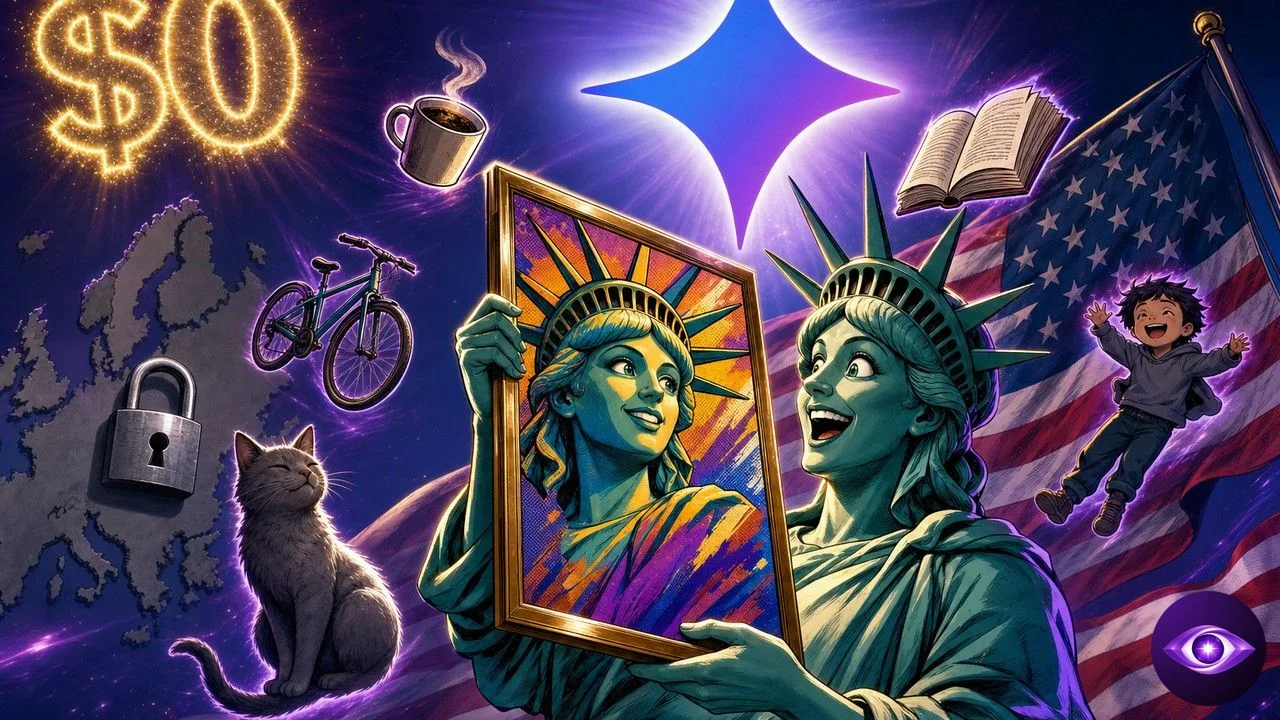
Google is making personalized image generation in Gemini, powered by the Nano Banana model and the Personal Intelligence framework, free for all eligible US users. The feature, previously locked behind Plus, Pro and Ultra subscriptions, now sits in the free tier, but the rollout stays inside US borders.
Key Takeaways
- Google is making Nano Banana, its native image generation model inside Gemini, available for free to all eligible US users.
- The Personal Intelligence framework connects Gemini to Gmail, Google Photos, YouTube and Search to infer personal context from a minimal prompt.
- Europe is excluded from this rollout, and Google states that Gemini is not trained directly on a user’s private Google Photos library.
Have an AI Sum Up This Article
ChatGPTNano Banana Steps Out of the Paywall and Resets Personalized Image Access
On June 29, 2026, Google announced that personalized image generation powered by Nano Banana, its native image generation model inside the Gemini family, would become free for all eligible US users. The capability had been gated behind three paid tiers, Plus, Pro and Ultra, that turned it into a frontline premium argument against competing image generators.
The product shift is clear in the prompting flow. Instead of a long descriptive prompt like “Create an illustration of me and my favorite things, such as coffee and baking”, the user can now type “Create an illustration of me and my favorite things” and let Gemini fill in the details from the data they have agreed to share. The model no longer invents the context, it reads it from the user’s Google ecosystem.
Lowering the barrier this way has a direct consequence. A free user who would never have subscribed to a paid plan just to generate a personalized image now gets a Pro level feature within reach, without a credit card. For Google, this is a clear volume bet over short term margin.
The logic mirrors what we already see on other consumer Gemini features, in continuity with the progressive opening of agentic capabilities like Gemini taking control of the computer. Google is no longer trying to monetize every advanced building block immediately, it is trying to install the habit.
A gray zone remains. The sources do not mention a specific free quota, nor an explicit daily cap for this new tier. The real scale of the free offer will depend on the silent limits that Google enforces in the weeks following the rollout.

Personal Intelligence, the Structural Weapon ChatGPT Cannot Match
The core of the announcement is not the free Nano Banana itself, it is the framework feeding it. Personal Intelligence connects Gemini to Gmail, Google Photos, YouTube, Search and other Google applications to turn a short prompt into a context aware image. This is a layer of personal inference that direct competitors cannot replicate without an equivalent ecosystem.
Opt in is explicit. The user has to grant access to their personal data to enable contextual reading. Google states that Gemini is not trained directly on a private Google Photos library, and that training stays limited to prompts typed into Gemini and to the model’s responses.
This precision matters, because it draws the line between inference time reading and training. Reading a photo to generate a personalized image on demand is not the same thing as ingesting that photo into a training dataset. The distinction is legal as much as it is technical, and it will shape how millions of users decide at the activation prompt.
For OpenAI, the balance shifts. DALL-E remains mostly accessible through ChatGPT Plus at a monthly price, and the image generator does not have a native equivalent of Personal Intelligence. A free Gemini paired with personal inference removes a premium argument from ChatGPT that used to rest on the depth and quality of generated images.
The question is no longer only the model’s quality, it is the quality of the context injected into the prompt. On that battlefield, Google plays at home, and the gap widens with every user who agrees to connect Gmail and Google Photos to Gemini.
Also on Horizon:
- Ford Rehires 350 Engineers After AI Quality Push Fails
- Qihoo 360 Takes On Anthropic With Its Bug-Hunting AI
- Dawn Song Joins Meta: AI Agents Are the Next Milestone
Europe Locked Out and Tension With Google AI Plus
The geography of the announcement is as political as it is technical. The free rollout stays inside the United States, and Europe is explicitly out of scope. No international rollout date has been communicated, which extends an asymmetry already visible on other Gemini features tied to personal data.
GDPR weighs heavily on this equation. Connecting an image generation model to the content of a European citizen’s Gmail inbox and Photos library implies a consent, minimization and portability framework that Google does not seem ready to offer right now. The geographic frontier of personalized AI is widening, and Europe stays structurally behind on the consumer uses of the Personal Intelligence stack.
The move also creates an internal tension with Google’s recent pricing strategy around Google AI Plus at 4.99 dollars. If Nano Banana drops into the free tier, the perceived value of the paid tier has to rest on something else, and Personal Intelligence mechanically becomes the differentiating argument.
In the medium term, Google seems to play a two layer move. The free tier pulls in the US consumer market, captures usage, and installs Gemini as a daily reflex. The paid tier retains users who want more quota, more advanced models or deeper professional integrations.
The privacy risk remains the blind spot. Millions of free users will activate Personal Intelligence without reading the conditions in detail, and the link between personalized Gemini and Google’s advertising ecosystem will be watched closely. For now the promise is clear, direct training on Google Photos is excluded, but the exact perimeter of data read at inference time still needs to be clarified by regulators and by users themselves.
Follow the story on Horizon.


