

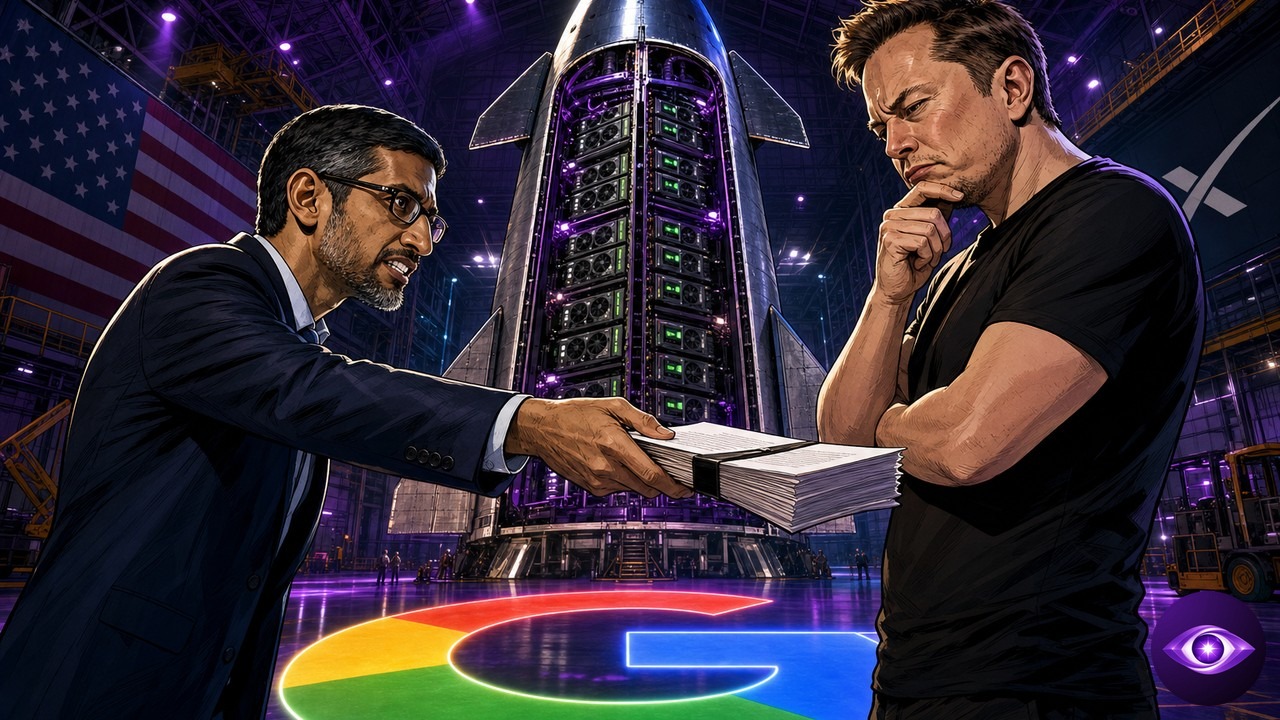
Google will pay SpaceX 920 million dollars per month from October 2026 through June 2029, for roughly 110,000 Nvidia GPUs. The Google SpaceX agreement targets “unexpected demand” on Gemini Enterprise. A 90-day exit clause kicks in after the end of 2026.
Key Takeaways
- 920 million dollars per month for nearly three years, around 11 billion per year for Google.
- Approximately 110,000 Nvidia GPUs added on top of Alphabet’s in-house fleet.
- The Google SpaceX deal lands days before SpaceX’s expected Nasdaq IPO at a 1.75 trillion dollar valuation.
Have an AI Sum Up This Article
ChatGPTA bridge contract to absorb the Gemini spike
The contract runs from October 2026 through June 2029. The monthly ticket lands at 920 million dollars for roughly 110,000 Nvidia GPUs, plus CPUs, memory, and related components. The cancellation clause triggers after December 31, 2026, with a 90-day notice period.
Google describes the Google SpaceX agreement as “bridge capacity” against unexpected demand on its recently launched AI products. The company specifically points to the Gemini Enterprise agent platform. Per the reported statements, the contract remains framed as a short-term, opportunistic move.
The full cumulative spend approaches 30 billion dollars over the term. On Alphabet’s scale, that is manageable. The group has already committed more than 180 billion dollars in capex for 2026, with expectations to step that up further in 2027.
SpaceX has not disclosed which data center will host the load. Elon Musk previously hinted that Colossus 2 would stay reserved for xAI. The capacity going to Google will therefore come from a different facility. SpaceX positions itself as a central player in AI infrastructure, after being seen as a secondary supplier until recently.

What the deal says about global compute
The Google SpaceX agreement reveals a lot about current pressure. Google holds the largest in-house AI compute fleet in the world, yet still signs an external 920 million dollar monthly contract. That amounts to admitting its own infrastructure cannot keep up with the demand on Gemini Enterprise.
For comparison, Anthropic signed with SpaceX in May for 1.25 billion dollars per month through 2029. Google’s contract represents about half of that monthly envelope. The market for rented compute is forming at high speed.
We already covered Alphabet’s capex pivot in our piece on Alphabet raising 80 billion for its AI infrastructure. The Google SpaceX deal completes that setup with an external line, far faster to activate than a new in-house campus.
The timing is no accident. The announcement lands a week before SpaceX’s Nasdaq IPO, targeting 75 billion dollars raised at a 1.75 trillion dollar valuation. A roughly 30 billion dollar Google contract mechanically strengthens the IPO narrative, by proving a solid B2B order book.
For Nvidia, the signal is just as positive. 110,000 GPUs rented from one third party to another reinforces demand on its chips, independent of hyperscaler direct purchase cycles.
Also on Horizon:
- Gemini 3.5 Flash Sees Your Screen and Clicks for You
- GPT-5.6 Rollout: White House Vets Every Customer
- Google Brain Drain: Anthropic and OpenAI Lure Top AI Talent
What it changes for the model race
Short term, the Google SpaceX contract should translate into an accelerated rollout of Gemini Enterprise. Capacity shortage likely held back customer contracts in recent months. The added compute clears a path for faster commercial ramp, earlier than expected. That capacity feeds Google’s agent push, like Gemini’s Remy personal AI agent.
Over three to six months, the competitive balance shifts. OpenAI and Microsoft remain bound to their own compute commitments. If Google and Anthropic soak up the available SpaceX capacity, OpenAI has to respond, either through other deals or by speeding up Stargate.
The other consequence touches cost structure for AI publishers. Renting compute externally at a unit price set by SpaceX changes the gross margin profile of enterprise AI products. The monetization model will have to absorb that overhead or pass it to end customers.
Medium term, the strategic question becomes infrastructure sovereignty. Google built its TPUs to reduce Nvidia dependency, and ends up signing a massive external Nvidia compute deal. The GPU/TPU split breaks down once demand truly explodes. Source diversification beats architectural purity.
For market watchers, the Google SpaceX move sums up the current phase. Compute is the critical resource now, not the algorithm. Contracts worth 11 billion per year, signed in weeks, reveal the real investment level required to stay in the race.
Follow the story on Horizon.