

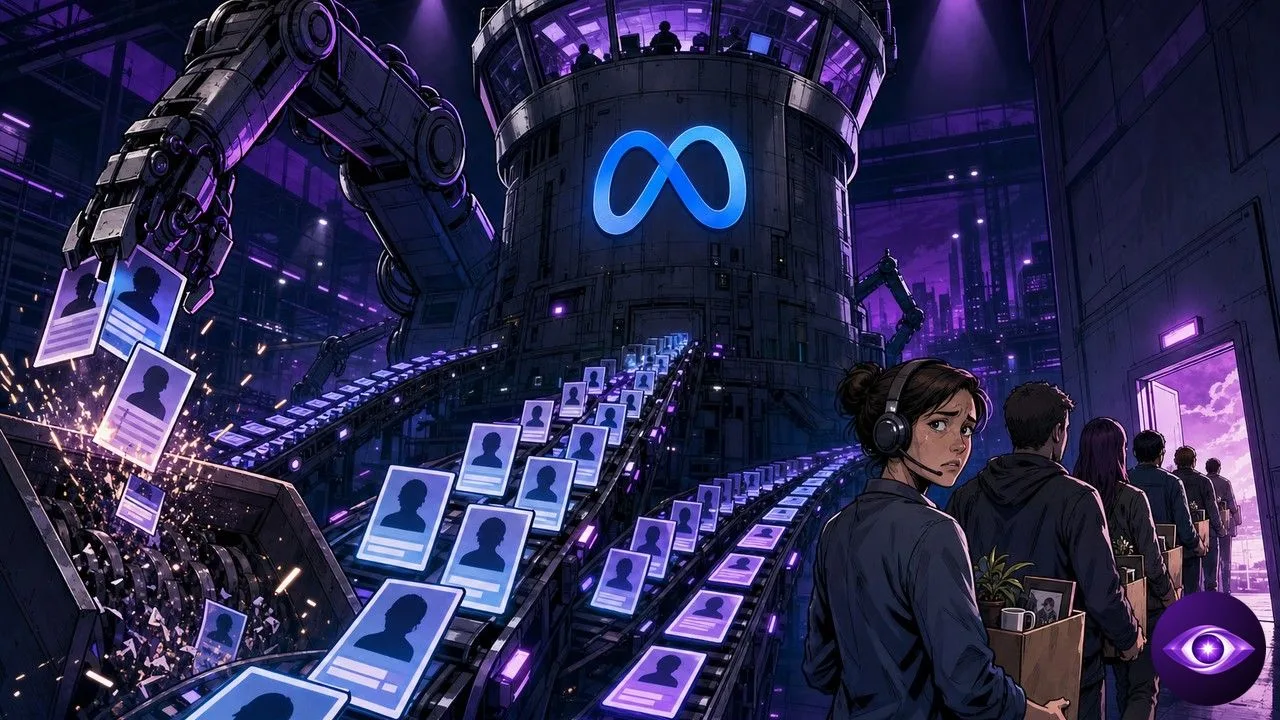
Meta has moved content moderation onto its own foundation model and says the system now makes 13 percent fewer errors than human reviewers while catching 10 percent more violations. Its target is to run more than 90 percent of some content categories without a human, and its own employees are warning that the rollout is moving too fast.
Key Takeaways
- Meta swapped Google’s Gemini for its in-house Muse Spark model to run moderation at scale.
- The company claims 13 percent fewer errors than humans and 10 percent more violations caught since March.
- Staff warn the system still removes or shadow-bans harmless content, and external contractors are already losing work.
Have an AI Sum Up This Article
ChatGPTMuse Spark now runs the moderation queue
The core change is which model reads your posts. Meta replaced Google’s Gemini with its own foundation model, Muse Spark, for moderation tasks, pulling a critical safety function fully in-house.
The scale is already large. Meta routed roughly half of its human moderation requests through language models across 2025, and it now aims to exceed 90 percent automation for certain content categories before the year closes.
The move fits a pattern we have tracked. Meta has been pushing Muse Spark as a cost play across its stack, the same logic that drove it to price its in-house model aggressively against the frontier labs, and moderation is the highest-volume place to put it to work.
Owning the model changes the economics. Running billions of enforcement decisions through a rented API is expensive, so a self-hosted model built for the task lets Meta cut a recurring bill while keeping the tuning knobs on its own side of the fence. It is the same in-house push that threaded Meta’s Muse image tools into Instagram and WhatsApp, now aimed at the moderation layer.
For any platform watching, that is the template. Moderation is the workload where automation pays back fastest, and a rival that owns its model can chase the same margin instead of feeding a third-party provider on every call.

The accuracy claim and the shadow-ban problem
Meta leans hard on one comparison. Since March, it estimates the models make 13 percent fewer errors than human reviewers while catching 10 percent more actual violations, a pitch that frames automation as both cleaner and stricter.
A better average is not the whole story. At Meta’s scale a small error rate still lands on a vast number of individual accounts, and a percentage improvement says nothing to the specific user whose post was pulled by mistake. The same scale trap shows up wherever automation makes high-stakes calls, the way an AI screening job applicants turned out more biased than the humans it replaced.
Meta’s own staff pushed back on the framing. Employees warn that the models still remove or shadow-ban harmless content, and that there is not enough oversight for a rollout moving this quickly, a shadow-ban being a quiet throttle that hides a post without telling the person who wrote it.
The accountability gap is the real weak point. Meta’s Oversight Board has already flagged that account bans lack due process and transparency, and that users should be told the role AI plays in a penalty rather than left guessing after the fact.
For a creator or a small business the stakes are concrete. When an automated system removes an account and the appeal path is thin, a page that took years to build can vanish over a single misread post, with no clear human to reach on the other side.
That is where the speed worries bite. An automated queue processes mistakes as fast as it processes real violations, so a rollout that outruns its review layer scales the wrong calls at the same rate as the right ones.
More articles on Horizon
- Gemini 3.6 Flash Ships Cheaper as 3.5 Pro Slips
- Fable 5 Max Keeps It Free, Pro Now Pays Per Token
- AI Hiring Bias Runs Higher Than Human Bias
What a 90 percent automated feed costs in jobs and appeals
The first bill lands on people. Meta’s rapid deployment is already causing layoffs among the external contractors who handled moderation, the human reviewers whose work the models are now absorbing.
This is a familiar shape at Meta. The company has leaned on automation to reshape headcount before, a thread we followed when a lawsuit claimed AI helped build a mass layoff list, and moderation contractors are the next group exposed to the same logic.
On the competitive side the signal is loud. If Meta can run moderation at this automation rate and publish an accuracy gain, every large platform now has cover to cut its own review teams and point at the same numbers.
The regulatory clock runs the other way. Oversight bodies and lawmakers are pushing for more transparency on automated penalties, so a 90 percent target set now may collide with rules that demand a human in the loop for account-level decisions.
The open question is whether the appeal layer keeps pace. A system this automated only stays defensible if a wrongly banned user can reach a real reviewer quickly, and that is the piece Meta’s own employees say is lagging behind the rollout.
The next months will show which way it breaks. Either Meta builds the oversight its staff are asking for, or the wrongful removals pile up fast enough to force the question back into the open.
Follow the story on Horizon.


