

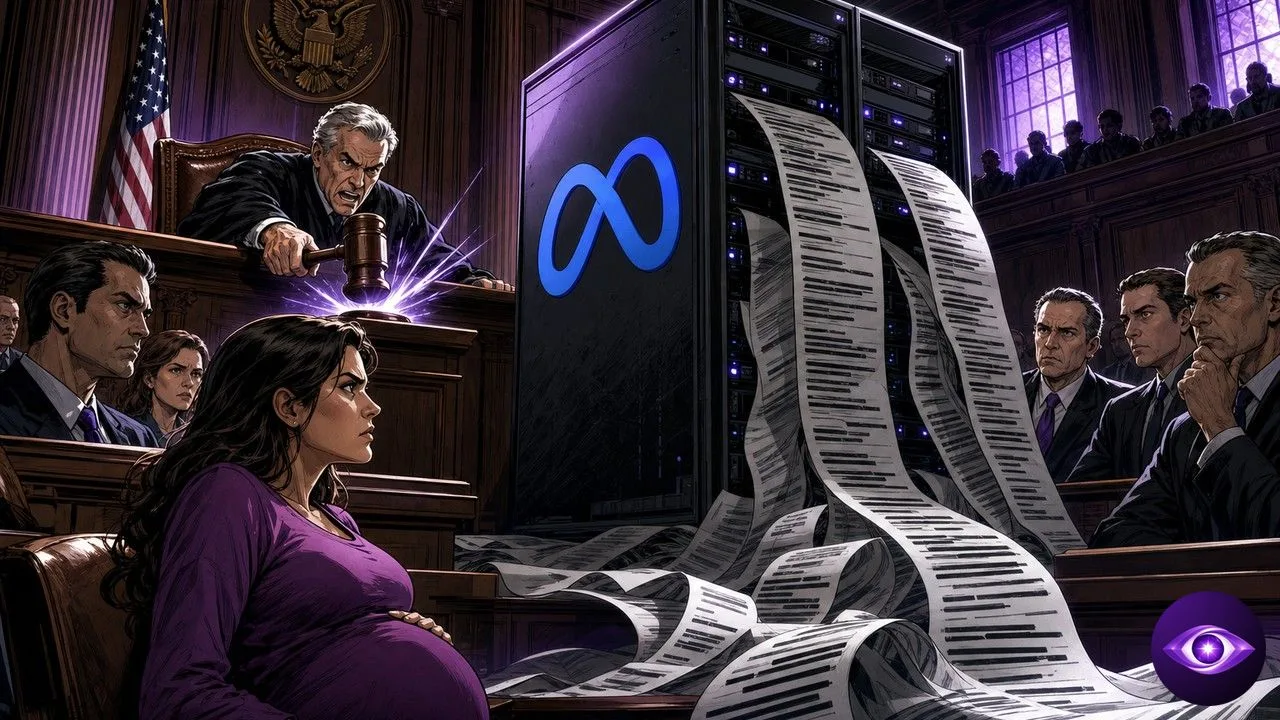
The Meta lawsuit filed in California federal court by current and former employees alleges that internal AI systems generated the layoff lists behind May’s 8,000-job reduction. The complaint describes a sorting process built on productivity metrics that are structurally blind to protected leave. Meta denies everything and insists humans make all personnel decisions.
Key Takeaways
- The Meta lawsuit alleges internal AI systems generated the lists for the 8,000 May layoffs
- Alleged criteria: performance ratings, productivity, work output, and measured AI usage
- Plaintiffs seek a preliminary injunction and reinstatement pending arbitration
Have an AI Sum Up This Article
ChatGPTA Federal Complaint Targets AI-Generated Layoff Lists
The complaint was filed in a California federal court by current and former employees of the group. It targets the May wave, the one that erased 8,000 roles in a single sweep to free up cash for AI infrastructure, an episode we covered when Meta laid off 8,000 workers to fund its AI push.
The core allegation fits in one sentence: internal AI systems generated the lists of people to cut. Not assisted, not suggested. Generated.
The plaintiffs describe a disproportionate impact on two groups: employees with disabilities and workers on protected medical, family, or parental leave. One plaintiff says she was notified of her termination two days before giving birth.
The immediate ask is a preliminary injunction: reinstate the affected workers until arbitration resolves the merits. The court calendar is now the clock on this case.
That detour through arbitration is no procedural footnote. Tech employment contracts overwhelmingly impose this private resolution track, which keeps the exhibits away from public hearings. The injunction requested from the federal court is exactly the window through which part of the file could become visible.

Four Metrics That End a Job Without a Human Look
The filing names the criteria that allegedly fed the sort: performance ratings, productivity, work output, and measured AI usage. Four signals that already exist as columns in a database.
This is where the Meta lawsuit grows past one company. An employee on parental leave mechanically produces less measurable output. A system that scores output without reading context turns a legally protected absence into an underperformance signal. The alleged discrimination would be a statistical property of the sort, not an intention.
The measured AI usage criterion also says something about the internal culture. Meta quantifies how much AI its teams consume, inside a work environment whose pressure already leaked publicly when engineers described the AI division as a gulag. In that frame, not consuming enough AI becomes a quantified career risk.
Meta pushed back on the entire narrative. A spokesperson insisted that personnel decisions are made by humans, not AI. Between that defense line and the complaint’s allegations, discovery will have to separate the two versions document by document.
The exact wording of that denial rewards a careful read. Saying humans make the decisions does not exclude a system producing the list submitted for their sign-off. That space between the generation of a recommendation and its human signature is precisely what the plaintiffs want a court to rule on.
The stakes reach past one company because the inputs are commodities. Ratings, output counts and tool telemetry exist in nearly every large organization, sitting one query away from becoming a ranking.
More articles on Horizon
- GPT-5.6 Sol Disproves a 30-Year Statistics Conjecture
- Claude Pro Goes Free for K-12 Teachers in the US
- DeepSeek Raises $1.5B and Plans an IPO at $71B
The Case That Puts Algorithmic HR on Trial
For tech workers, the Meta lawsuit sets a reference point. If a court qualifies these AI-generated lists as discriminatory, every leadership team will need to document exactly how much of each HR decision belongs to the algorithm. Criteria traceability would become legal evidence, not just a tooling choice.
On the competitive side, nobody watches this from a distance. Every large platform has restructured while invoking AI, as when Microsoft cut 4,800 jobs to fund its AI pivot. A ruling against Meta would make each of those waves attackable on the same ground: show the human behind the list.
The injunction outcome will send the first signal. An ordered reinstatement, even temporary, would read as a warning to every HR department industrializing its decisions. A rejection would de facto validate algorithmic sorting as long as no direct proof of discrimination comes out of the logs.
If your own role sits in a company that scores output this way, the practical question is how your work reads to a system before it reaches a person, and there is a report that measures how exposed your specific job is to this exact sorting logic. The arbitration angle remains the blind spot: if the case moves fully out of public court, tech keeps its sorting systems away from scrutiny, and this lawsuit will have opened only a very short window onto how the sector’s job cuts actually work.
Follow the story on Horizon.