

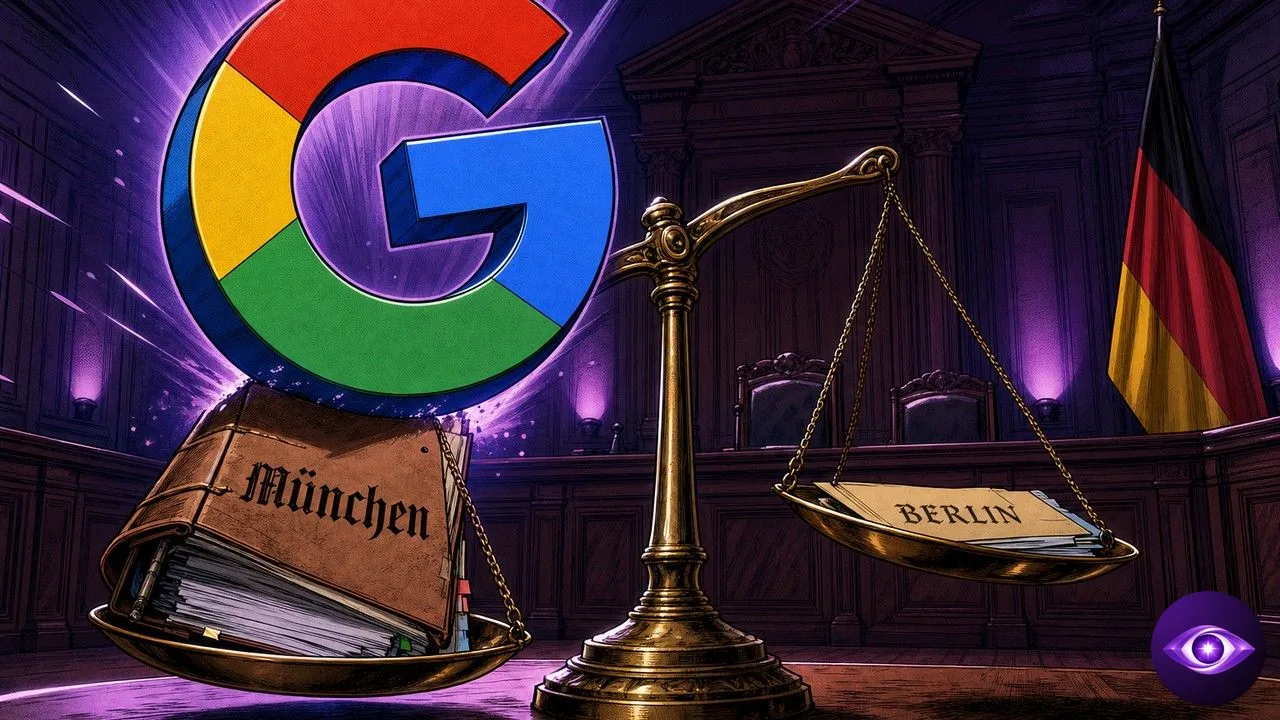
Google has announced it will appeal the Munich court decision that made it directly liable for the content of its Munich AI Overviews. The company says the ruling targets narrow errors and does not reflect how the product really works. Berlin issued an opposite decision a few days later. The legal fight is turning into a doctrinal duel between two German courts.
Key Takeaways
- Google announced its appeal of the Munich AI Overviews ruling on June 19.
- The Munich court ruled in late May that AI Overviews are Google’s own words and trigger direct liability.
- A Berlin court ruled the opposite in early June, treating AI Overviews as ordinary search results.
The appeal and Munich’s doctrine
The Munich Regional Court delivered a heavy ruling against Google in late May. AI Overviews, the AI-generated summaries displayed at the top of search results, were qualified as “standalone content, not mere search results”. That qualification triggers direct liability on Google for any errors.
The specific case: the AI allegedly linked two Munich-based publishers to fraud schemes that had nothing to do with them. The publishers sued, and Munich ruled in their favor. On June 19, Google confirmed it would appeal.
Google’s appeal argument is narrow. The company says the ruling addresses “specific and narrow errors” and does not reflect “the foundational way AI Overviews display web content”. In other words, Google quietly admits errors happened, but pushes back on the wider requalification that would expose the whole product.
The appeal is not a surprise. We had flagged the systemic risk in our analysis of the initial Munich ruling: the doctrine threatened the entire augmented-search model, and Google was never going to let it stand without a counter. Now the line of attack is on the record.

Berlin against Munich, two incompatible doctrines
The plot twist came from Berlin. In early June, a Berlin court ruled the opposite way. For Berlin, AI Overviews behave like search results. Google’s liability stays limited, framed as that of an “indirect contributor” rather than a content publisher.
This split inside the German judicial system is a gift for Google. The company will naturally lean on the Berlin decision to back its appeal against Munich. Two first-instance courts, two opposite doctrines on the same product: that is exactly the raw material an appeals court takes up to unify the law.
The stakes go well beyond Google. If the Munich doctrine survives appeal, OpenAI, Perplexity and Anthropic will sit under the same exposure. Each of them runs a function that blends web search with generative synthesis. A publisher qualification would tip their economics into editorial liability at scale, with the legal costs that follow.
If the Berlin doctrine prevails, the status quo holds. Platforms stay as intermediaries, their summaries inherit the search-result status, and liability rests on the original publishers. That outcome would relieve the whole AI-search industry and send a clear signal to the rest of Europe.
Also on Horizon:
- China cuts 12,000 university degrees made obsolete by AI
- 79% of parents already use AI to raise their kids
- GPT-5.5 Instant beats doctors on health answers
The verdict European courts will be watching
Short term, the appeal calendar becomes a focus point for the legal teams at other AI labs. Anthropic, OpenAI and Perplexity will watch every hearing as a case study for their own exposure. A unified German ruling will anchor disputes to come in France, Italy and Spain.
Medium term, the case will shape the trajectory of the European AI Act. Several articles in that regulation deal with AI-generated content and traceability. A German appeals decision that qualifies an AI summary as a standalone publisher would push the European text into a far stricter reading than industry players have been planning for.
For Google, the issue is also commercial. The Munich AI Overviews and their equivalents around the world sit at the heart of the defense strategy against ChatGPT and Perplexity. If the legal cost of the product explodes in Europe, Google could be forced to scale Overviews back in some jurisdictions, and that would hand ground to rivals.
European publishers are watching the case closely too. Several groups have already pushed back at Google on how AI Overviews recycle their articles without sending enough traffic back. A standalone publisher qualification would reshuffle the ongoing licensing negotiations.
The exact date of the appeal hearing has not been disclosed. But the clock is running. As long as the Berlin against Munich split is not resolved, every article published with a mistake inside an AI Overview in Europe could become a test case. The reputational and legal risk stays high for Google and for every direct competitor on the same product.
Follow the story on Horizon.