

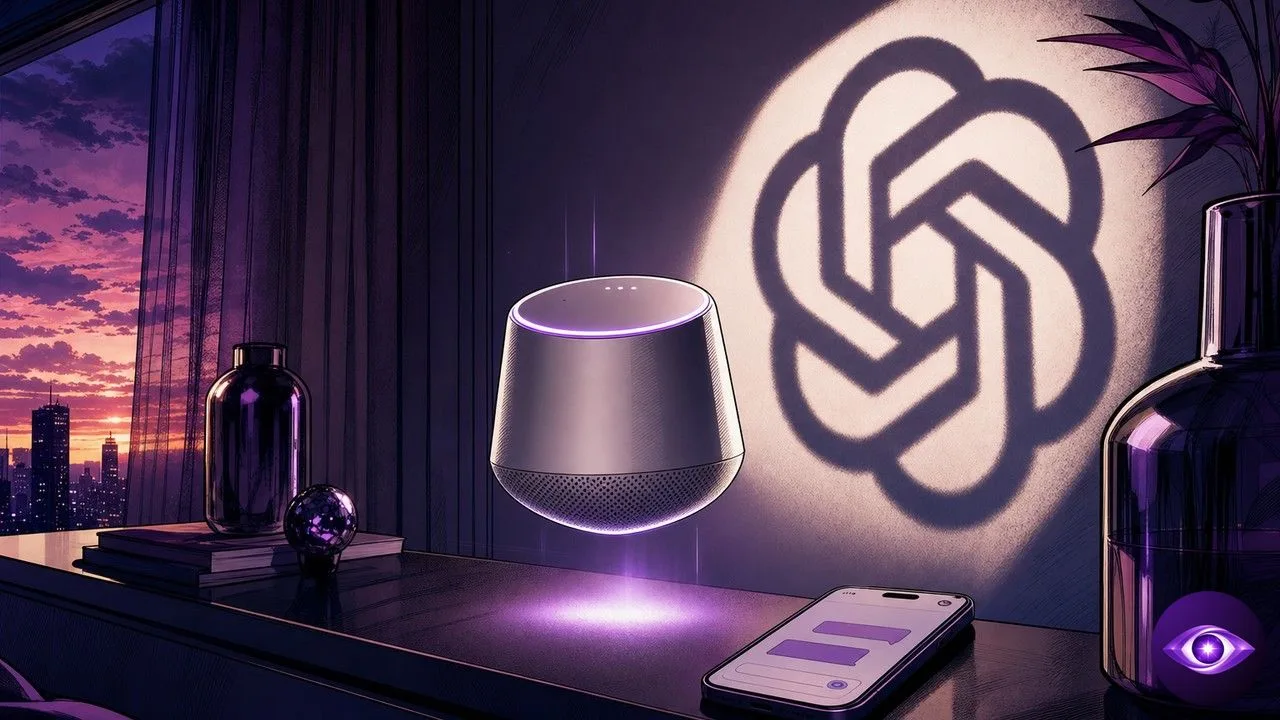
The first consumer device from OpenAI is starting to take shape: a screenless home companion that moves on its own and picks up its surroundings to learn its owner over time. The hardware push is led by former Apple engineers who worked on the iPhone and the Mac, and it lands right in the middle of the trade secrets lawsuit Cupertino filed against OpenAI last week.
Key Takeaways
- OpenAI is building a screenless mobile smart speaker synced to ChatGPT, designed to work as a persistent home companion.
- The hardware team is staffed with former iPhone and Mac engineers, in the middle of Apple’s trade secrets lawsuit against OpenAI.
- AI hardware is heating up: rival startup Hark just raised a $700M Series A at a $6B valuation.
Have an AI Sum Up This Article
ChatGPTA Screenless Home Companion That Learns Its Owner
The device takes the form of a screenless speaker with internal motorized parts that let it move on its own around the room. That form factor drops the object into a hybrid category, closer to a small indoor robot than to a direct successor of the Amazon Echo or the Google Home.
The product syncs in real time with ChatGPT. OpenAI is pitching a personality that proactively learns from its owner, rather than a reactive question-and-answer assistant. The teams are working on access to the user’s emails and to other pieces of their digital life, so the device can ground its answers in personal context built up over weeks and months.
This approach breaks from the historic smart speaker script. Amazon Echo and Google Home run short cycles, with no context memory beyond the session. What OpenAI is building looks more like an object that accumulates long-term memory of its user, with a physical presence that borrows from the service-robot idea more than from the living-room speaker. This hybrid category sidesteps Apple’s own product lines head-on, at a moment when Apple is suing OpenAI over trade secret theft tied to more than 400 ex-Apple hires.
No price has been shared yet, and no launch date has been locked in. The product is still in development. OpenAI’s internal framing positions the object as a “physical manifestation” of ChatGPT, wording that betrays the intent to turn the chatbot into a tangible presence in the home instead of an interface behind a screen.

The Ex-iPhone and Ex-Mac Engineers Running the Project
The OpenAI hardware team is built around former Apple engineers who worked on the iPhone and the Mac. The recruiting spree traces back to the hardware push Sam Altman locked in with Jony Ive at the end of 2025 through the LoveFrom studio. The target is a first object shipped at an accessible price point, with a supply chain that does not lean on Cupertino.
Those hires now sit right in the middle of a legal fight. Cupertino’s July filing points to more than 400 ex-Apple employees named in the complaint. OpenAI is defending the project as “significantly different” from Apple’s current product lines, an argument built to show no trade secret was used on this specific object.
That legal context also weighs on the roadmap. A screenless mobile home companion is territory Apple’s current catalog barely occupies, which makes the defense easier than a head-on smartphone rival would be. The play is to ship first an object that lives in a category Apple has not owned, then broaden the lineup step by step.
The move is part of a broader pivot. OpenAI just offered a 5% stake to the Trump administration to lock in its US anchor while it diversifies the product surface. Cloud, chatbot, agent, and now a physical device: hardware closes the loop by giving the brand a foothold inside homes, on top of the software interfaces already in place.
More articles on Horizon
- Grok 4.5 vs Muse Spark 1.1: Our Test Verdict
- 16 Nobel Laureates Say Prepare the Economy for AI Now
- LinkedIn Hosts 41% of AI-Written Long Posts
AI Hardware Is Turning Into a Multi-Hundred-Million-Dollar Lane
OpenAI’s project does not stand alone. Hark, a US startup in the same segment, just raised $700M in Series A funding at a $6B valuation to build a catalog of custom AI hardware. That round sends a clear signal: venture money is willing to back the dedicated AI device thesis again, after a long dry spell that followed the Humane Pin flop.
Meta is pushing in the same direction with the Ray-Ban smart glasses and a Quest lineup that pivots on AI. Amazon is prepping a redesigned Alexa Plus, and Google wants Gemini baked into Pixel hardware. Anthropic is betting on the enterprise angle, with numbers showing Claude is now used mostly for office work rather than code, which leaves OpenAI a wider runway on the consumer physical side.
What ties these products together is the push to move generative AI out of the browser and into the physical everyday. The battle is now fought on brand, distribution, and the long-term relationship with the user. OpenAI walks in with the ChatGPT card, the best-known consumer AI brand of the moment, but with no retail network of its own and no mobile ecosystem. The device on the table is a bet on brand pull alone, against giants that already own the distribution pipes.
One last point deserves attention. A companion object with access to emails and to other pieces of the user’s digital life raises major privacy questions. Every player on this market will have to convince buyers that a mobile object sitting in the living room can read their inbox without turning into a surveillance device. That debate will weigh on purchase decisions as heavily as the model performance itself.
Follow the story on Horizon.


