

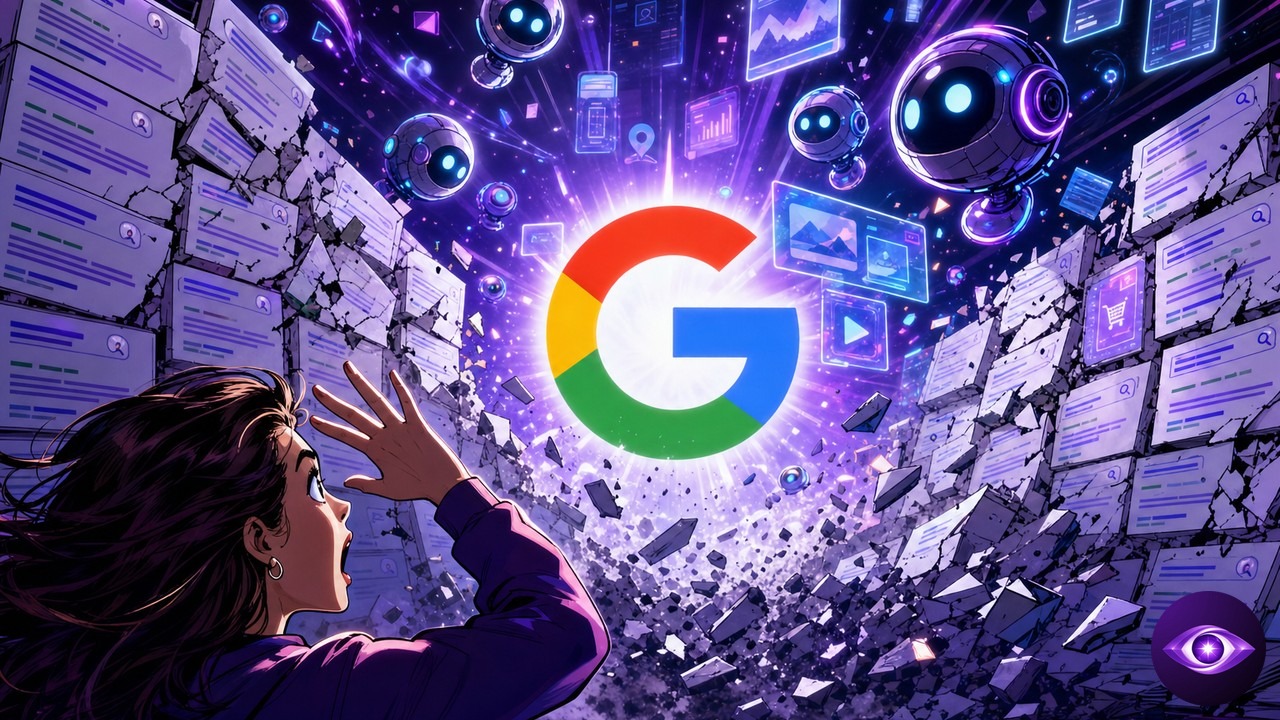
Google Search is undergoing its most radical overhaul in more than 25 years, unveiled at Google IO 2026. The traditional blue links are giving way to an agentic interface powered by Gemini, featuring around-the-clock information agents, a generative UI, and the ability to build mini-apps directly inside Search.
Key Takeaways
- Google Search shifts to an agentic interface with 24/7 information agents, generative UI, and mini-apps
- AI Overviews has 2.5 billion monthly users; AI Mode has 1 billion monthly users
- New features roll out first to Google AI Pro and Ultra subscribers
Have an AI Sum Up This Article
ChatGPTThe End of the Blue Links: What Google Search Actually Becomes
The search box itself is changing. Google Search now expands to accommodate longer, conversational queries, with an enhanced suggestion system that goes well beyond traditional autocomplete. The transformation is not cosmetic: the mental model of search is shifting from keywords to questions phrased in natural language. Gemini’s whole look changes in parallel, a new design unveiled at Google I/O.
Google itself acknowledges this is the biggest change to Search in more than 25 years. The ten blue links that defined web search since the early 2000s are being replaced by interactive experiences where the AI responds, synthesizes, and suggests, rather than directing users to a third-party source.
Adoption figures show how far the shift has already gone. AI Overviews, the AI summary appearing at the top of Google Search results, has 2.5 billion monthly users. AI Mode, the conversational search interface, has 1 billion monthly users. These are no longer experimental features. They are the new standard for how Search is actually used.
As we explored in our coverage of Remy, Google’s 24/7 personal AI agent built on Gemini, Google’s strategy is to integrate AI across all its consumer surfaces simultaneously. Search is not an isolated case: the entire Google ecosystem is shifting toward an agentic interface within the span of a few months.

Information Agents, Generative UI, and Mini-Apps
Information agents are coming in summer 2026. These agents monitor the web continuously and alert users when relevant information appears on a topic they are tracking. They can follow specific parameters such as market movements in a given sector, and deliver consolidated summaries rather than a list of links. This is the direct evolution of Google Alerts, launched in 2003, brought to the level of autonomous agents.
The generative UI marks another break from the existing interface. Powered by Gemini Flash 3.5 and Google DeepMind, it creates custom widgets and visualizations in real time based on the user’s query. A follow-up question generates a new visual interface tailored to that question, rather than a refreshed list pointing to the same sources. That agentic shift runs on Gemini 3.5 Flash and its autonomous agents.
Mini-apps push the concept further. A user can build a custom app directly inside Google Search using natural language: a meal tracker calibrated to their nutritional goals, a fitness program adapted to their routine. Search becomes a creation environment, not just a tool for consulting information.
The new search box is rolling out this week. The generative UI arrives in summer 2026. Mini-apps and agents will be available first to Google AI Pro and Ultra subscribers before a wider rollout. Staged deployment by subscription tier has become the standard model for distributing AI features to consumers.
Also on Horizon:
- China cuts 12,000 university degrees made obsolete by AI
- 79% of parents already use AI to raise their kids
- GPT-5.5 Instant beats doctors on health answers
What This Shift Changes for the Ecosystem in the Coming Months
In the short term, the most direct impact falls on web publishers. An interface that answers and synthesizes mechanically reduces clicks to third-party sources. Search traffic represents a structural share of audience for many media outlets and e-commerce sites. The overhaul of Google Search is a direct threat to this acquisition model.
For advertisers, the shift to an agentic interface raises open questions about ad placement. Sponsored links have historically lived alongside search results. In an interface that synthesizes and responds, where ads sit in the flow is an unresolved question that received no clear answer at Google IO.
In the medium term, the transformation of Google Search accelerates the consolidation of consumer AI around a small number of players. Google controls distribution, the model, and the infrastructure. OpenAI with SearchGPT and Perplexity moved early on conversational search, but neither has Google’s user base to execute this pivot at this speed and scale. The same dynamic plays out in video with Gemini Omni generating from any multimodal input. Google is also fighting on price, dropping AI Plus to $4.99.
European regulators are watching. An interface that synthesizes and responds rather than directing users to third parties raises direct competition concerns: Google becomes both the search engine and the final answer. The same tensions behind Shopping and price comparison antitrust cases are present here, in an even more integrated form.
Follow the story on Horizon.



Pingback: Google Earth Pulls Its Fake Satellite Image Tool - Horizon IA
Pingback: DuckDuckGo Up 30%: Users Reject Google's Forced AI Search - Horizon IA